The Life of George Remus

German-born immigrant and renowned defence lawyer George Remus was described as the King of the Bootleggers during Prohibition in the United States
George Remus, born on November 13, 1876, in Germany, and died on December 20, 1952, in Covington, Kentucky, exemplifies the complex consequences of the Volstead Act. Remus, a talented and intelligent German immigrant, transitioned from a respected trial attorney to a notorious bootlegger, driven by the opportunities Prohibition presented.
The Complex Personality of George Remus
While many German-Americans viewed Prohibition laws as absurd, George Remus’s decision to violate the law was not rooted in principle but in opportunism. The Volstead Act revealed Remus’s dual nature: a consummate professional who was also capable of anarchistic behavior. He did not believe in God, government, friends, or home. The passing of the Volstead Act merged these two aspects of his personality, leading him to a life of mistrust, jealousy, and lawlessness, ultimately earning him the title “King of the Bootleggers.”

In an effort to legislate morality in the United States, federal and state governments passed and ratified the Eighteenth Amendment to the Constitution in 1919, commonly known as the Volstead Act. This law outlawed the manufacturing, sale, barter, transport, import, export, and distribution of intoxicating liquor, ushering in the era of Prohibition. Image: Front page headlines, and map representing states ratifying Prohibition Amendment (Eighteenth Amendment to the United States Constitution), as reported in The New York Times on January 17, 1919.
Family Background and Early Life
George Remus was born to Frank and Maria Remus in Germany. He had one sister, Frances, and a younger brother, Herman, who was born in Chicago and later became disabled. The family emigrated to the United States when Remus was four years old, initially settling in Baltimore, then Milwaukee, and finally Chicago, where Frank found work as a lumber scorer.
Chicago’s population boomed in the late 19th century due to industrialization and immigration. German neighborhoods thrived, and by 1900, about one in four residents had German roots. Although immigrant parents often instilled a sense of German homeland culture in their children, George Remus quickly assimilated into American life, excelling academically and speaking both German and English fluently.
Around 1890, when his father became disabled due to rheumatism, Remus had to quit school and support his family financially. He avoided unskilled labor, choosing instead to work in his uncle’s drugstore. By 19, he had earned a pharmacist’s license and, at 21, purchased his uncle’s drugstore, eventually expanding his business and obtaining an optometrist certificate.
Transition to Law
Despite his success in the pharmacy business, Remus sought greater challenges. He began attending law school at night, completing the three-year course in just 18 months. In 1900, he was admitted to the Illinois Bar and established his law practice in Chicago. His office was in the Ashland Block Building, which also housed famed attorney Clarence Darrow.
As a trial attorney, Remus gained a reputation for defending controversial cases. One notable case in 1914 involved William Cheney Ellis, who was charged with murdering his wife in a jealous rage. Remus’s defense of Ellis, based on the theory of “transitory insanity,” was groundbreaking and set a legal precedent.
Domestic Turmoil
By 1916, Remus had built a successful law practice and lived a comfortable middle-class life with his wife, Lillian, and daughter, Romola. However, domestic tensions arose when Lillian threatened to divorce him in 1915, suspecting infidelity. Remus had indeed become infatuated with Augusta Imogene Holmes, a young woman in the process of divorcing her husband. Remus moved in with Imogene in 1918, further straining his marriage.
Entry into Bootlegging

George Remus earned the nickname “King of the Bootleggers.” One of his fortified distilleries was called “Death Valley Farm.”
The anti-German hysteria of World War I and the subsequent push for Prohibition created an opportunity for Remus. By 1919, many states had already enacted Prohibition laws, and the Volstead Act became federal law in 1920. Remus saw Prohibition as a chance to acquire great wealth. He studied the Volstead Act for loopholes, finding ways to legally purchase and distribute pre-Volstead Act bonded liquor.
Remus moved his operations to Cincinnati, strategically located near large stockpiles of pre-Prohibition whiskey. He bought distilleries and set up a network to divert alcohol intended for medicinal purposes into the illegal market. His operations were protected by bribing government officials, and he quickly became one of the largest bootleggers in the United States.
Rise to Notoriety
Remus’s success in bootlegging was unparalleled. He controlled an empire spanning nine states and employed 3,000 workers. His wealth and influence grew rapidly, and his extravagant parties became legendary. However, his high profile attracted the attention of law enforcement. In 1921, he was indicted on thousands of Volstead Act violations. Despite legal challenges, Remus continued his operations until he was eventually convicted and sentenced to two years in the Atlanta Federal Penitentiary.
Did you know…?
In 1922, George Remus and his wife held a New Year’s Eve party at their mansion, the Marble Palace, inviting one hundred couples from prestigious families. Remus presented the men with diamond stickpins and gave each guest’s wife a brand new car.

George Remus and his wife
Betrayal and Murder
While Remus was imprisoned, his wife Imogene took control of his assets and conspired with Franklin Dodge, a prohibition agent, to sell off his properties and have him killed. Upon his release, Remus discovered the betrayal and, in a fit of rage, killed Imogene on the day of their divorce proceedings in 1927. Representing himself in a highly publicized trial, Remus pleaded temporary insanity and was acquitted.
Later Life and Legacy
After his acquittal, Remus struggled financially and socially. He lived quietly in Covington, Kentucky, until his death in 1952. Despite his criminal activities, Remus left a lasting legacy as a symbol of the Prohibition era’s complexities. His story has been featured in various media, including Ken Burns’s documentary “Prohibition” and the TV series “Boardwalk Empire.”
Questions and Answers about George Remus

George Remus’s life is a compelling tale of ambition, ingenuity, and the darker side of human nature. From his early days as a promising pharmacist and lawyer to his rise as a notorious bootlegger and his dramatic fall, Remus’s story encapsulates the tumultuous era of Prohibition in America.
Where did George Remus attend law school, and when was he admitted to the Illinois Bar?
George Remus attended the Illinois College of Law, which later merged with DePaul University College of Law. He was admitted to the Illinois Bar in 1904.
What type of legal cases did George Remus specialize in, and what was his notable defense strategy?
George Remus specialized in criminal defense, particularly murder cases. He gained fame for pioneering the “transitory insanity” defense, now known as “temporary insanity.”
How much was George Remus earning by 1920, and what would that amount be approximately in today’s dollars?
By the early 1920s, George Remus was earning more than $450,000 a year, which is roughly equivalent to $7,650,000 today.
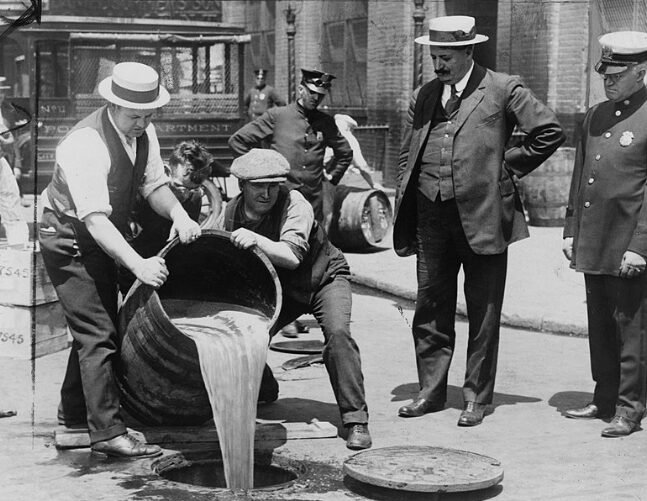
Prohibition began in the U.S. on January 17, 1920, following the ratification of the 18th Amendment and the passage of the Volstead Act. This event had a tremendous influence on George Remus’s career path. Image: Authorities disposing liquor during Prohibition
How did George Remus exploit the Volstead Act to become a successful bootlegger?
George Remus memorized the Volstead Act and found a loophole that allowed him to buy distilleries and pharmacies to produce and sell bonded liquor for medicinal purposes under government licenses. His employees would then hijack his own liquor, enabling him to sell it illegally.
Remus moved to Cincinnati, where 80 percent of America’s bonded whiskey was located within a 300-mile radius.
What led to the end of George Remus’s marriage to Lillian Klauff?
George Remus’s marriage to Lillian Klauff ended in divorce in 1920 after he began an affair with his legal secretary, Augusta Imogene Holmes.
What legal trouble did Remus encounter in 1925, and what was his sentence?
In 1925, Remus was indicted for thousands of Volstead Act violations. He was convicted and sentenced to two years in the Atlanta Federal Penitentiary.

George Remus’s ability to exploit legal loopholes, his extravagant lifestyle, and his ultimate downfall provide a vivid illustration of the era’s contradictions. Remus remains a fascinating figure, a symbol of both the allure and the peril of unbridled ambition.
What betrayal did Remus experience while in prison, and who was involved?
While in prison, Remus confided in an inmate who was an undercover prohibition agent, Franklin Dodge. Instead of reporting Remus, Dodge resigned and began an affair with Remus’s wife, Imogene. They liquidated Remus’s assets and hid the money.
What drastic action did Remus take in response to his wife’s betrayal in 1927?
In late 1927, on the way to court for the finalization of their divorce, Remus chased his wife’s cab through Eden Park, Cincinnati, forced it off the road, and fatally shot her in front of onlookers.
Who prosecuted Remus for the murder of his wife, and what was the outcome of the trial?
Charles Phelps Taft II, son of Chief Justice William Howard Taft (also 27th President of the United States), prosecuted Remus. Remus defended himself, claiming transitory insanity, and the jury acquitted him after only nineteen minutes of deliberation.
What happened to Remus after his acquittal for his wife’s murder?
After his acquittal, Remus was committed to an insane asylum but was released after seven months.
How did Remus spend his later years, and where did he die?
Remus moved to Covington, Kentucky, lived modestly, married his long-time secretary Blanche Watson, and ran a small contracting firm until he suffered a stroke in 1950. He died on January 20, 1952, at the age of 73.
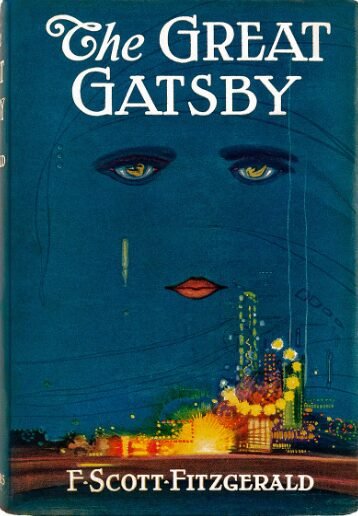
George Remus is sometimes credited as the inspiration for The Great Gatsby. He was featured in Ken Burns’ documentary Prohibition and portrayed by Glenn Fleshler on HBO’s Boardwalk Empire. Image: The front dust jacket art of the first edition of F. Scott Fitzgerald’s The Great Gatsby, known as Celestial Eyes