The Nok Culture: History & Major Facts
The Nok culture is one of the earliest known civilizations in sub-Saharan Africa, notable for its advanced use of iron and unique terracotta sculptures.
Flourishing from around 1500 BCE to 1 BCE, the Nok people lived in what is now central Nigeria, specifically in the region of Kaduna State. Their impressive terracotta art, technological advancements, and lasting influence on subsequent West African societies make them a pivotal part of African history.
Despite many mysteries surrounding the Nok, archaeological discoveries continue to provide insight into their culture, trade, and social structure.
In the article below, World History Edu delves into the history of the Nok culture and highlights its major facts, exploring its origins, art, technology, and legacy.
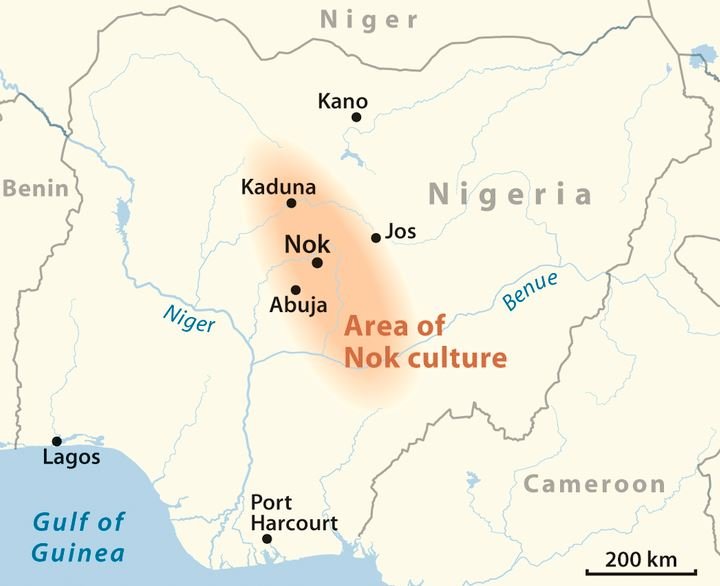
Nok sculptures, made from clay likely sourced from a single location, have been found across an area of over 75,000 square kilometers, indicating a centralized authority and a widespread civilization. Image: A map showing the area of the Nok culture.
Origins of the Nok Culture
The Nok culture is named after the village of Nok in southern Kaduna State, Nigeria, where its first artifacts were discovered in 1928 by a tin miner. The culture is best known for its terracotta sculptures, many of which depict human figures with highly stylized features. These artifacts were initially found accidentally, but over the years, archaeologists and historians have studied them extensively to piece together the story of the Nok people.
The origins of the Nok people are still a matter of scholarly debate, but there are two primary theories about their migration patterns.
Some researchers believe that the Nok people may have migrated from the Central Sahara, bringing with them crops such as pearl millet and the knowledge of pottery-making.
The above theory suggests that they diverged from other groups in the region, including the Gajiganna people, before settling in the Nok region of northern Nigeria.
Another theory proposes that the Nok people migrated from the West African Sahel. Regardless of their exact origins, it is clear that the Nok culture played a significant role in shaping early West African civilizations.
Chronology and Archaeological Discoveries
Archaeological evidence suggests that the Nok culture began to emerge around 1500 BCE, making it one of the earliest known civilizations in West Africa. The culture persisted for more than a millennium, until around 1 BCE. Throughout this time, the Nok people made significant advancements in various fields, from agriculture and ironworking to art and trade.
One of the most important archaeological discoveries associated with the Nok culture is the terracotta sculptures for which they are famous. These sculptures, often depicting human figures, animals, and other subjects, are believed to have been created as part of a complex funerary culture. The earliest examples of these terracotta sculptures date back to around 900 BCE, and they are notable for their detailed features, including triangular or oval-shaped eyes and elaborate hairstyles.
Archaeologists have also discovered a variety of Nok settlement sites, often located on mountaintops, which provided natural defense and strategic advantage. These settlements were likely hubs of economic activity, where agriculture, trade, and ironworking took place. Notably, the Nok people were among the first in Africa to develop iron smelting technology, which allowed them to create tools and weapons that improved their agricultural and military capabilities.
Nok Terracotta Sculptures
The most iconic legacy of the Nok culture is its terracotta sculptures. These sculptures are significant not only for their artistry but also for what they reveal about Nok society, beliefs, and practices. The terracotta figures are typically human in form, though they also include depictions of animals. The human figures are often seated, with their hands resting on their knees, and they feature highly stylized facial features, such as wide eyes, flared nostrils, and elaborate hairdos or headpieces.
One unique characteristic of Nok sculptures is their attention to detail, particularly in the representation of hairstyles, jewelry, and clothing. This suggests that the Nok people placed great importance on social status and personal appearance, which may have been tied to their social or religious roles.
Many of these sculptures are thought to have been used in funerary contexts, possibly as grave markers or offerings to the deceased. Some of the figures appear to hold weapons like slingshots or bows and arrows, which may indicate the Nok people engaged in hunting or warfare.
Another significant discovery in Nok terracotta art is the depiction of two individuals in a dugout canoe, paddling with goods. This suggests that the Nok people used waterways such as the Gurara River, a tributary of the Niger River, to transport goods as part of a regional trade network.
The presence of seashells on some sculptures’ heads further supports the theory that their trade routes extended as far as the Atlantic coast. This depiction of watercraft offers a rare glimpse into the maritime practices of early West African civilizations and suggests that the Nok people were more interconnected with other regions than previously thought.

In 1943, archaeologist British archeologist Bernard Fagg identified these artifacts as belonging to an unknown culture, now recognized for its distinctive terracotta sculptures. These sculptures, often depicting human heads, figures, and animals, are characterized by their triangular or oval eyes and elaborate hairstyles, with seated human figures being a common motif. Image: Nok sculpture of a male figure.
Iron Metallurgy and Technological Advancements
One of the most remarkable achievements of the Nok culture was its early use of iron. Archaeologists have discovered evidence of iron smelting at Nok sites dating back to between 750 BCE and 550 BCE, making the Nok among the earliest known African societies to develop iron metallurgy. This technological advancement had a profound impact on their society, as it allowed them to create more effective tools and weapons.
Iron tools, including axes, hoes, and farming implements, significantly improved agricultural productivity, enabling the Nok to clear land more efficiently and cultivate larger areas for crops. The production of iron weapons also gave the Nok people an advantage in hunting and possibly warfare. This development in iron technology may have contributed to the Nok culture’s ability to thrive for over a millennium.
The Nok’s advancement in ironworking is particularly significant because it appears to have developed independently, without the prior use of copper or bronze, which were common in other parts of the world before iron. This direct transition from stone tools to iron tools makes the Nok one of the few civilizations to have made such a leap, marking a unique technological achievement in the history of metallurgy.
Agriculture and Economy
Agriculture was the backbone of the Nok economy, and their ability to farm efficiently was likely supported by their use of iron tools. The Nok people cultivated crops such as millet, which they may have brought with them during their migration from the Central Sahara or the West African Sahel. Millet was a staple crop in many early African societies because it could withstand the region’s dry climate and provided a reliable source of food.
In addition to farming, the Nok people were involved in hunting and gathering, as evidenced by the presence of weapons like slingshots and bows and arrows in their terracotta sculptures. The combination of farming, hunting, and trade likely allowed the Nok people to maintain a stable and prosperous economy for centuries.
Trade also played a crucial role in the Nok culture, as they were part of an extensive network that connected various regions of West Africa. Their access to river systems like the Niger and its tributaries allowed them to exchange goods with neighboring cultures. The discovery of the terracotta canoe sculpture suggests that waterborne trade was an essential part of their economy. They likely traded agricultural products, pottery, and possibly iron tools with other communities. The presence of seashells on some Nok sculptures indicates that their trade routes may have extended to coastal regions, giving them access to resources from distant areas.
Social and Political Organization
Although much about Nok society remains speculative, their terracotta art and the organization of their settlements offer clues about their social and political structure. The elaborate hairstyles, jewelry, and clothing depicted in their sculptures suggest that social status and hierarchy played an important role in their society. The presence of centralized control over resources, such as clay for terracotta sculptures, also implies the existence of an elite class that managed production and distribution.
The Nok people likely lived in small, organized communities, possibly led by chiefs or rulers who oversaw economic and religious activities. Their settlements were often built on elevated ground, such as mountaintops, which provided natural protection against invaders. The strategic placement of these settlements suggests that defense and security were important considerations in their community planning.
The large-scale production of terracotta sculptures, which were likely used in funerary rituals, indicates that the Nok culture had a complex belief system and possibly a centralized religious structure. The use of iron for weapons and tools also suggests that warfare and agriculture were significant aspects of their society, with leaders or warriors holding positions of power.
Religious Beliefs and Funerary Practices
The Nok culture’s religious beliefs and funerary practices remain somewhat enigmatic, but their terracotta sculptures provide important clues. The detailed and stylized human figures, along with their use in funerary contexts, suggest that these sculptures were part of rituals to honor the dead. The emphasis on individual figures and their elaborate appearance may indicate a belief in the afterlife or a desire to commemorate important individuals within the community.
Some researchers believe that the Nok people may have practiced ancestor worship, a common tradition in many African cultures. The placement of terracotta sculptures in graves or as part of funerary ceremonies could have been a way to ensure that the deceased were honored and remembered. Additionally, the depiction of weapons and hunting tools in the sculptures suggests that the Nok people may have believed in protecting the dead in the afterlife.
The use of clay from a centralized source for creating these sculptures points to the existence of a highly organized and possibly state-controlled system of production. This centralized production could reflect the Nok people’s social stratification, with the elite class overseeing religious and funerary practices.
Nok Art and Influence on West African Cultures
Nok art is not only significant for its beauty and craftsmanship but also for its influence on subsequent West African cultures. The terracotta sculptures created by the Nok people are regarded as the earliest large-scale figurative art in sub-Saharan Africa, excluding ancient Egyptian art. Their artistic tradition may have shaped the development of later West African civilizations, such as the Bura culture in Niger, the Koma culture in Ghana, the Igbo-Ukwu culture in Nigeria, and the Jenne-Jeno culture in Mali.
One of the most notable influences of Nok art can be seen in the Ife culture of Nigeria, which flourished between the 11th and 15th centuries CE. The Ife people are famous for their highly realistic bronze and terracotta sculptures of human heads, which bear a striking resemblance to the stylized features of Nok terracotta figures. While it is still unclear whether there is a direct connection between the Nok and Ife cultures, the similarities in their artistic styles suggest that the Nok tradition may have influenced Ife’s artistic development.
In addition to art, the Nok culture’s advancements in ironworking technology likely contributed to the technological evolution of other West African civilizations. The Nok people were among the first in Africa to smelt iron, and their innovations in metallurgy may have spread to neighboring cultures, facilitating the rise of more complex societies throughout the region.
Decline of the Nok Culture
The decline of the Nok culture around 1 BCE remains a mystery, as there is no definitive evidence to explain what caused their civilization to fade. Several factors could have contributed to their decline, including environmental changes, population pressure, or shifts in trade routes. It is also possible that the Nok culture gradually integrated with or was absorbed by neighboring communities, leading to the eventual dissolution of their distinct cultural identity.
Despite the disappearance of the Nok culture, their legacy lived on through their artistic and technological contributions to West African history. Their terracotta sculptures, iron tools, and agricultural practices continued to influence the development of later civilizations in the region.
African Art: History, Characteristics, Famous Works, & Major Facts
Questions and Answers

The Nok were early adopters of iron technology, with evidence of iron smelting dating back to the fourth century B.C.E. Despite their iron tools, stone tools were also used, suggesting limited access to metal. Image: A Nok sculpture depicting a man seating.
What is the Nok culture named after, and where was it first discovered?
The Nok culture is named after the Ham village of Nok in southern Kaduna State, Nigeria, where its terracotta sculptures were first discovered in 1928.
Where might the Nok people have migrated from, and what did they bring with them?
The Nok people may have migrated from the Central Sahara, possibly bringing pearl millet and pottery, or from the West African Sahel.
When did the Nok culture likely emerge, and how long did it persist?
The Nok culture likely emerged around 1500 BCE and persisted until 1 BCE.
What are Nok terracotta sculptures believed to be part of, and what rituals might they reflect?
Nok terracotta sculptures are believed to be part of a complex funerary culture that may have included rituals such as feasting.
What do some Nok sculptures depict, and what activities might these represent?
Some Nok sculptures depict figures with slingshots, bows, and arrows, possibly representing hunting and trapping activities.

Image: A sculpture work depicting a female figure in Nok culture.
What significant terracotta sculpture provides insight into Nok transportation methods?
A significant terracotta sculpture shows two individuals paddling a dugout canoe, suggesting that Nok people used such canoes to transport goods along regional rivers.
What does the Nok depiction of a seashell on a figure’s head suggest about their trade network?
The depiction of a seashell on a figure’s head suggests that the Nok trade network may have extended as far as the Atlantic coast.
How does the Nok depiction of a dugout canoe compare to the Dufuna canoe?
The Nok depiction of a dugout canoe parallels the earlier Dufuna canoe, which is one of the earliest known water vessels in sub-Saharan Africa, constructed about 8000 years ago.
What role might Nok ceramics have played in traditional medicine?
Nok ceramics may have been used in traditional medicine to process roots and bark for medicinal decoctions.
Why are Nok sculptures significant in the context of African art history?
Nok sculptures are considered the earliest large-scale figurative art in sub-Saharan Africa, excluding ancient Egyptian art.
Which later West African cultures might have been influenced by the Nok artistic tradition?
Later West African cultures, such as the Bura, Koma, Igbo-Ukwu, Jenne-Jeno, and Ile Ife, may have been influenced by the Nok terracotta tradition.
What technological advancement is the Nok culture credited with, and when did it occur?
Nok settlements were often located on mountaintops, likely for natural defense and strategic advantage.
The Nok culture is credited with independently developing iron metallurgy between 750 BCE and 550 BCE.
10 significant events that shaped African history during the 20th century





