The Ramesseum
The Ramesseum is the mortuary temple of Ramesses II, one of ancient Egypt’s most powerful and renowned pharaohs. Also known as “Ramesses the Great,” he ruled during the 19th Dynasty of the New Kingdom, from 1279 to 1213 BCE.
Summary
The Ramesseum is located on the west bank of the Nile, in the Theban Necropolis near modern-day Luxor, and stands as a testament to Ramesses II’s efforts to immortalize his legacy.
Like other mortuary temples, the Ramesseum was not only a place of worship but also a symbol of the pharaoh’s divine status, designed to ensure that his memory and cult remained active after his death.
The name “Ramesseum” was coined by Jean-François Champollion, the French scholar and philologist who deciphered the Rosetta Stone, during his visit to the ruins in 1829. The original Egyptian name of the temple was “The House of Millions of Years of Usermaatre Setepenre, united with Thebes in the domain of Amun,” reflecting Ramesses II’s throne name.
The temple was intended to solidify Ramesses’s image as a living god, emphasize his military conquests, and associate him with the divine Amun-Ra, the chief deity of Thebes.
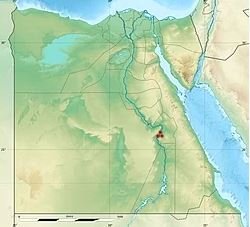
Image: The Ramesseum’s exact location (highlighted in red) within Egypt.
READ MORE: 10 Most Revered Gods and Goddesses in Ancient Egypt
Historical Context of Ramesses II
Ramesses II’s reign is often considered one of the most illustrious in ancient Egyptian history. His military campaigns, vast building projects, and the consolidation of Egyptian power earned him the title “The Great.”
Ramesses ruled for 66 years and left a lasting legacy through his grand monuments, including the temples at Abu Simbel, the Karnak Temple complex, and the Ramesseum. His reign followed a period of relative instability, but Ramesses managed to maintain Egypt’s dominance through military prowess, most notably at the Battle of Kadesh in the 13th century BCE.
The Ramesseum was built to honor Ramesses II as both a god and a king. It was constructed during the early years of his reign and took approximately 20 years to complete. Like other New Kingdom pharaohs, Ramesses sought to leave behind a lasting physical legacy through monumental architecture. His mortuary temple was designed not only as a place for his worship but also as a reflection of his power, grandeur, and relationship with the gods.

Image: Ramesses II
READ MORE: Battle divisions used by Ramesses the Great at the Battle of Kadesh
Architectural Features and Design of the Ramesseum
The Ramesseum adheres to the architectural conventions of New Kingdom temples, though it was built on an extraordinary scale. The temple complex is oriented northwest to southeast and features several key components that define its layout. These elements include monumental pylons, courtyards, a hypostyle hall, sanctuaries, and various auxiliary buildings.
Pylons and Courtyards
The temple is accessed through two massive stone pylons, the hallmark of New Kingdom temple architecture. These pylons are approximately 60 meters wide and are decorated with reliefs commemorating Ramesses II’s military victories, particularly the Battle of Kadesh. This battle, fought against the Hittites around 1274 BCE, is one of the most well-documented military engagements in ancient Egyptian history. The reliefs depict Ramesses as a heroic warrior, showcasing his might and triumph over his enemies. The first pylon also features a controversial reference to the city of “Shalem,” which some scholars speculate could be an early reference to Jerusalem, though this interpretation remains debated.
The entrance through the first pylon leads to the first courtyard, which contains a mixture of religious and military imagery. Statues of Ramesses II once lined the courtyard, while the walls displayed scenes of the pharaoh offering to various gods. The second pylon, also decorated with reliefs, leads to a second courtyard, where a colossal statue of Ramesses once stood. This 19-meter (62-foot) syenite statue, now fragmented, would have towered over the courtyard, serving as a visual reminder of Ramesses’s immense power.
Hypostyle Hall
Beyond the second courtyard lies the hypostyle hall, one of the architectural marvels of the Ramesseum. Hypostyle halls are characterized by rows of massive columns that support the roof, and this one originally contained 48 columns.
Today, 39 of these columns remain standing. The columns are intricately decorated with scenes of Ramesses II in the presence of various deities, including Amun-Ra, Osiris, and Ptah. The ceiling of the hall was adorned with gold stars against a blue background, symbolizing the sky and adding to the celestial atmosphere of the space. The hypostyle hall was not only a space for ceremonial purposes but also a place for reinforcing the pharaoh’s divine status through its symbolic and religious decoration.

Image: Several ruined structures at the temple.
The Sanctuary and Inner Rooms
The sanctuary, located at the rear of the temple complex, was the spiritual heart of the Ramesseum. It consisted of three consecutive rooms, each smaller than the last, culminating in the most sacred space where religious ceremonies dedicated to Ramesses’s cult were performed.
The sanctuary was aligned with the rising sun, emphasizing the connection between the pharaoh and the sun godRa, whose daily journey across the sky symbolized life, death, and rebirth. The ceilings of the inner rooms were also decorated with astral scenes, reinforcing the temple’s connection to the heavens.
Auxiliary Structures
In addition to the main temple, the Ramesseum complex included several auxiliary buildings. To the north of the hypostyle hall was a smaller temple dedicated to Ramesses’s mother, Queen Tuya, and his chief wife, Nefertari.
These auxiliary temples served to honor the royal family and further emphasize the divine nature of the pharaoh’s lineage. The complex also housed storerooms, granaries, and workshops that supported the temple’s operations. These structures were crucial for maintaining the mortuary cult of Ramesses II, ensuring that offerings were continually made to his spirit.
The Colossal Statue of Ramesses II
One of the most iconic features of the Ramesseum was the colossal statue of Ramesses II that once stood in the second courtyard. This massive syenite statue, standing 19 meters (62 feet) high and weighing over 1,000 tons, was one of the largest statues of its kind. It was transported over 270 kilometers (170 miles) from the quarries of Aswan to the Ramesseum, a feat that underscores the engineering skills of the ancient Egyptians.
Although only fragments of the statue remain today, including part of the base and torso, its size and scale remain impressive. This statue was intended to glorify Ramesses II, presenting him as a god-like figure who could rival the colossal statues of earlier pharaohs like the Colossi of Memnon. The statue’s grandeur also reflects Ramesses’s desire to immortalize his image and his reign.
Decoration and Symbolism
The Ramesseum is rich in symbolic decoration, much of which highlights Ramesses II’s divine authority and military prowess. The temple’s outer walls are adorned with scenes of the pharaoh’s victories, particularly the Battle of Kadesh, where Ramesses is depicted as a heroic figure triumphing over the Hittites. This imagery is meant to convey the idea of the pharaoh as both a warrior and a protector of Egypt, reinforcing his role as a semi-divine figure.
In addition to military scenes, the temple is decorated with religious iconography that emphasizes Ramesses’s relationship with the gods. He is often shown in the company of Amun-Ra, the chief god of Thebes, as well as other deities like Osiris, the god of the afterlife, and Ptah, the god of creation. These depictions reinforce the idea that Ramesses was chosen by the gods to rule Egypt and that his reign was divinely sanctioned.
The ceiling of the hypostyle hall, adorned with gold stars on a blue background, symbolizes the heavens and underscores the temple’s celestial connection. The alignment of the sanctuary with the rising sun further highlights the temple’s association with the sun god Ra, who was believed to bestow life and power upon the pharaoh.
READ MORE: Creator Deities in Ancient Egyptian Religion and Mythology
The Decline and Rediscovery of the Ramesseum
Despite its grandeur, the Ramesseum did not survive the passage of time unscathed. Its location near the edge of the Nile floodplain meant that the temple was subject to flooding, which gradually weakened its foundations. Over the centuries, neglect and the rise of new religions contributed to the temple’s decay. During the early Christian period, parts of the Ramesseum were repurposed as a Christian church, further altering its structure and function.
By the time of the modern rediscovery of the temple, much of the Ramesseum lay in ruins. The fallen colossal statue of Ramesses II, in particular, captured the imagination of European explorers and scholars. In the early 19th century, the Italian explorer Giovanni Belzoni visited the site and transported fragments of the statue, including a large head, to England. These fragments became known as the “Younger Memnon” and are now housed in the British Museum.
The rediscovery of the Ramesseum also inspired the English poet Percy Bysshe Shelley (1792 – 1822) to write his famous sonnet “Ozymandias.” The poem reflects on the impermanence of human power, using the fallen statue of Ramesses as a symbol of the fleeting nature of greatness. In the poem, Shelley describes the “vast and trunkless legs of stone” and the “shattered visage” of the fallen statue, emphasizing the contrast between the pharaoh’s once-mighty reign and the ruins that remain.
Archaeological Discoveries
In addition to the monumental structures of the Ramesseum, archaeological excavations have uncovered important insights into daily life during Ramesses II’s reign. Excavations around the temple have revealed kitchens, bakeries, and storerooms that supported the temple’s operations. These facilities were essential for maintaining the daily offerings to Ramesses’s cult and ensuring that the temple functioned as a place of continuous worship.
One of the most significant discoveries beneath the hypostyle hall was a shaft tomb from the Middle Kingdom, predating the construction of the Ramesseum. This tomb contained a wealth of religious and funerary artifacts, including figurines, jewelry, and ceremonial items. The discovery of this tomb suggests that the site of the Ramesseum held religious significance long before Ramesses II began construction on his mortuary temple.
Archaeologists have also uncovered evidence of a scribal school within the Ramesseum complex. This school would have trained young boys to become scribes, one of the most important professions in ancient Egypt. The discovery of ostraca (inscribed pottery shards) and papyri in the area supports the idea that the Ramesseum was not only a place of worship but also a center for education and administration.
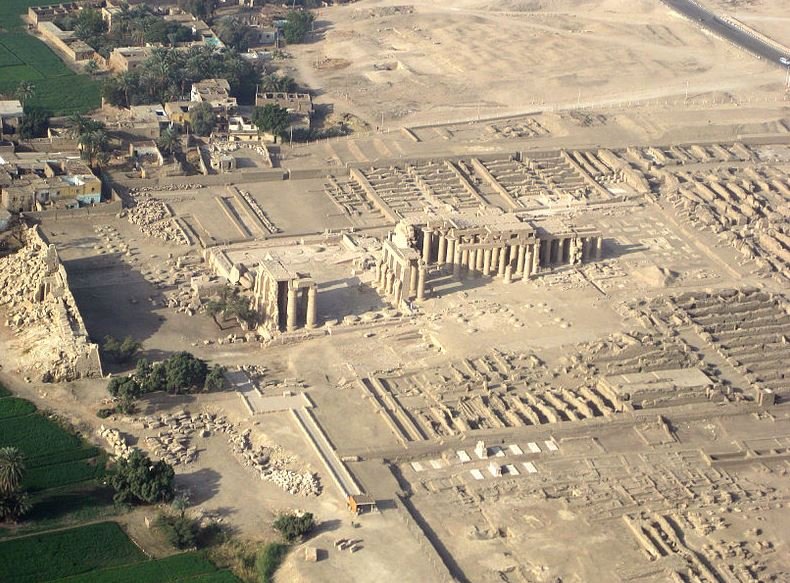
Image: Bird-eye’s view of the Ramesseum.
READ MORE: How did the Nile make Egypt a great ancient civilization?
The Ozymandias Colossus and Cultural Impact
The Ramesseum’s cultural impact extends far beyond ancient Egypt. The fallen statue of Ramesses II, known as the “Ozymandias Colossus,” has become an enduring symbol of the transience of power and the inevitable decline of even the greatest rulers. Percy Bysshe Shelley’s sonnet “Ozymandias” brought the Ramesseum to the attention of a broader audience and solidified its place in Western cultural history.
In Shelley’s poem, the fallen statue of Ramesses, or “Ozymandias,” is described as a “colossal wreck” lying in the desert, its shattered features a reminder that all empires eventually fade. The poem’s message about the impermanence of human achievement has resonated with readers for centuries, making the Ramesseum a symbol of the fleeting nature of power and glory.
Conclusion
The Ramesseum stands as a testament to Ramesses II’s ambition, power, and desire for immortality. Through its monumental architecture, intricate decoration, and symbolic imagery, the temple reflects the pharaoh’s role as a god-like ruler and protector of Egypt. Although much of the Ramesseum has been lost to time, its remains continue to inspire admiration for the grandeur of ancient Egypt.
Frequently Asked Questions
What are some key features of the Ramesseum’s architectural design?
The Ramesseum follows the traditional New Kingdom temple layout, with two massive pylons leading into courtyards and a 48-column hypostyle hall. The temple also includes a sanctuary, royal palace, and colossal statues of Ramesses II.
How was the Ramesseum decorated, and what historical events are depicted on its walls?
The Ramesseum’s pylons and walls are decorated with scenes glorifying Ramesses II’s military victories, particularly the Battle of Kadesh. The temple also features images of Ramesses’s triumphs over the Hittites and religious celebrations honoring the god Min.
What is the significance of the colossal statue of Ramesses II at the Ramesseum?
The colossal statue of Ramesses II, originally 19 meters (62 feet) high and weighing over 1,000 tons, was one of the largest in the world. Although now in fragments, it symbolizes the grandeur of Ramesses’s reign and inspired the famous poem “Ozymandias” by Percy Bysshe Shelley.

Colossal Statue of Ramses II.
What additional structures are part of the Ramesseum complex?
Adjacent to the main temple is a smaller temple dedicated to Ramesses’s mother, Tuya, and his wife, Nefertari. The complex also includes storerooms, workshops, and granaries that supported the temple’s daily operations.
What challenges has the Ramesseum faced over time?
The temple has suffered damage due to its proximity to the Nile floodplain, neglect, and conversion into a Christian church during the early Christian period. Despite these challenges, the Ramesseum retains significant historical and cultural value.
How did the Ramesseum gain fame in modern times, and what cultural impact did it have?
The Ramesseum gained fame due to the rediscovery of its colossal statues, particularly the fallen statue of Ramesses II that inspired Shelley’s poem “Ozymandias.” The poem highlights the impermanence of human power, making the Ramesseum a symbol in literary history.





