The Sea Peoples: Who were they, and how much chaos did they create in the Bronze Age?
The Sea Peoples were a confederation of seafaring tribes who, during the late Bronze Age, launched a series of devastating attacks across the eastern Mediterranean.
Their raids are closely associated with the widespread destruction that occurred around 1200 BCE, which coincided with the collapse of several powerful civilizations. Despite their significant impact on history, the Sea Peoples remain an enigmatic group.
Scholars have debated their origins, their motivations, and the extent of the chaos they unleashed, as well as their role in the broader collapse of the Bronze Age system.
The story of the Sea Peoples is an intricate part of one of the most dramatic periods in ancient history, where entire empires crumbled, cities were burned to the ground, and a long-standing international system dissolved into chaos.

The Sea Peoples were tribes that attacked the eastern Mediterranean around 1200 BCE, contributing to the Bronze Age collapse, though their exact role remains debated. Image: This scene from Medinet Habu’s north wall depicts Egypt’s battle against the Sea Peoples during the Battle of the Delta (c. 1175 BCE) under Ramesses III, with hieroglyphs vaguely describing the enemies as from “northern countries.”
The Bronze Age World
To understand the Sea Peoples and the havoc they wreaked, it is essential to first understand the world they were entering. By the late Bronze Age, a vast network of powerful kingdoms and city-states dominated the eastern Mediterranean and Near East. This region was marked by a complex web of trade, diplomacy, and warfare, linking cultures as far apart as Egypt, Mycenaean Greece, Hatti (the Hittite Empire), and Mesopotamia.
The period from about 1550 to 1200 BCE is often referred to by modern scholars as the Late Bronze Age. During this time, a diplomatic and trading system known as the “Great Powers Club” connected the major states of the region. The members of this club included Egypt, Hatti, Kassite Babylon, Assyria, and Cyprus (referred to as Alashiya). These powers often formed alliances, exchanged gifts, and conducted diplomacy, as evidenced by the Amarna Letters, a trove of diplomatic correspondence between Egypt and other major powers. Smaller city-states in the Levant, such as those in present-day Israel, Lebanon, and Syria, were subordinate members of this system, and they frequently served as battlegrounds for conflicts between larger powers, particularly Egypt and the Hittites.
Trade routes crisscrossed the region, linking Egypt, Mesopotamia, Anatolia, and the Aegean. Goods such as grain, wine, olive oil, metals, textiles, and luxury items like ivory and gold flowed freely between these states. This interconnected system was responsible for creating a stable and prosperous world, with international trade bringing wealth to many regions. However, this interconnectedness also made the system fragile; when one part of the network began to unravel, the effects could be felt across the entire region.
Who Were the Sea Peoples?
The term “Sea Peoples” is a modern scholarly designation based on ancient Egyptian records that describe these invaders as “the peoples of the sea.” The exact composition of the Sea Peoples is still debated, as they were not a single, unified group.
Instead, they appear to have been a coalition of different tribes or ethnic groups, many of whom may have originated in different parts of the Mediterranean. While the Egyptians provided names for some of these groups, such as the Sherden, Shekelesh, Peleset, Denyen, Weshesh, and Tjekker, there is little consensus about who these people were or where they came from.
Some scholars argue that the Sea Peoples originated in the Aegean, perhaps as displaced Mycenaeans, while others suggest origins in Anatolia, the western Mediterranean, or the Balkans. Theories about their origins range from suggesting they were refugees fleeing natural disasters or famine to arguing that they were marauders seeking new land and resources. Regardless of their origin, what is clear is that the Sea Peoples arrived in large numbers, often with families in tow, indicating that they were not merely raiders but migrants seeking new settlements.
The Sea Peoples and Egypt

Image: Granodiorite bust of Merneptah, Egyptian Museum, Cairo
Much of what we know about the Sea Peoples comes from Egyptian sources, particularly from the reigns of Pharaoh Merneptah (c. 1224-1204 BCE) and Ramesses III (c. 1184-1153 BCE). These two rulers faced large-scale invasions by the Sea Peoples, and their accounts provide valuable, albeit biased, information about the attackers.
In the fifth year of Merneptah’s reign, around 1208 BCE, a confederation of Sea Peoples tribes, along with their Libyan allies, attempted to invade Egypt. This event is recorded on the “Stela of Merneptah,” which describes how Merneptah successfully repelled the invaders. The inscription provides a list of Sea Peoples groups involved in the attack, including the Sherden, Shekelesh, Ekwesh, Luka, and Teresh. The Egyptians emphasized their victory, describing the Sea Peoples as defeated and scattered. However, this invasion was part of a larger wave of migration and warfare that would continue for decades.

Portrait of Merneptah with sun god Ra
The most famous encounter with the Sea Peoples occurred during the reign of Ramesses III. Around 1177 BCE, in the eighth year of his reign, Ramesses III faced a massive invasion by the Sea Peoples, who had already ravaged much of the eastern Mediterranean. This invasion is documented in both textual and pictorial form at the mortuary temple of Medinet Habu. The reliefs at Medinet Habu show the Sea Peoples arriving by both land and sea, with their ships filled with warriors, families, and livestock, suggesting that they were migrating in large numbers.
Ramesses III’s account of the battle, like Merneptah’s, emphasizes his victory over the invaders. According to Egyptian records, the Sea Peoples were utterly defeated, and many were captured and settled in Egypt as prisoners of war. The Egyptians even claimed to have repopulated some of their cities with captured Sea Peoples. However, despite these claims of victory, the damage caused by the Sea Peoples was immense, and their attacks were part of a broader pattern of destruction that swept across the region.
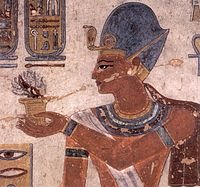
The New Kingdom Era was weakened by the onset of attacks by the Sea People and tribesmen from Libya. Those attacks began during the reign of Ramesses III, the second pharaoh of the 20th Dynasty. Image: Ramses III offering incense, wall painting in KV11.
The Impact of the Sea Peoples
The Sea Peoples’ attacks had a profound impact on the eastern Mediterranean and Near East, contributing to the collapse of several major civilizations. Between 1200 and 1150 BCE, many of the great powers of the Late Bronze Age fell, and their cities were destroyed. Some of the most significant victims of this wave of destruction included:
- The Hittite Empire: Once one of the most powerful states in the Near East, the Hittite Empire collapsed around 1200 BCE. Hattusa, the Hittite capital, was sacked and burned, and the Hittite state fragmented into smaller Neo-Hittite kingdoms. While the Sea Peoples were likely only one of several factors contributing to the fall of the Hittites, they played a significant role in the region’s destabilization.
- Mycenaean Greece: The Mycenaean civilization, which had dominated the Aegean for centuries, was also devastated during this period. Many of the great Mycenaean palaces, such as those at Pylos, Tiryns, and Mycenae itself, were destroyed around 1200 BCE. Some scholars suggest that the Sea Peoples were responsible for these destructions, while others argue that internal conflict, social upheaval, or environmental factors may have played a role.
- The Levant: The city-states of the Levant, such as Ugarit and Byblos, were also heavily affected by the Sea Peoples’ invasions. Ugarit, one of the most important trading centers in the region, was destroyed and never rebuilt. The destruction of these cities disrupted trade networks and contributed to the overall collapse of the Late Bronze Age system.
- Cyprus: The island of Cyprus, known as Alashiya in Bronze Age texts, was another victim of the Sea Peoples’ attacks. Archaeological evidence suggests that many of the island’s cities were destroyed around 1200 BCE, and the island’s trading network, which had been vital to the region’s economy, was severely disrupted.
The Sea Peoples and the Bronze Age Collapse
The Sea Peoples are often seen as one of the primary causes of the so-called Bronze Age Collapse, a period of widespread destruction and societal breakdown that occurred around 1200 BCE. This collapse was marked by the fall of many of the great civilizations of the Late Bronze Age, including the Hittites, Mycenaeans, and the Egyptian New Kingdom (which, although it survived the invasions, was significantly weakened). The collapse also saw the end of the complex international trade and diplomatic system that had connected the eastern Mediterranean and Near East for centuries.
However, while the Sea Peoples played a significant role in this collapse, they were likely not the only cause. Modern scholars have pointed to a variety of other factors that may have contributed to the breakdown of the Bronze Age system. These include:
- Climate Change: Evidence suggests that the eastern Mediterranean experienced a period of prolonged drought around 1200 BCE. This may have led to crop failures, food shortages, and social unrest, prompting migrations and invasions as people searched for new resources and more fertile land.
- Earthquakes: The eastern Mediterranean is a seismically active region, and some scholars have suggested that a series of powerful earthquakes may have contributed to the destruction of cities during this period. However, this theory is still debated, as not all of the destruction can be attributed to natural disasters.
- Internal Conflict: In many of the regions affected by the Bronze Age collapse, there is evidence of internal social and political instability. For example, some of the Mycenaean palace destructions may have been caused by internal revolts rather than external invasions. Similarly, the Hittite Empire may have been weakened by internal divisions before its final collapse.
- Trade Disruptions: The interconnected trade networks of the Late Bronze Age were a double-edged sword. While they brought wealth and prosperity to the region, they also made the system vulnerable to disruptions. The destruction of key trading cities, such as Ugarit, would have had a ripple effect across the entire region, contributing to economic collapse.
Ancient Egyptian Kings of the New Kingdom and their Accomplishments
What Happened to the Sea Peoples?
After their failed invasions of Egypt and the widespread destruction they caused, the fate of the Sea Peoples varied. Egyptian records suggest that some groups, such as the Sherden and Weshesh, were captured and settled in Egypt, where they became part of the local population. Other groups, such as the Peleset, are believed to have settled in the Levant. The Peleset are widely identified with the Philistines, a people mentioned in the Bible who lived along the southern coast of modern-day Israel and Gaza. The Philistines became one of the major players in the region during the Iron Age, and their name is the origin of the modern term “Palestine.”
Other Sea Peoples groups, such as the Shekelesh and Tjekker, may have settled in coastal areas of the Levant or continued to engage in piracy and raiding. Some, like the Teresh, have been tentatively linked to the Etruscans of Italy, suggesting that the Sea Peoples may have had far-reaching effects across the Mediterranean.
The Lasting Impact of the Sea Peoples
The chaos wrought by the Sea Peoples contributed to one of the most dramatic transformations in the ancient world. The collapse of the Bronze Age system led to the emergence of new powers and cultures in the eastern Mediterranean and Near East. In the centuries following the collapse, new civilizations arose, including the Phoenicians, Israelites, and Arameans in the Levant, and the Neo-Hittite kingdoms in Anatolia. In Greece, the so-called Greek Dark Ages followed the fall of the Mycenaean palaces, but this period eventually gave rise to the classical Greek civilization of the Iron Age.
The Sea Peoples’ invasions also had a significant cultural impact. The memory of these invasions and the destruction they caused was preserved in Egyptian texts, which portrayed the Sea Peoples as dangerous and barbaric outsiders. However, the Sea Peoples were not merely destroyers. Some of them, like the Philistines, went on to establish new societies that would play a major role in the region’s history. Their migrations also contributed to the spread of new technologies and cultural practices across the Mediterranean.
In modern scholarship, the Sea Peoples remain a fascinating and controversial topic. Their role in the Bronze Age collapse continues to be debated, and new archaeological discoveries are constantly adding to our understanding of this period. While we may never know the full story of who the Sea Peoples were or why they embarked on their destructive campaigns, their legacy as agents of chaos during one of history’s great turning points is undeniable.
Questions and Answers
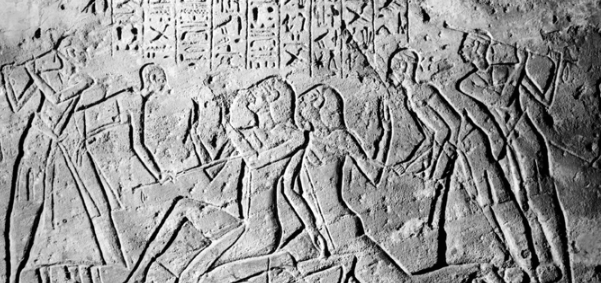
Image: A carved relief from the Kadesh inscriptions depicts Egyptian soldiers beating Shasu spies, capturing a moment of interrogation during the conflict.
Who were the Sea Peoples, and how did they get their name?
The Sea Peoples were a collection of tribes that attacked the kingdoms and city-states of the eastern Mediterranean basin in the late 13th and early 12th centuries BCE. They were sometimes allied with one another and other times acted independently.
They were collectively named “Sea Peoples” based on Egyptian texts that referred to them as the “people beyond the sea.” Despite modern scholars grouping them under this term, many aspects of their identity, origins, and role in the collapse of the Bronze Age system remain unclear.
What was the “Great Powers Club” during the Late Bronze Age?
The “Great Powers Club” was a geopolitical system that existed in the eastern Mediterranean and Near East around 1550-1200 BCE. The main members included Egypt, Hatti, Kassite Babylon, and Alyshia (modern Cyprus), with Assyria and Arzawa joining over time.
These powers maintained diplomatic marriages, trade agreements, and military alliances to preserve peace and stability. The smaller Levantine city-states, such as those in Syria-Palestine, were subordinate members, often caught in the crossfire of larger conflicts between the major powers.
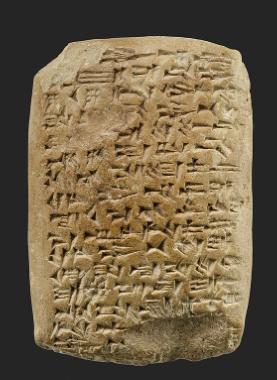
The Amarna Letters, a collection of Akkadian-cuneiform tablets, documented correspondence between the kings of the Great Powers. These letters reveal how the kings viewed each other as equals, while smaller Canaanite kings were treated as inferiors.
What were the major outcomes of the Sea Peoples’ invasions in the late 13th century BCE?
The Sea Peoples’ invasions led to widespread destruction in the Mediterranean and Near East. They are credited with destroying the Hittite kingdom and ravaging cities such as Kode, Carchemish, Arvad, and Alasa. They also devastated Cyprus, sacked Ugarit, and attacked several Mycenaean cities. These invasions played a key role in the collapse of the Bronze Age system, although they were only part of a larger process of decline.
How did the Sea Peoples attempt to invade Egypt, and what were the outcomes of these attempts?

Image: Relief from the sanctuary of the Temple of Khonsu at Karnak depicting Ramesses III
The Sea Peoples made two major attempts to invade Egypt, both of which failed. The first invasion took place during the reign of King Merneptah (c. 1224-1204 BCE) and involved five Sea Peoples tribes alongside their Libyan allies. The second invasion occurred during the eighth year of Ramesses III’s reign (c. 1184-1153 BCE). In both instances, the Sea Peoples formed alliances and launched coordinated attacks but were ultimately repelled by the Egyptians.
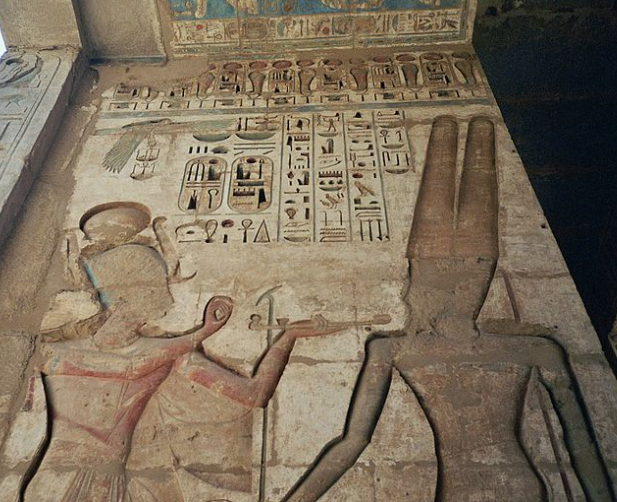
Relief of Ramesses III at the Medinet Habu temple
What environmental factors may have contributed to the collapse of the Bronze Age system?
Drought and overpopulation were significant factors that likely contributed to the collapse of the Bronze Age system. Historical accounts, such as those from Herodotus, mention severe droughts in regions like Anatolia.
Additionally, texts from Merneptah’s rule indicate that grain had to be shipped to the Hittite kingdom to alleviate famine. The droughts likely forced migrations, including those of the Sea Peoples, in search of fertile land. Overpopulation, particularly in the Aegean, further exacerbated the situation, leading to conflict and migration.
How did population pressures in the Aegean contribute to the Sea Peoples’ invasions?
By the late 13th century BCE, the population in regions like Messenia had grown significantly, with up to 50,000 people living there. This overpopulation, combined with the effects of drought, led many young Mycenaean men to take up arms as raiders and warriors. Some fought against other Mycenaeans, while others migrated east and south, eventually joining the Sea Peoples in their attacks on the Mediterranean and Near East.
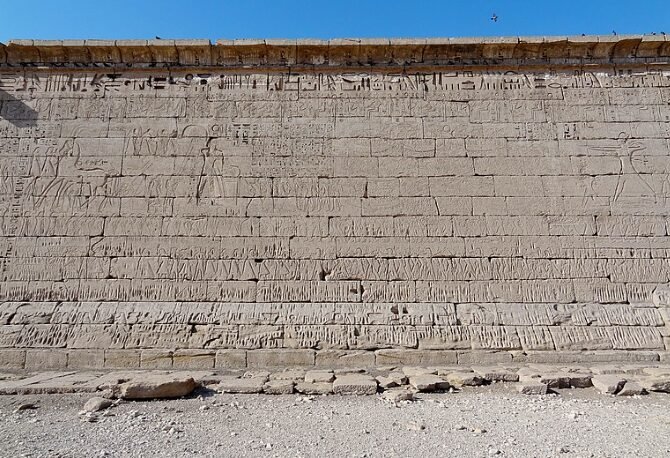
Image: Northeast wall of the Temple of the Dead Ramses III in Medinet Habu, Egypt
What impact did the Sea Peoples have on the Hittites and the Levant?
The Sea Peoples played a significant role in the destruction of the Hittite Empire. Along with attacks by the Phrygians from Europe, the Hittite capital, Hattusa, was destroyed. With the Hittites defeated, the Sea Peoples were able to march through the Levant, where they destroyed several cities and continued their campaigns toward Egypt. Their attacks also marked the end of Ugarit, a major city-state in the region.
What happened to the Sea Peoples after their invasions, and where did they settle?
After their invasions, the Sea Peoples dispersed and settled in various regions. Some tribes, like the Sherden and Weshesh, were forcibly settled in Egypt. Others, like the Teresh, are believed to have settled in Tuscany, becoming the Etruscans. The Peleset, who are thought to have become the biblical Philistines, settled in the Levant. Each tribe had a distinct fate, with some integrating into local societies while others founded new ones.





The Sea Peoples were illegal immigrants.