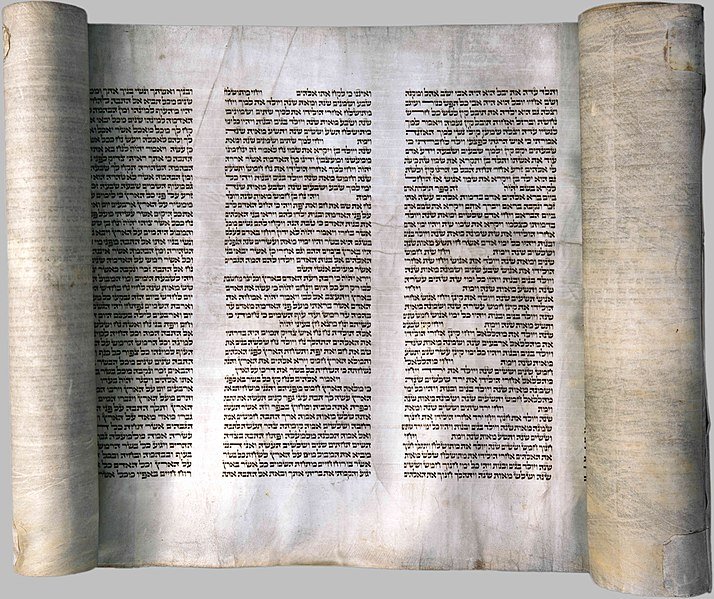
An opened Torah scroll displaying the Book of Genesis.
The Torah is the foundation of Jewish religious tradition, comprising the first five books of the Hebrew Bible: Genesis, Exodus, Leviticus, Numbers, and Deuteronomy. Also referred to as the Pentateuch or the Five Books of Moses, it serves as a combination of history, law, and ethical instruction. In Jewish tradition, the Torah is considered divine revelation, given to Moses by God at Mount Sinai and later transcribed under divine guidance.
The significance of the Torah extends beyond Judaism, influencing Christianity and Islam, where it is known as the Tawrat in Arabic.
The Meaning and Names of the Torah
The word Torah originates from the Hebrew root yarah, meaning to guide or to teach. While often translated as law, this interpretation is somewhat limiting, as the Torah encompasses a broader scope of instruction and moral guidance. The Greek Septuagint translated Torah as nomos (law), a designation later adopted by Latin and English versions of the Bible. In rabbinic tradition, the Torah can refer not only to the Written Torah (Torah Shebichtav) but also to the Oral Torah (Torah Shebe’al Peh), which includes interpretations and expansions found in the Talmud and Midrash.
Composition and Structure
The five books of the Torah contain a mixture of narrative and legal material, structured as follows:
- Genesis (Bereshit): The book of beginnings, detailing the creation of the world, the early history of humanity, and the ancestral history of the Israelites through Abraham, Isaac, and Jacob.
- Exodus (Shemot): Chronicles the enslavement of the Israelites in Egypt, their miraculous deliverance under Moses, and the revelation of the divine laws at Mount Sinai.
- Leviticus (Vayikra): Primarily a book of laws, focusing on priestly duties, ritual purity, and moral commandments.
- Numbers (Bemidbar): Records the Israelites’ wanderings in the desert, their challenges, and censuses of the tribes.
- Deuteronomy (Devarim): Composed mainly of Moses’ farewell speeches, reinforcing the laws and recounting Israel’s journey before entering the Promised Land.
The Torah remains a cornerstone of religious tradition, shaping Jewish identity and influencing Christian and Islamic thought.
Authorship and Historical Development
Traditionally, the Torah is ascribed to Moses, who is believed to have received divine instruction and transcribed it. However, modern scholarship suggests that the Torah was compiled over centuries from multiple sources. The Documentary Hypothesis, formulated in the 19th century, proposes that the Torah is composed of four primary sources:
- J (Yahwist): Emphasizes the personal nature of God.
- E (Elohist): Highlights visions and divine communication.
- P (Priestly): Focuses on rituals, genealogies, and priestly concerns.
- D (Deuteronomist): Forms the basis of Deuteronomy, emphasizing obedience to God’s laws.
This theory suggests that the Torah reached its final form during the Persian period (5th century BCE), with possible later additions during the Hellenistic period (4th–2nd centuries BCE).
Hellenistic Kingdoms: What were they and what were some of their notable achievements?
The Torah in Jewish Tradition
The Torah is central to Jewish life and practice, playing a significant role in religious observance and daily ethics.
- Public Reading: The Torah is read in synagogues on Mondays, Thursdays, and Saturdays (Shabbat), with the annual reading cycle culminating on Simchat Torah.
- Study and Interpretation: Traditional Jewish study involves deep engagement with the Torah alongside rabbinic commentaries, such as Rashi, Maimonides, and the Talmud.
- Ritual Use: A Torah scroll (Sefer Torah) is meticulously handwritten on parchment by a sofer (scribe) and treated with the utmost reverence.
The Torah Beyond Judaism
The Torah is integral to Christian theology, forming the first five books of the Old Testament. While some Christian traditions view it as superseded by the New Testament, others, particularly in Catholicism and Eastern Orthodoxy, see it as foundational to understanding God’s covenant and moral laws.
In Islam, the Torah (Tawrat) is regarded as a holy book given to Moses (Musa). However, Islamic tradition maintains that its original message was later altered (tahrif), leading to the necessity of the Qur’an as the final divine revelation.
Interpretations and Commentaries
Throughout history, the Torah has been subject to extensive interpretation:
- Rabbinic Interpretation: The Midrash and Talmud expand upon Torah laws and narratives.
- Kabbalistic Perspective: Jewish mysticism (Kabbalah) sees the Torah as a text with hidden spiritual meanings.
- Modern Critical Analysis: Scholars analyze the Torah using linguistic, historical, and archaeological methods to understand its origins and evolution.
Translations and Versions
The Torah has been translated into numerous languages, including:
- The Septuagint (Greek): A 3rd-century BCE translation for Hellenistic Jews.
- Targumim (Aramaic): Early paraphrased translations used in synagogues.
- Latin (Vulgate): Jerome’s 4th-century CE translation for the Christian Church.
- Modern Translations: Various versions exist in English, German, Russian, and other languages, used in both Jewish and Christian contexts.
Whether viewed as divine revelation, historical document, or ethical guide, it continues to be a source of study, interpretation, and spiritual reflection for millions worldwide.
Frequently Asked Questions
How is the Torah used in Jewish tradition?
It is read publicly in synagogues on Mondays, Thursdays, and Saturdays, following a yearly cycle. It also serves as the foundation of Jewish law and teachings.
What is the difference between the Written and Oral Torah?
The Written Torah consists of the five books of Moses, while the Oral Torah includes interpretations and traditions passed down orally, later compiled in the Talmud and Midrash.
Who is believed to have written the Torah?
Traditional Jewish belief attributes the Torah to Moses, while modern scholars suggest it was written and edited over centuries, finalized during the Persian period.
What is the significance of the Torah in other religions?
In Christianity, it forms part of the Old Testament. In Islam, it is known as the Tawrat and is considered a holy book revealed to the prophets of the Israelites.
What are the key themes of the Torah?
The Torah contains narratives of creation, early Israelite history, laws, commandments, and covenants between God and the Israelites.
What languages has the Torah been translated into?
Historically, it was translated into Greek (Septuagint), Aramaic (Targum), Latin (Vulgate), and many modern languages, with Jewish and Christian versions differing slightly.
How is the Torah physically preserved and read?
Torah scrolls are handwritten by scribes on parchment, stored in synagogues, and read using a pointer (yad) to avoid direct contact with the sacred text.

Yad





