The Christian Old Testament
The Old Testament (OT) is the foundational text of the Christian biblical canon, derived from the Hebrew Bible, or Tanakh. This collection of ancient Hebrew and some Aramaic writings reflects the religious and cultural heritage of the Israelites. As the first part of the Christian Bible, the Old Testament is complemented by the New Testament, which was written in Koine Greek and focuses on the life and teachings of Jesus Christ and his apostles.
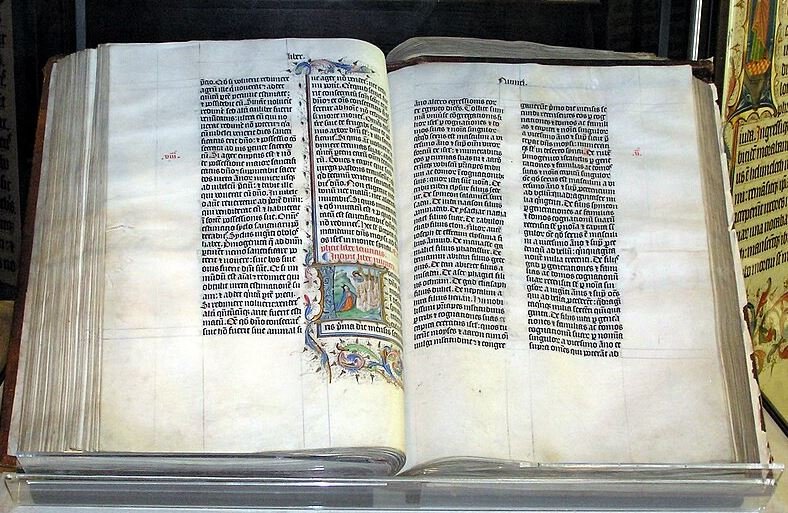
A handwritten Latin Bible exhibited at Malmesbury Abbey in Wiltshire, England.
Structure of the Old Testament
Christians traditionally divide the Old Testament into four main sections:
The Pentateuch (Torah)
The first five books—Genesis, Exodus, Leviticus, Numbers, and Deuteronomy—outline the creation of the world, the covenant between God and Israel, and the laws that define the Israelites’ relationship with God.
Historical Books
These recount the history of Israel, from their conquest of Canaan to their exile in Babylon. They include books like Joshua, Judges, Ruth, Samuel, and Kings.
Poetic and Wisdom Literature
Books such as Psalms, Proverbs, Job, and Ecclesiastes explore themes like human experience, morality, divine justice, and the nature of wisdom.
Prophetic Books
These writings, from major prophets like Isaiah, Jeremiah, and Ezekiel, to the twelve minor prophets, provide warnings and promises from God to the Israelites.

A Torah scroll opened to the Book of Genesis.
Differences in Old Testament Canons
The number and selection of Old Testament books vary among Christian denominations:
- Protestant Canon: Contains 39 books, aligning closely with the Hebrew Bible.
- Catholic Canon: Includes 46 books, incorporating additional texts known as the deuterocanonical books.
- Orthodox Canon: Contains up to 49 books, drawing extensively from the Septuagint, the ancient Greek translation of the Hebrew Bible.
The additional books in Catholic and Orthodox canons, such as Tobit, Judith, and Maccabees, are absent from most Protestant Bibles but sometimes appear in a separate section called the Apocrypha.
Origins and Historical Context
The Old Testament’s composition spanned centuries, beginning with oral traditions that were eventually written down. The Pentateuch likely reached its final form during the Persian period (538–332 BCE). The historical books, which recount Israel’s history up to the Babylonian exile, were likely completed during the 6th century BCE.
The prophetic and wisdom literature were written in various periods, with some texts, such as Ecclesiastes and the Song of Songs, reflecting the influence of Hellenistic thought.
The historical accuracy of the Old Testament has been a subject of scholarly debate. Key events such as the Exodus, the conquest of Canaan, and the reign of King David have varying levels of archaeological support. While early scholarship often took biblical accounts at face value, modern research combines skepticism with recognition of historical elements, particularly from the 9th century BCE onward.
Themes of the Old Testament
The Old Testament explores a range of theological, moral, and philosophical themes:
Central to the Old Testament is the covenant between God and Israel, which establishes the Israelites as God’s chosen people.
The Old Testament emphasizes the worship of Yahweh as the one true God, though it acknowledges the existence of other deities worshiped by neighboring cultures.
The Old Testament provides moral teachings, including laws against murder, theft, and corruption, and calls for justice, fairness, and care for the vulnerable.
The texts grapple with questions of divine justice, particularly in the context of suffering and disaster, as seen in the books of Job and Lamentations.
The Old Testament highlights the importance of faith in God and obedience to His laws, often contrasting the consequences of faithfulness with those of disobedience.

Formation of the Canon
The process of canonization—the recognition of certain texts as authoritative—was gradual:
- By the 5th century BCE, the Torah was considered sacred scripture.
- The Prophets gained similar status by the 2nd century BCE.
- Other writings, known as the Writings (Ketuvim), remained fluid for some time, with different Jewish communities accepting different books.
The Septuagint, a Greek translation of the Hebrew scriptures completed between 280 and 130 BCE, became influential in the early Christian Church. Its inclusion of additional texts contributed to the variations in Christian Old Testament canons.
Translations and Versions
The Septuagint (LXX) was a Greek translation of the Hebrew Bible, widely used in the Hellenistic Jewish diaspora and the early Christian Church. It includes books not found in the Hebrew canon, such as Wisdom and Sirach.
In the 4th century CE, Jerome translated the Bible into Latin, producing the Vulgate. While Jerome preferred the Hebrew text for his Old Testament translation, the Vulgate also incorporated books from the Septuagint, influencing the Catholic canon.
During the Reformation, Protestant leaders like Martin Luther rejected the deuterocanonical books as non-canonical, aligning their Old Testament with the Hebrew Bible.
Key Books and Their Content
- Genesis: The creation of the world, the stories of the Patriarchs (Abraham, Isaac, and Jacob), and the beginnings of Israel.
- Exodus: The Israelites’ liberation from Egypt, the giving of the Law at Mount Sinai, and the establishment of the covenant.
- Psalms: A collection of hymns and prayers expressing a wide range of emotions, from praise to lament.
- Isaiah: Prophecies of judgment and redemption, emphasizing the holiness of God and the hope of a messianic future.
- Daniel: Apocalyptic visions and narratives emphasizing God’s sovereignty over human history.

Depiction of Genesis 1 verse 2 by Wenceslaus Hollar
Theological Significance
The Old Testament portrays God as both transcendent and immanent, a creator who is deeply involved in the lives of His people. It emphasizes His attributes of justice, mercy, and faithfulness.
While the Old Testament does not explicitly predict Jesus Christ, Christians interpret many passages as messianic prophecies. These include Isaiah’s “suffering servant” and Micah’s prophecy of a ruler from Bethlehem.
The Old Testament’s covenants—especially those with Abraham, Moses, and David—form the basis of Christian theology, which views Jesus as the fulfillment of these promises.
Frequently Asked Questions
How is the Old Testament organized in Christian Bibles?
It is divided into four sections: the Pentateuch (Torah), historical books, poetic and wisdom literature, and the prophetic books.
Why do Old Testament canons differ among Christian denominations?
Protestants include 39 books, Catholics 46, and Orthodox Christians up to 49, with differences due to inclusion of deuterocanonical books from the Septuagint.
How reliable are Old Testament historical accounts?
While early biblical accounts influenced history, modern scholarship debates their accuracy, especially regarding events like the Exodus and the United Monarchy, balancing skepticism with some archaeological evidence.
When was the Old Testament written?
Its composition spans centuries, from the Persian period (538–332 BC) for the Pentateuch to the 2nd–1st centuries BC for the Maccabees.
Why is it called “Old Testament”?
It reflects Christianity’s view of the Old Testament as fulfilled by the New Testament and Jeremiah’s prophecy of a New Covenant, extending God’s relationship to all believers.





