The Treaty of Brest-Litovsk
The Treaty of Brest-Litovsk, signed in March 1918, marked a decisive turning point in the First World War and in the early history of Soviet Russia. Concluded between the new Bolshevik government and the Central Powers—Germany, Austria-Hungary, the Ottoman Empire, and Bulgaria—it represented a moment when Russia, exhausted by a catastrophic war and internal upheavals, withdrew from the global conflict on onerous terms.
The treaty’s context and consequences illuminate the interplay of revolution, geopolitics, and strategic desperation. Although later annulled, its legacy influenced the fate of Eastern Europe and laid important foundations for Soviet diplomacy and territorial reconfiguration in the years that followed.

Image: The front page of the treaty.
Background
By 1917, the Eastern Front had devolved into a grueling deadlock. Russia, under the Romanovs, had entered the war with high hopes of defending Slavdom and asserting imperial might. Yet mounting casualties, economic dislocation, and logistical failures strained both the army and home front to the breaking point. Whole swathes of territory were lost to advancing German and Austro-Hungarian forces. Morale eroded among troops and civilians, and calls for an immediate end to the war grew louder as the initial patriotic fervor disappeared beneath layers of hardship.
Amid these dire conditions, 1917 brought two revolutions. The February Revolution toppled the centuries-old monarchy, replacing it with a Provisional Government that lacked the authority or popular mandate to end the conflict. When the war effort failed again in mid-1917, disillusionment surged. Into this power vacuum stepped the Bolsheviks, led by Vladimir Lenin, who promised “Peace, Land, and Bread.” By November (October, Old Style), they had seized power in Petrograd. Once in control, they treated an immediate end to the war as a top priority. Lenin viewed peace not only as a popular demand but as a necessity to consolidate the fledgling regime and safeguard the revolution from internal and external threats.
Negotiations at Brest-Litovsk
Negotiations with the Central Powers began after an armistice in December 1917. The Soviet representatives initially included Adolph Joffe and later Leon Trotsky, tasked with achieving a settlement that reflected Bolshevik principles of self-determination and “no annexations or indemnities.” The Central Powers, for their part, saw an opportunity to impose conditions that would secure vast eastern territories as buffers, resource bases, and bargaining chips in reshaping the postwar order.
From the start, the Bolsheviks tried to stall. They hoped that delay might foment socialist revolutions in Germany or Austria-Hungary, thereby strengthening their negotiating position. Trotsky, who replaced Joffe, attempted a tactic of “no war, no peace”—a withdrawal from conflict without formally signing an agreement. The Central Powers, however, were not inclined to indulge these maneuvers indefinitely. In February 1918, frustrated by stalling, they launched a new offensive against the nearly defenseless Soviet territory, forcing a humiliating capitulation.

Image: Leon Trotsky
Terms of the Treaty
Under the final terms signed in March 1918, Soviet Russia relinquished large territories, including Ukraine, Belarusian lands, the Baltic provinces, and regions of the Caucasus. These areas contained a significant fraction of the former empire’s population, industries, and infrastructure. The treaty endorsed the independence of Finland and compelled Russia to evacuate occupied lands. Effectively, the empire that had stood for centuries lost its western borderlands, relinquishing any immediate claim to Poland, the Baltics, and Ukraine.
The treaty’s terms dealt a severe blow to Russia’s economic and demographic base. Losing crucial industrial centers, fertile agricultural lands, and coal-rich regions left the new Soviet state weakened. Millions of former imperial subjects now fell under the authority of German-occupied or German-sponsored entities, fragmenting the old imperial structure. The loss was not merely symbolic; it greatly reduced the resources that the Bolsheviks could tap into at a moment when they were struggling to restore economic stability and secure their rule.
Domestic Consequences in Russia
Within the Bolshevik leadership, the treaty sparked fierce debates. Figures like Lenin argued that survival of the Soviet regime demanded an acceptance of humiliating terms, as any resumed conflict would crush the revolution. Others, known as the “Left Communists,” believed that continuing a revolutionary war would inspire uprisings abroad, thus paving the way for a more favorable settlement. Although Lenin’s view prevailed, the internal strife cast a long shadow over the party, exposing deep ideological splits about the path forward.
For the Left Socialist-Revolutionaries, erstwhile partners of the Bolsheviks, Brest-Litovsk was a betrayal of revolutionary principles. They withdrew from the government in protest and later resorted to violence, contributing to the turbulence of the ensuing civil war. Meanwhile, anti-Bolshevik forces—the Whites—wielded the treaty as propaganda, claiming the Bolsheviks had surrendered Russian interests. This helped galvanize opposition and shaped the dynamic of the multi-faceted conflict that followed, as various factions fought to define the future of the former empire’s remnants.
Impact on the Central Powers
Initially, Germany and its allies celebrated the treaty as a spectacular success. They expected to exploit the agricultural and industrial resources of newly acquired regions, ensuring supplies for their war effort. Berlin also hoped to consolidate Eastern Europe into a sphere of influence and establish dependent buffer states ruled, ideally, by pro-German elites.
For Germany and its allies, the treaty’s elaborate annexations and protectorates never yielded the expected dividends and, in some ways, contributed to their downfall by diverting energy from the Western Front.
However, these strategic gains soon proved illusory. Administering vast, war-torn territories proved daunting. Local populations were often hostile, and promised resources failed to materialize in sufficient quantity. The occupation strained German manpower at a time when crucial reinforcements were needed on the Western Front.
While freeing many divisions from the Eastern Front, the treaty ironically tied down large occupation forces who had to maintain order far from the decisive battlegrounds in France and Belgium. The complex demands of administering newly acquired lands siphoned off resources and attention at a critical juncture. Ultimately, the hoped-for advantage in the west never fully materialized, contributing to Germany’s eventual collapse under the Allied counteroffensives.
Reactions of the Allied Powers
From the perspective of Britain, France, and later the United States, Brest-Litovsk offered a grim preview of what a victorious Germany might impose. Seeing how harshly the Russians were treated, the Allies stiffened their resolve. The treaty’s brutality suggested no leniency would be extended to them if they lost. In this sense, Brest-Litovsk helped to rally the Allied war effort and justified continued sacrifices to thwart German dominance in Europe.
For the broader international community, Brest-Litovsk served as a cautionary tale: it showed that a war-weary giant could be dismembered by ruthless diplomacy, yet that such an outcome might be ephemeral if not supported by sustainable political and economic structures.
The Allied Powers also contemplated intervening in Russia’s civil strife. Concerned that Germany could exploit chaos in the East, they intermittently supported anti-Bolshevik factions. While these interventions were modest and often confused, Brest-Litovsk was an underlying reason: the treaty underscored the strategic importance of ensuring that no single hostile power controlled the enormous resources of the former Russian Empire.

Image: German and Soviet forces in February 1918.
Aftermath and Annulment
The treaty’s existence proved short-lived. Germany’s defeat on the Western Front in November 1918 made Brest-Litovsk a dead letter. In the Armistice of 11 November, one key clause stipulated the annulment of all arrangements concluded by Germany under its wartime coercion. This liberated the Bolsheviks from the punitive constraints and allowed them to declare the treaty void.
In the wake of the Armistice, the Bolsheviks sought to regain many of the lands ceded at Brest-Litovsk. The Russian Civil War, raging from 1917 to 1922, became partially a struggle over the borders of the former empire. While the Red Army reconquered areas like Ukraine and the Caucasus, other territories such as the Baltic states secured independence. Poland also emerged as an independent state, resisting Soviet attempts to reassert control and defeating the Red Army in the Polish-Soviet War. Thus, the initial losses at Brest-Litovsk were never fully reversed, and some borders established then mirrored the frontiers recognized after the Soviet Union’s collapse in 1991.
Brest-Litovsk accelerated the fragmentation of the old imperial space. Estonia, Latvia, and Lithuania achieved independence. Finland, recognized early on, consolidated its sovereignty. Poland returned to Europe’s map as a separate state. These political transformations lasted well beyond the fleeting existence of the treaty. Over time, these new nations shaped the political landscape of Eastern Europe throughout the interwar period, influencing alignments and tensions that would surface again in the Second World War.
Long-Term Significance
Although nullified within a year, the treaty offered a template for disintegration and reconfiguration of imperial territories. It set the stage for a more diverse and fragmented Eastern Europe, no longer entirely under the sway of one autocratic empire. Smaller states, having broken free, sought to safeguard their independence and assert their own national identities. The result was a regional order that bore the scars of imperial collapse and would remain unstable, subject to external manipulation and internal disputes.
For the Soviet leadership, Brest-Litovsk demonstrated that ideology alone could not override raw military and political realities. The Bolsheviks learned that preserving their revolution might require bitter concessions. This pragmatic lesson informed Soviet foreign policy going forward, encouraging a willingness to sign temporary compromises and use diplomacy tactically. Furthermore, the treaty anticipated future struggles in Eastern Europe, as the Soviet Union later reclaimed or annexed many areas lost in 1918, especially under the Molotov-Ribbentrop Pact of 1939 and subsequent wartime expansions.
From a broader historical perspective, Brest-Litovsk reflected the complexities of forging peace amid revolutionary upheaval. It signaled that post-imperial transitions would be anything but smooth. By forcing the Bolsheviks to retreat, it inadvertently strengthened their resolve to build a centralized, militarized state capable of defending itself against future invasions and upheavals.

Frequently Asked Questions
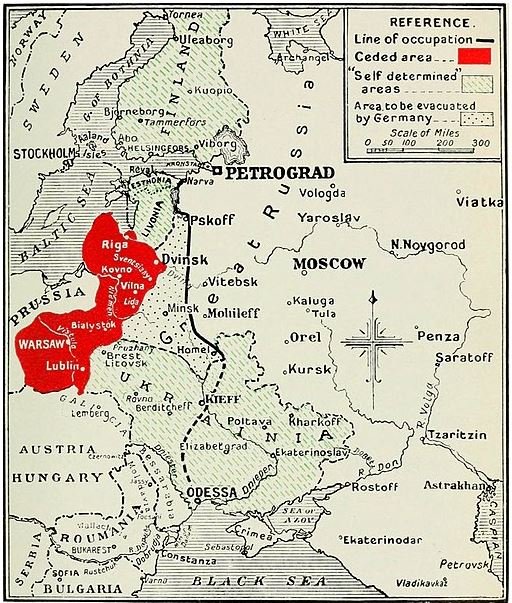
Image: Key borders created during the Treaty of Brest-Litovsk.
What led Russia to negotiate the Treaty of Brest-Litovsk?
Russia had suffered immense casualties, economic collapse, and widespread discontent from World War I, pushing the new Bolshevik government to seek an immediate end to the fighting on the Eastern Front.
Who participated in negotiating the treaty?
Negotiations took place between Soviet Russia, represented at various times by Adolph Joffe and Leon Trotsky, and the Central Powers, including Germany, Austria-Hungary, the Ottoman Empire, and Bulgaria, with key figures such as Richard von Kühlmann, Max Hoffmann, Ottokar Czernin, and Talaat Pasha.
What were the main territorial losses for Russia under the treaty?
Russia was forced to relinquish vast territories, including Ukraine, the Baltic states, parts of Belarus and Poland, and some areas in the Caucasus, amounting to significant losses in population, industry, and resources.
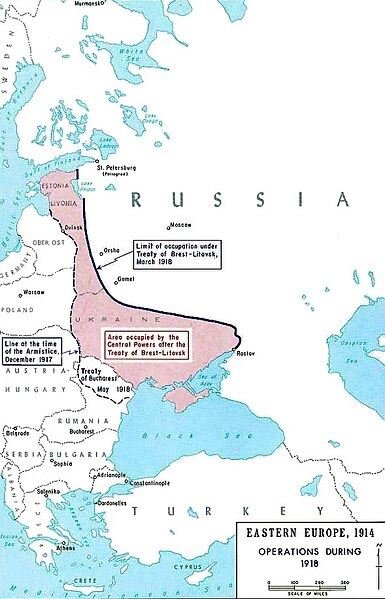
Image: A map showing Russia’s territories lost after the treaty.
How did the treaty affect Russian domestic politics?
The harsh terms intensified divisions within the Soviet leadership, alienated the Left Socialist-Revolutionaries, fueled opposition from anti-Bolshevik forces, and contributed to internal unrest that would help spark and sustain the Russian Civil War.
Why did the Germans want such sweeping territorial concessions?
Germany and the other Central Powers aimed to create buffer states, secure resources, and preempt future Russian threats, hoping to consolidate their eastern frontiers into spheres of influence or client states.
How did the treaty influence the outcome of World War I?
While it freed German troops to move west, the difficulties of occupying the vast territories and the eventual Allied successes on the Western Front meant the treaty’s strategic advantages were short-lived, and it did not prevent Germany’s ultimate defeat.
What happened to the treaty after Germany’s surrender in 1918?
The Armistice of 11 November 1918 effectively nullified the treaty, allowing the Bolsheviks to reject its terms and later attempt to reassert control over lost territories, although with mixed results.





