The Twelve Tribes of Israel
The Twelve Tribes of Israel are the descendants of the biblical patriarch Jacob, also referred to as Israel. According to Hebrew scriptures, these tribes collectively form the Israelite nation. Considered a prophet in Abrahamic religions, Jacob fathered twelve sons through his wives Leah and Rachel, as well as his concubines Bilhah and Zilpah. However, in modern scholarship, there is debate regarding whether these tribes were historical entities or part of a symbolic tradition in Israelite national mythology.
Genealogy of the Twelve Tribes
Jacob, the son of Isaac and Rebecca and the grandson of Abraham and Sarah, had twelve sons who became the progenitors of the twelve tribes. These sons were born to different mothers as follows:
- Leah: Reuben, Simeon, Levi, Judah, Issachar, Zebulun
- Rachel: Joseph, Benjamin
- Bilhah (Rachel’s handmaid): Dan, Naphtali
- Zilpah (Leah’s handmaid): Gad, Asher
Joseph, who was particularly favored by Jacob, received a double inheritance. His two sons, Ephraim and Manasseh, were elevated to the status of full tribes in their own right, effectively replacing Joseph’s name in tribal lists. This rearrangement meant that the Levites, who were set apart for religious duties, did not receive a designated tribal land but instead were given cities among the other tribes.

An illustration by Flemish artist Adam van Noort, depicting Jacob blessing his 12 sons.
The Tribes and Their Allotted Lands
Following the conquest of Canaan, the land was divided among the tribes. The book of Joshua details how the territory was distributed:
- Reuben: East of the Jordan River
- Simeon: Inside Judah’s territory in the south
- Ephraim: Central hill country
- Judah: Southern Canaan
- Issachar: North-central region
- Zebulun: North of Issachar
- Dan: Initially near the Philistine coast, later moved northward
- Naphtali: Galilee region
- Gad: East of the Jordan River
- Asher: Coastal northern Canaan
- Manasseh: Both sides of the Jordan River
- Benjamin: Between Judah and Ephraim
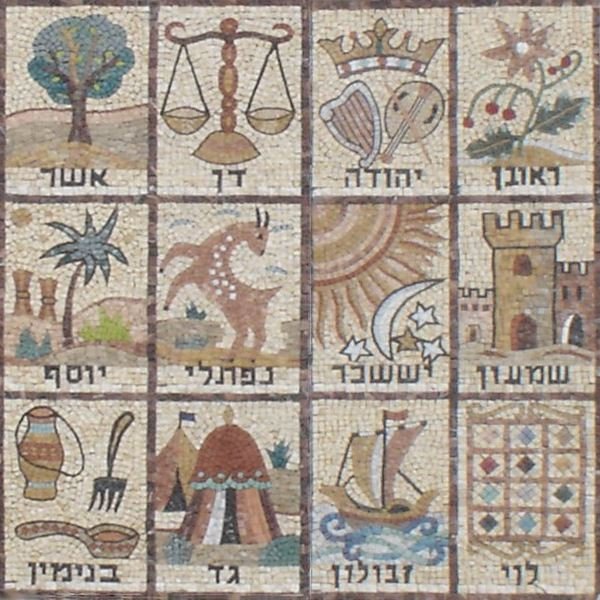
A mosaic work portraying the Twelve Tribes of Israel alongside their symbolic images.
The Levites were given cities of refuge and lands scattered among the other tribes rather than a contiguous territory of their own.
The Tribes in the Historical and Religious Context
During the period of the Judges, the tribes functioned as a loose confederation. Leadership was sporadic, with judges emerging during times of crisis. Eventually, the tribes united under the monarchy of King Saul, which was later solidified under David and Solomon. After Solomon’s reign, the kingdom split into the northern Kingdom of Israel (containing ten tribes) and the southern Kingdom of Judah (containing Judah and Benjamin).
The Exile and Dispersion
With the Assyrian conquest of the northern kingdom in 722 BCE, the ten northern tribes were exiled, leading to their historical disappearance, often referred to as the “Lost Tribes of Israel.” Judah and Benjamin remained in the southern kingdom, which was later exiled to Babylon in 586 BCE, though many returned to the land of Israel under Persian rule.
Symbols and Tribal Emblems
Each tribe was associated with a unique emblem or symbol, some of which were based on Jacob’s blessings:
- Reuben: Water (symbolizing instability)
- Simeon: Gates of Shechem
- Levi: Thummim and Urim (priestly symbols)
- Judah: Lion
- Issachar: Donkey
- Zebulun: Ship
- Dan: Snake
- Naphtali: Deer
- Gad: Army or warrior
- Asher: Olive tree
- Benjamin: Wolf
- Joseph: Bull (represented by Ephraim and Manasseh)
The Twelve Tribes in Different Religious Traditions
In Christianity
The New Testament references the twelve tribes multiple times. Jesus promises his disciples that they will “judge the twelve tribes of Israel” in the Kingdom of God (Luke 22:30, Matthew 19:28). The Book of Revelation lists twelve tribes (excluding Dan) as those who will be sealed for salvation.
In Islam
The Quran acknowledges the twelve tribes in Surah Al-A’raf (7:160), where it describes Moses dividing his people into twelve groups, each provided with its own drinking source.
Scholarly Perspectives on the Historicity of the Twelve Tribes
Modern scholars debate the literal existence of the twelve tribes. Some theories include:
- Symbolic Interpretation: The number twelve was likely a symbolic construct, paralleling duodecimal counting systems in Near Eastern cultures.
- Postdiction Hypothesis: Some scholars argue that the tribes were retroactively grouped to fit the biblical narrative.
- Administrative Division Theory: It has been proposed that the division of Israel into twelve tribes may have originated under the rule of King David as an administrative structure rather than as historical lineages.
Whether seen as historical entities or as part of a theological construct, the legacy of the Twelve Tribes of Israel has influenced Judaism, Christianity, and Islam.
The Lost Tribes and Modern Claims
Many groups around the world claim descent from the lost tribes, including:
- Samaritans: Claim partial descent from Ephraim and Manasseh.
- Pashtun Tribes (Afghanistan and Pakistan): Some traditions suggest a link to the lost tribes.
- Bnei Menashe (India): Claim descent from Manasseh.
- Beta Israel (Ethiopian Jews): Traditionally linked to the tribe of Dan.
Lion of Judah: Origin Story, Meaning, Symbolism and Significance
Frequently Asked Questions
How were the Twelve Tribes of Israel formed?
Jacob had twelve sons through his wives Leah and Rachel and their handmaids Bilhah and Zilpah. These sons became the patriarchs of the twelve tribes. Joseph’s tribe was later divided into Ephraim and Manasseh, making up twelve distinct tribal groups.
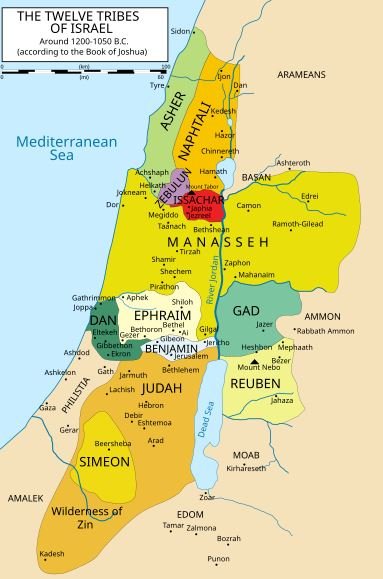
Joshua’s division of territory among the tribes of Israel.
Did all Twelve Tribes receive land in Israel?
No. The Tribe of Levi did not receive land but was given priestly duties, and Joseph’s inheritance was divided between his sons, Ephraim and Manasseh. This resulted in twelve land allotments.
What happened to the Twelve Tribes?
After the conquest of Canaan, the tribes lived as a confederation. Following the Assyrian conquest (8th century BCE), ten tribes were lost to history. Only Judah, Benjamin, and remnants of Levi remained identifiable after the Babylonian exile.
Why is there skepticism about the Twelve Tribes’ historical accuracy?
Some scholars argue the twelve-tribe structure was symbolic rather than historical, possibly created as a national founding myth. Others point to inconsistencies in biblical lists and historical evidence challenging their distinct existence.
What is the significance of the Twelve Tribes in Christianity?
In the New Testament, Jesus refers to his disciples ruling over the twelve tribes in God’s kingdom. Revelation 7 describes 12,000 from each tribe being sealed for salvation, though Dan is omitted.
How are the Twelve Tribes referenced in Islam?
The Quran (Surah 7:160) mentions that the people of Moses were divided into twelve tribes, each provided with a source of water, signifying their distinct identities in the early Israelite community.
READ MORE: History of Islam: How and When Did Islam Begin?
Are there modern groups claiming descent from the Twelve Tribes?
Yes. Ethiopian Jews (Beta Israel) claim descent from Dan, the Bene Ephraim in India claim lineage from Ephraim, and some Samaritan and Persian Jewish communities associate with Ephraim and Manasseh. Genetic studies suggest Levites share a common ancestor from the Middle East.





