The War of Jenkins’ Ear
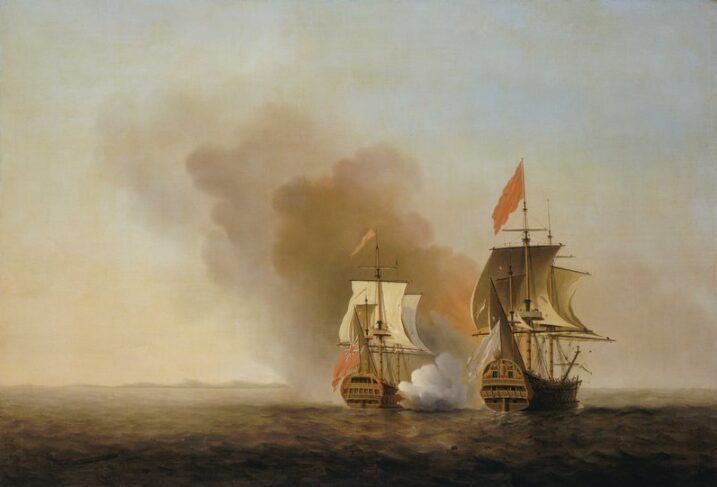
The War of Jenkins’ Ear (Spanish: Guerra del Asiento, meaning “War of the Agreement”) was a conflict between Britain and Spain, lasting from 1739 to 1748. Image: George Anson’s capture of the Manila galleon, painted by British landscape painter Samuel Scott before 1772
The War of Jenkins’ Ear (1739–1748) was a conflict between Great Britain and Spain, which initially stemmed from disputes over trade in the Caribbean and along the Spanish Main (the northern coast of South America). Though it is one of the lesser-known wars in European history, its events played a significant role in the broader conflict of the 18th century and contributed to the larger War of the Austrian Succession (1740–1748).
The war is most famously known for its unusual and dramatic name, which derives from a notorious incident involving Robert Jenkins, a British merchant captain. His severed ear became a symbol of British grievances against Spanish actions in the Americas, leading to heightened tensions and ultimately war.
Background and Causes
The War of Jenkins’ Ear was rooted in long-standing economic and territorial rivalries between Spain and Britain in the Americas. Throughout the 17th and early 18th centuries, Spain held a vast colonial empire in the Americas, including the lucrative territories of New Spain (modern-day Mexico and much of Central America), Peru, and parts of the Caribbean. These regions were crucial to Spain’s economy, as they provided valuable goods such as silver, gold, and agricultural products.
At the same time, Britain was emerging as a global maritime and colonial power, and it sought to expand its influence and trade in the Americas. Spanish colonial policies, particularly the enforcement of its monopoly on trade with its American colonies, created tension between the two nations. Under the terms of various treaties, Spain strictly regulated trade between its colonies and other nations, attempting to keep foreign merchants out of its markets. However, British traders, eager to profit from the growing demand for goods in the New World, frequently engaged in illegal smuggling in Spanish territories.
To curb this smuggling, Spain authorized its coastguard (the Guardacostas) to patrol its waters and enforce its trade laws. This resulted in numerous seizures of British ships and the mistreatment of British sailors, escalating tensions between the two nations.

Most of the fighting during the War of Jenkins’ Ear took place in New Granada and the Caribbean Sea, with major operations effectively ending by 1742. Image: Sir Robert Walpole
The Jenkins Incident (1731)
The specific incident that gave the war its name occurred in 1731. Robert Jenkins, the captain of a British merchant ship, was sailing off the coast of Florida when his vessel was boarded by Spanish coastguards. The Spanish accused Jenkins of smuggling, and in the course of the confrontation, they allegedly cut off his ear. According to reports, the Spanish officer who mutilated Jenkins warned him to tell his king (George II) that the same fate awaited any other British smugglers caught in Spanish waters.
Jenkins later returned to Britain, and in 1738, he appeared before Parliament to testify about his experience. During the hearing, he supposedly presented his severed ear as evidence of Spanish atrocities. Though some modern historians question the veracity of this account, the incident helped inflame British public opinion against Spain. Jenkins’ mutilation became a symbol of Spanish abuses and galvanized calls for retaliation against Spain’s treatment of British merchants.

Image: Robert Jenkins presents his severed ear to a disinterested Prime Minister Robert Walpole, while an associate ignores the scene, engaging with a lady. Satirical Cartoon, 1738, British Museum.
Political Tensions and the Road to War
The Jenkins incident, though dramatic, was part of a broader context of growing Anglo-Spanish tensions. In the early 18th century, Britain had been granted the Asiento de Negros, a contract that allowed British merchants to supply enslaved Africans to Spain’s American colonies. This contract was part of the Treaty of Utrecht (1713), which had ended the War of the Spanish Succession. However, disputes arose over the terms of the Asiento, particularly regarding British rights to trade goods in Spanish America.
In addition to tensions over trade, Britain and Spain were at odds over territorial claims in North America and the Caribbean. Spain controlled Florida and much of the Gulf Coast, while Britain held colonies along the eastern seaboard of North America, from Georgia to Massachusetts. The Spanish Main (the northern coast of South America) and the Caribbean islands were also key points of contention, as both powers sought to control the lucrative trade routes and resources of the region.
By the late 1730s, the British government, led by Prime Minister Sir Robert Walpole, faced increasing pressure to take action against Spain. Walpole, a pragmatic leader who preferred diplomacy to war, had tried to negotiate with Spain over trade disputes. However, the public outrage over the Jenkins incident, combined with pressure from influential political and economic interests (such as merchants and colonial leaders), made war seem inevitable.
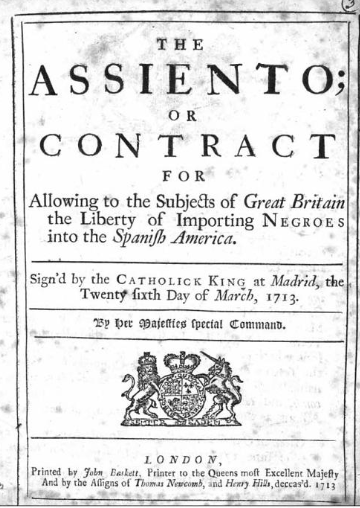
Though initially overlooked, British opposition politicians later used Jenkins’ incident to rally support for war with Spain, driven by economic motives, particularly expanding Caribbean trade and retaining the Asiento de Negros. Image: Cover of the 1713 English translation of the Asiento contract, signed as part of the Treaty of Utrecht, granting Britain exclusive rights to sell slaves in the Spanish Indies.
The Outbreak of War (1739)
In October 1739, after years of diplomatic wrangling, Britain formally declared war on Spain, marking the start of the War of Jenkins’ Ear. The war was initially limited to the Caribbean and North America, where British and Spanish forces clashed over control of trade routes, colonies, and strategic naval bases.
One of the early British objectives was to disrupt Spain’s trade and weaken its colonial power by attacking key ports and fortresses in the Caribbean. The Royal Navy, commanded by Admiral Edward Vernon, played a central role in British strategy. Vernon’s forces targeted Spanish colonies in the Caribbean, including Portobelo (in modern-day Panama) and Cartagena de Indias (in modern-day Colombia).
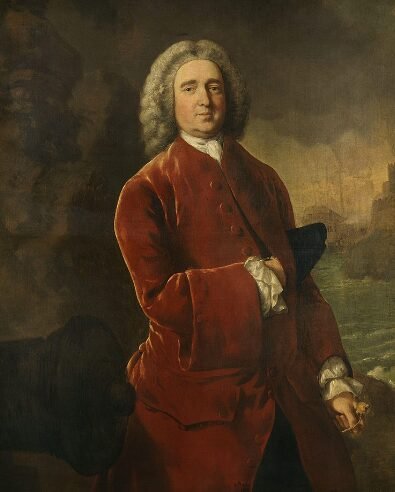
Admiral Edward “Old Grog” Vernon. Portrait by English portrait painter Thomas Gainsborough
The Capture of Portobelo (1739)
One of the earliest and most notable British successes in the war was the capture of Portobelo in November 1739. Portobelo was a key Spanish port on the Isthmus of Panama, used to transport silver from the mines of Peru to Spain. Admiral Vernon led a surprise attack on the port, which was defended by a small Spanish garrison. The British forces quickly overran the defenders, and the town fell after a brief battle.
The capture of Portobelo was celebrated in Britain as a major victory. Vernon became a national hero, and the operation was hailed as a blow to Spanish commerce in the Americas. The success at Portobelo encouraged further British attacks on Spanish colonies in the Caribbean and raised hopes that the war would be a quick and decisive victory for Britain.
The Cartagena Expedition (1741)
Buoyed by the success at Portobelo, the British government decided to launch a more ambitious campaign against the Spanish stronghold of Cartagena de Indias on the northern coast of South America. Cartagena was one of Spain’s most heavily fortified ports in the Americas and a key hub for the transatlantic trade of goods and silver.
In March 1741, Admiral Vernon led a massive British fleet, consisting of over 180 ships and 27,000 troops, in an attempt to capture Cartagena. The British forces included American colonial troops, such as the famous Georgia regiment led by James Oglethorpe. The British hoped that the capture of Cartagena would cripple Spanish defenses in the Caribbean and open the way for further conquests.
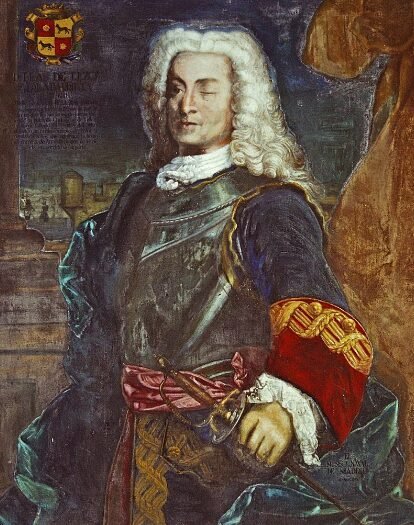
Portrait of Spanish Admiral Blas de Lezo, Museo Naval de Madrid
However, the Cartagena expedition ended in disaster for the British. The Spanish defenders, led by Blas de Lezo, a brilliant and determined admiral, successfully repelled the British assault. Lezo, despite being severely outnumbered, used Cartagena’s strong fortifications and his knowledge of the terrain to his advantage. The British forces, hampered by poor coordination, tropical diseases, and logistical difficulties, were unable to break through the Spanish defenses.
After weeks of brutal fighting, Vernon was forced to abandon the siege and withdraw. The failure at Cartagena was a major blow to British morale and marked a turning point in the war. The defeat underscored the difficulties of conducting large-scale military operations in the Caribbean and demonstrated the resilience of Spanish colonial defenses.
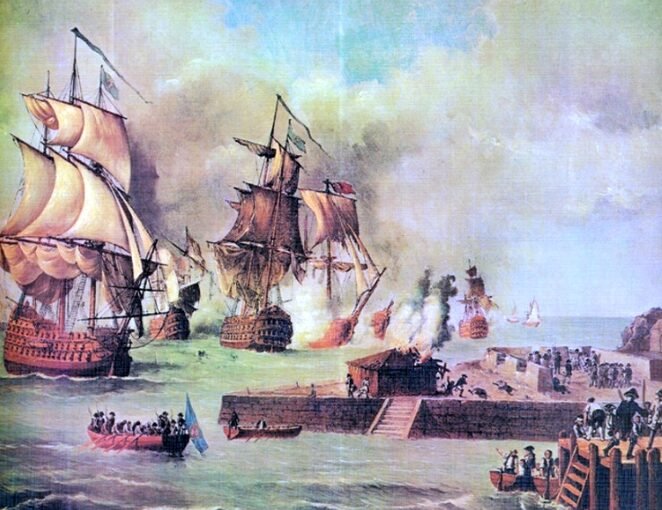
Backed by the South Sea Company, the British saw war as a chance to expand in the Americas. The 1741 Battle of Cartagena ended disastrously, with heavy losses, halting further major operations. Image: British attack on Cartagena de Indias by Luis Fernández Gordillo. Oil on canvas, Naval Museum of Madrid
The War in North America and the Caribbean
While the Caribbean was a primary theater of the war, the conflict also extended to North America, particularly in the area around Florida and Georgia. In 1732, Britain had established the colony of Georgia as a buffer between Spanish Florida and British South Carolina. The war provided an opportunity for both sides to assert their territorial claims in this region.
In 1742, Spanish forces launched an invasion of Georgia, hoping to capture the British colony and expand their influence along the eastern seaboard. The Spanish, led by Governor Manuel de Montiano, landed on St. Simons Island in Georgia and attempted to march inland. However, the British forces, under the command of James Oglethorpe, successfully repelled the Spanish at the Battle of Bloody Marsh. This victory secured Georgia for the British and ended Spanish ambitions in the region.
The war also saw naval engagements and privateering in the Caribbean, as both sides sought to disrupt each other’s trade. British and Spanish privateers attacked merchant ships and coastal settlements, contributing to the broader economic impact of the conflict.
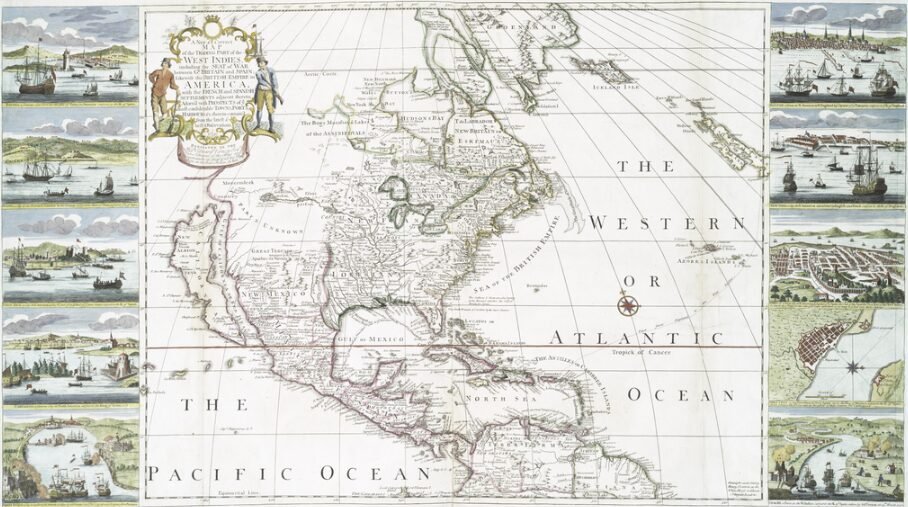
Beyond the Caribbean, there were smaller skirmishes in Florida, Georgia, and Havana, but after 1742, the war gradually merged into the larger War of the Austrian Succession, involving most of Europe’s major powers. The conflict officially ended in 1748 with the Treaty of Aix-la-Chapelle, which largely restored the pre-war conditions. Image: Trade map of the West Indies and North America during the war, 1741
The War’s Link to the War of the Austrian Succession (1740-1748)
Although the War of Jenkins’ Ear began as a limited conflict between Britain and Spain, it soon became entangled in the much larger War of the Austrian Succession (1740–1748). The War of the Austrian Succession was a major European conflict involving most of the great powers of the time, including Britain, Spain, France, Austria, and Prussia. The two wars became intertwined as Britain and Spain’s respective allies were drawn into the broader conflict.
The War of Jenkins’ Ear essentially merged with the War of the Austrian Succession, as Britain and Spain continued to fight in the Caribbean, North America, and Europe. The combined conflict stretched British resources and shifted the focus away from the initial objectives of the war.
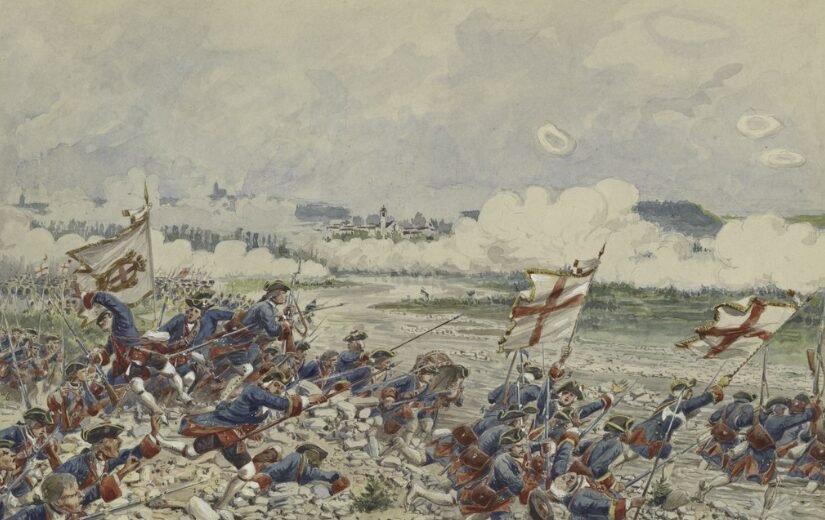
The Genoese charge during the Battle of Bassignano in 1745
The End of the War and the Treaty of Aix-la-Chapelle (1748)
By the mid-1740s, the war had reached a stalemate, with neither side able to achieve a decisive victory. Britain’s hopes of conquering significant Spanish territories in the Americas had faded, and both nations were eager to bring an end to the costly conflict. The war, combined with the ongoing War of the Austrian Succession, had drained resources and strained diplomatic relations.
In 1748, the war came to an end with the signing of the Treaty of Aix-la-Chapelle, which concluded the War of the Austrian Succession. The treaty essentially restored the status quo between Britain and Spain, with no significant territorial changes. Spain agreed to renew the Asiento de Negros, allowing British merchants to continue supplying enslaved Africans to Spanish colonies. However, the broader issues of trade and territorial disputes in the Americas were left unresolved, setting the stage for future conflicts between the two powers.

Image: Jacques Dumont – Allégorie en l’honneur de la publication de la paix d’Aix-la-Chapelle
Major Facts about the War of Jenkins’ Ear
- Origin of the War’s Name: The war is named after Robert Jenkins, a British merchant captain whose ear was allegedly cut off by Spanish coastguards in 1731. The incident became a rallying cry for British grievances against Spain and was used to justify the declaration of war in 1739.
- Caribbean Focus: The war was primarily fought in the Caribbean and along the Spanish Main, where Britain and Spain vied for control of trade routes and colonial possessions. Key battles included the capture of Portobelo in 1739 and the disastrous British attempt to seize Cartagena in 1741.
- Failure of the Cartagena Expedition: The British siege of Cartagena was one of the largest military operations of the war, involving a fleet of over 180 ships and 27,000 troops. Despite their numerical advantage, the British were defeated by the Spanish defenders, led by Blas de Lezo. The failure at Cartagena marked a major setback for British ambitions in the Caribbean.
- Conflict in North America: The war also extended to North America, where British and Spanish forces clashed in Florida and Georgia. The Battle of Bloody Marsh in 1742 saw British forces under James Oglethorpe successfully repel a Spanish invasion of Georgia, securing the colony for Britain.
- Connection to the War of the Austrian Succession: The War of Jenkins’ Ear became entangled with the War of the Austrian Succession, a larger European conflict that involved most of the great powers. The two wars effectively merged, leading to a prolonged and complicated conflict that stretched from Europe to the Americas.
- Treaty of Aix-la-Chapelle: The war ended in 1748 with the signing of the Treaty of Aix-la-Chapelle, which restored the status quo between Britain and Spain. The treaty did not resolve the underlying issues of trade and territorial disputes, leaving tensions between the two powers unresolved.
- Legacy of the War: While the War of Jenkins’ Ear is often overshadowed by other 18th-century conflicts, it played a key role in shaping the geopolitical landscape of the Caribbean and North America. The war highlighted the growing importance of colonial trade and set the stage for future conflicts between Britain, Spain, and other European powers in the Americas.

Image: Map of Europe in the years after the Treaty of Aix-la-Chapelle in 1748
Conclusion
The War of Jenkins’ Ear was a significant, though often overlooked, conflict in the history of 18th-century European colonialism. It stemmed from long-standing trade disputes between Britain and Spain and was fueled by economic interests, territorial ambitions, and the desire to control the lucrative markets of the Americas. Although the war’s most famous cause—the severing of Robert Jenkins’ ear—was a relatively minor incident, it symbolized the broader tensions between the two empires.
The war had mixed results for both sides. While Britain achieved some initial victories, such as the capture of Portobelo, its broader objectives of territorial conquest in the Americas were largely unfulfilled, as demonstrated by the failure at Cartagena. In the end, the war was subsumed by the larger War of the Austrian Succession, and the eventual peace settlement restored the status quo without addressing the underlying causes of the conflict.
Despite its relative obscurity in popular history, the War of Jenkins’ Ear had a lasting impact on the development of British and Spanish colonial policies in the Americas. It also served as a precursor to later, more well-known conflicts between the two powers, such as the Seven Years’ War and the American War of Independence.
Questions and Answers
What were the War of Jenkins’ Ear and the War of the Austrian Succession?
The War of Jenkins’ Ear (1739–1748) was a colonial conflict between Britain and Spain, primarily fought over trade and territorial disputes in the Caribbean and North America. The War of the Austrian Succession (1740–1748) was a European war sparked by the disputed succession of Maria Theresa to the Austrian throne, involving multiple European powers.
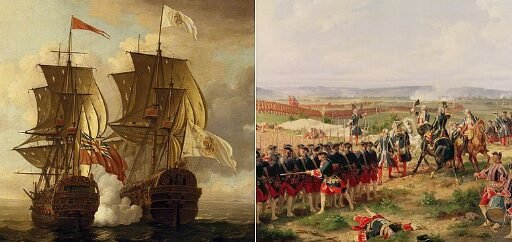
The War of Jenkins’ Ear is often linked to the War of the Austrian Succession (1740–1748), a broader European conflict. Image: War of Austrian Succession (1740 – 1748)
How did the War of Jenkins’ Ear get its name?
The war was named after an incident in 1731 when Spanish coastguards captured British merchant captain Robert Jenkins and cut off his ear, telling him to present it to King George II as a warning. This event heightened tensions between Britain and Spain.
What were the primary theaters of conflict during the War of Jenkins’ Ear?
The War of Jenkins’ Ear was primarily fought in the Caribbean Sea, where naval battles occurred, and along the frontier between Spanish Florida and the British colony of Georgia.
What sparked the War of the Austrian Succession?
The War of the Austrian Succession began in 1740 when European powers, including France and Prussia, challenged the legitimacy of Maria Theresa’s succession to the Austrian throne after the death of Emperor Charles VI.
How did the War of Jenkins’ Ear and the War of the Austrian Succession become connected?
The two wars became linked when Spain allied with France during the War of the Austrian Succession, drawing Britain into the broader European conflict. Britain formally declared war on France in 1744, extending the conflict into North America.
What was the most significant campaign in North America during these wars?
The Siege of Louisbourg in 1745 was a key event. British colonial forces from New England, under William Pepperell, captured the French fortress of Louisbourg on Cape Breton Island, severely weakening French influence in North America.
How did the French retaliate after the British victory at Louisbourg?
In retaliation, French and Wabanaki Confederacy forces launched raids on British settlements in Maine and Nova Scotia, including the Northeast Coast Campaign of 1745 and the attack on Saratoga, New York, where over 100 British settlers were killed or captured.
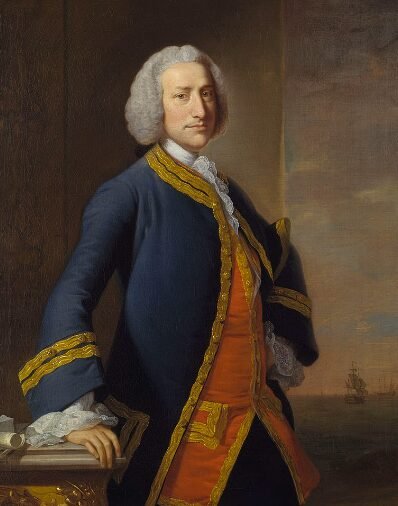
Great Britain failed to achieve its goals as Spain defended its American territories. However, Admiral George Anson’s 1740-1744 global voyage remains a celebrated event in British naval history. Image: Portrait of Lord Anson by English portrait painter Thomas Hudson
What were the terms of the Treaty of Aix-la-Chapelle in 1748?
The Treaty of Aix-la-Chapelle ended both wars, restoring all colonial boundaries to their pre-war status. This included returning the captured fortress of Louisbourg to France in exchange for Madras in India, which had been taken by the French.
Why were the British colonists in New England upset by the treaty?
New England colonists, particularly those from Massachusetts, felt betrayed by the British government’s decision to return Louisbourg to France after they had successfully captured it during the war.
What conflict followed the War of Jenkins’ Ear and the War of the Austrian Succession?
The unresolved tensions between Britain, France, and Spain led to the French and Indian War in 1754, which eventually expanded into the global conflict known as the Seven Years’ War (1756–1763).

While the War of Jenkins’ Ear did not dramatically alter the balance of power in the Americas, it is an example of how colonial trade and European power struggles in the 18th century frequently escalated into wider conflicts. Image: Lieutenant-General James Edward Oglethorpe