Tomb Paintings from the Etruscan Civilization
The Etruscans, an ancient civilization that flourished in central Italy between the 8th and 3rd centuries BCE, are renowned for their rich cultural heritage, particularly their elaborate funerary practices. Among the most significant remnants of their civilization are the tomb paintings, which offer profound insights into their daily life, religious beliefs, and artistic achievements.
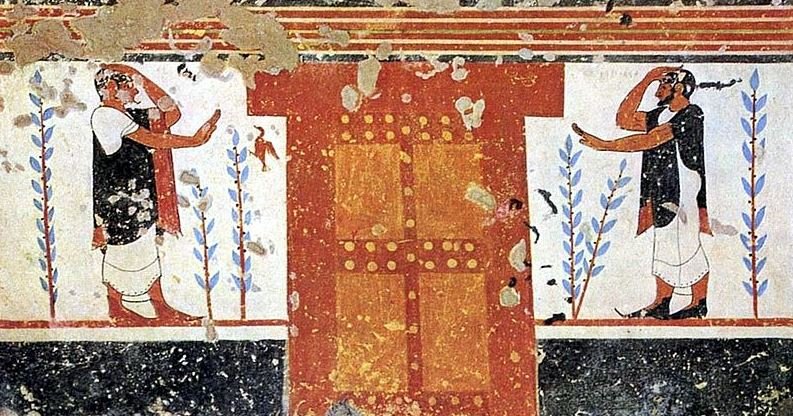
Tomb of the Augurs
Historical Context
Emerging from the Villanovan culture around 900 BCE, the Etruscans established a network of city-states in regions corresponding to modern-day Tuscany, Lazio, and parts of Umbria. Their society was characterized by a high degree of urbanization, advanced metallurgy, and extensive trade networks, notably with the Greeks and Phoenicians. These interactions profoundly influenced Etruscan art and culture, as evidenced in their tomb paintings.
Purpose and Significance of Tomb Paintings
Etruscan tombs were not merely final resting places but were designed as eternal homes for the deceased. The walls of these tombs were adorned with vibrant frescoes depicting various scenes, serving multiple purposes:
- Celebration of Life: Many frescoes illustrate banquets, dances, and musical performances, reflecting the Etruscan appreciation for life’s pleasures and the belief in an afterlife where such joys continued.
- Religious and Mythological Narratives: Some paintings portray deities, demons, and mythological scenes, indicating religious beliefs and the importance of the afterlife in Etruscan culture.
- Social Status and Identity: The inclusion of specific symbols, attire, and activities in the frescoes often signified the social standing and personal achievements of the deceased.
Artistic Techniques and Styles
Etruscan artists employed the fresco technique, applying pigments onto wet plaster, which allowed the colors to penetrate the surface and remain vibrant over millennia. Their style evolved over time, influenced by interactions with neighboring cultures:
- Archaic Period (6th century BCE): Characterized by stiff, formal figures with stylized features, reflecting early Greek influences.
- Classical Period (5th–4th centuries BCE): Figures became more naturalistic, with attention to proportion and movement, indicating a shift towards realism.
- Hellenistic Period (3rd–2nd centuries BCE): Incorporation of dramatic expressions and complex compositions, showcasing advanced artistic techniques.
Notable Tombs and Their Frescoes
Several Etruscan tombs stand out for their exceptional frescoes:
- Tomb of the Leopards (c. 470–450 BCE): Located in the Monterozzi necropolis near Tarquinia, this tomb features a banquet scene with male and female figures reclining, attended by servants and musicians. Above them, two leopards are depicted confronting each other, symbolizing protection. The vibrant colors and dynamic composition reflect the Etruscan celebration of life and the afterlife.
- Tomb of the Augurs (c. 530–520 BCE): Also situated in Tarquinia, this tomb presents scenes interpreted as funerary games, including wrestling matches and a depiction of a man bidding farewell, possibly representing the deceased’s journey to the afterlife.
- Tomb of Hunting and Fishing (c. 510 BCE): This tomb showcases scenes of youths engaging in hunting and fishing activities, set against a backdrop of nature. The frescoes highlight the Etruscan appreciation for nature and the belief in a pleasurable afterlife.
- François Tomb (late 4th century BCE): Discovered in Vulci, this tomb is renowned for its complex frescoes depicting mythological and historical scenes, including battles and heroic figures. The detailed representations provide insights into Etruscan mythology and their interpretation of historical events.
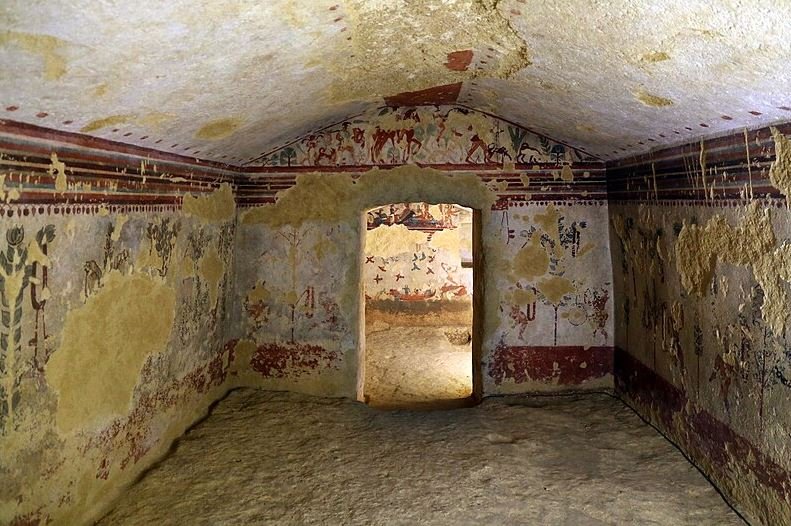
Tomb of Hunting and Fishing.
Themes and Symbolism
Etruscan tomb paintings encompass a range of themes, each laden with symbolism:
- Banquets and Feasting: Symbolize the continuation of life’s pleasures in the afterlife and the social status of the deceased.
- Dancing and Music: Reflect the joy of life and possibly rituals associated with funerary practices.
- Hunting and Fishing: May represent prowess and the harmony between humans and nature, as well as the provision of sustenance in the afterlife.
- Mythological Scenes: Depict deities, demons, and heroes, illustrating religious beliefs and moral lessons.
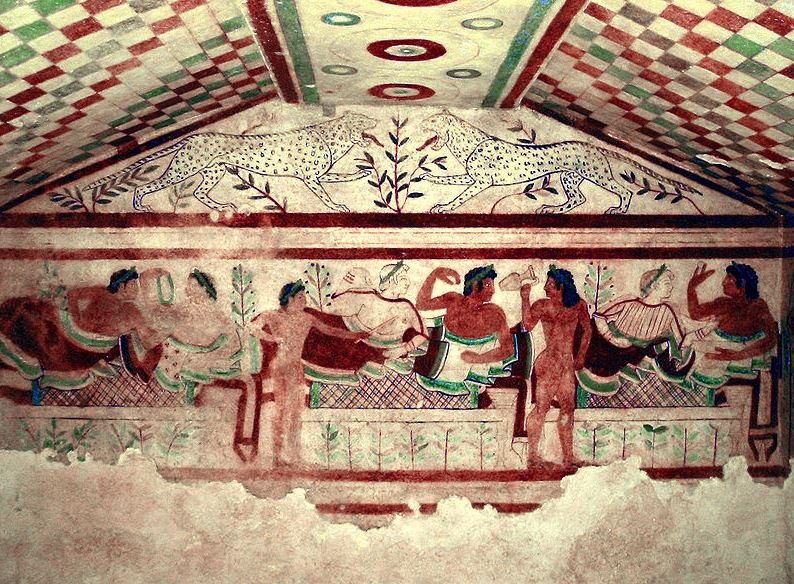
Leopards depicted watching over a feast in the Tomb of the Leopards.
Preservation and Legacy
The preservation of Etruscan tomb paintings has been a challenge due to factors such as environmental conditions, tomb robbing, and the passage of time. However, many frescoes have survived, providing invaluable insights into Etruscan culture. Modern conservation efforts focus on preserving these artworks through controlled environments and advanced restoration techniques.
Etruscan tomb paintings are not merely decorative art; they are profound narratives that encapsulate the essence of Etruscan society.
The legacy of Etruscan tomb paintings is evident in their influence on Roman art and their contribution to our understanding of ancient Italic cultures. The vivid depictions offer a window into the Etruscan way of life, their beliefs, and their artistic achievements, underscoring the sophistication of this ancient civilization.
Questions and answers
What is the significance of Etruscan tomb paintings?
Etruscan tomb paintings provide valuable insights into the civilization’s mythology, daily life, and beliefs about the afterlife. They offer a rare glimpse into a culture that was eventually assimilated by the Romans, leaving limited traces of its distinct heritage.
Which notable sites house Etruscan tomb paintings?
Prominent sites include Tarquinia, Cerveteri, Chiusi, and Vulci, where tombs are adorned with vibrant frescoes depicting various aspects of Etruscan life and beliefs.
What technique did Etruscan artists use for their tomb paintings?
Etruscan artists primarily employed the fresco technique, applying pigments onto wet plaster, allowing the colors to bond with the wall surface, ensuring durability.
Etruscan tomb paintings have significantly influenced our understanding of ancient Italic cultures and have left a lasting impact on Roman art.
From what sources were the pigments derived?
Pigments were derived from various organic and mineral sources:
- White: Chalk or kaolin
- Black: Vegetable mixtures
- Green: Malachite
- Red, Ochre, and Yellow: Iron oxides
- Blue: Rarely used, possibly made from imported materials
How did Etruscan painting techniques evolve over time?
Initially, Etruscan paintings exhibited minimal shading. By the 4th century BCE, under Greek influence, artists began incorporating chiaroscuro techniques, introducing strong contrasts between light and dark to create a sense of depth and volume.
What were the artistic practices in different Etruscan cities?
In Tarquinia, artists applied a thin plaster base layer before sketching outlines with chalk or charcoal. In contrast, in Cerveteri and Veii, many paintings were executed directly onto stone walls without a plaster foundation, leading to greater deterioration over time.
What purposes did these tomb paintings serve?
These paintings, found in about 3% of Etruscan tombs, were likely commissioned by the elite to demonstrate their wealth and status during burial ceremonies. Beyond displaying affluence, the artworks reflect beliefs in an afterlife and were intended to comfort and assist the deceased on their journey to the next world.
What common themes are depicted in Etruscan tomb paintings?
Common themes include:
- Banquets and Feasting: Reclining diners enjoying meals and drinks
- Dancing and Music: Figures engaging in dance accompanied by musicians
- Hunting and Fishing: Individuals partaking in these pursuits
- Sporting Events: Depictions of running, jumping, wrestling, boxing, and discus throwing
What are some notable Etruscan tombs and their features?
Notable tombs include:
- Tomb of the Leopards (early 5th century BCE, Tarquinia): Features a banquet scene with male and female figures reclining, attended by servants and musicians. Above them, two leopards are depicted confronting each other, symbolizing protection.
- Tomb of the Monkey (480–470 BCE, Chiusi): Depicts a woman under a parasol observing a parade of jugglers, athletes, dancers, and chariots, offering insights into Etruscan social life and entertainment.
- François Tomb (late 4th century BCE, Vulci): Renowned for its complex frescoes depicting mythological and historical scenes, including battles and heroic figures. The detailed representations provide insights into Etruscan mythology and their interpretation of historical events.