What units of measurement did the Romans use?
The units of measurement in ancient Rome were well-documented and generally consistent across the empire. Roman measurements encompassed length, area, volume, weight, and time, each playing a crucial role in commerce, construction, and daily life. These standardized units facilitated trade, engineering projects, and military logistics, contributing to Rome’s efficiency and expansion.
Length
The fundamental unit of linear measurement in Rome was the pes (plural: pedes), or Roman foot. This unit was extensively studied by scholars, including John Greaves in the 17th century, who examined various Roman artifacts to determine its exact length. The generally accepted modern value of the pes monetalis (standard Roman foot) is approximately 296 mm.
The Roman foot was divided into smaller units:
- Digitus (finger) – 1/16 of a foot (18.5 mm)
- Uncia (inch or thumb) – 1/12 of a foot (24.6 mm)
- Palmus minor (palm) – 1/4 of a foot (74 mm)
- Palmipes (foot and a palm) – 1 1/4 feet (370 mm)
- Cubitum (cubit) – 1 1/2 feet (444 mm)
- Gradus (step) – 2 1/2 feet (740 mm)
- Passus (pace) – 5 feet (1.48 m)
- Decempeda (perch) – 10 feet (2.96 m)
- Mille passus (Roman mile) – 5,000 feet (1.48 km)
- Leuga (league) – 7,500 feet (2.22 km)
The Romans also used a unit called the schoenus, which varied in value but was typically used for measuring long distances, particularly in Egypt and Nubia.
Area
Roman area measurements were derived from square versions of length units, with the most common being the pes quadratus (square foot). Larger units were employed for land measurement, crucial for agriculture and taxation.
Key units of area included:
- Pes quadratus (square foot) – 0.0876 m²
- Scrupulum (100 square feet) – 8.76 m²
- Actus simplex – 42.1 m²
- Jugerum – 2,523 m², often used to measure farmland
- Heredium – 5,047 m², equivalent to two jugera
- Centuria – 200 jugera (50.5 ha), commonly used in land division
- Saltus – 800 jugera (201.9 ha), a large tract of land
Area units used by the Romans were essential for surveying and land allocation, especially in the Roman agricultural system and military land grants.
Volume
Roman volume measurements were based on the sextarius, which was defined as 1/48 of a cubic foot. This unit was crucial for both liquid and dry goods, forming the basis for everyday transactions and ration distributions.
Liquid Volume
Roman liquid volume units included:
- Ligula – 11.4 mL
- Cyathus – 45 mL
- Acetabulum – 68 mL
- Quartarius – 136 mL
- Hemina (cotyla) – 273 mL
- Sextarius – 546 mL
- Congius – 3.27 L
- Urna – 13.1 L
- Amphora quadrantal – 26.2 L
- Culeus – 524 L
The amphora quadrantal was a key unit for transporting wine and oil, while the sextarius was a common household measurement.
Dry Volume
For dry goods, the same unit names applied, but with slightly different values:
- Ligula – 11.4 mL
- Cyathus – 45 mL
- Acetabulum – 68 mL
- Quartarius – 136 mL
- Hemina (cotyla) – 273 mL
- Sextarius – 546 mL
- Modius – 8.73 L
- Modius castrensis – 12.93 L
The modius was a key grain measurement, often used in army provisions and taxation.
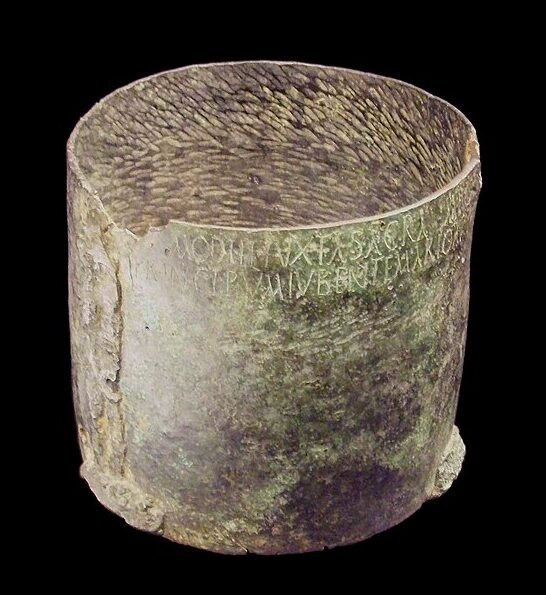
A 4th-century AD bronze modius measure featuring an inscription referencing Imperial regulations on weights and measures.
Weight
Roman weight measurements were based on the libra, or Roman pound, which was divided into twelve unciae (ounces). The libra is estimated to have been around 328.9 grams.
Uncial Divisions of the Libra
- Uncia (ounce) – 27.4 g
- Sescuncia – 41.1 g
- Sextans – 54.8 g
- Quadrans – 82.2 g
- Triens – 109.6 g
- Quincunx – 137 g
- Semis (half-pound) – 164.5 g
- Septunx – 191.9 g
- Bes – 219.3 g
- Dodrans – 246.7 g
- Dextans – 274.1 g
- Deunx – 301.5 g
- Libra (pound) – 328.9 g
Additional weight measurements included smaller fractions of the uncia, such as the siliqua (carat) and scrupulum (scruple). Many of these units also corresponded to Roman coinage, reflecting the close relationship between weight and economic transactions.
How did Romans measure time?
Roman timekeeping evolved from a lunar-based calendar to the Julian calendar in 45 BCE. The Julian system introduced a regular leap-year cycle, forming the foundation for the modern Gregorian calendar.
Years and Weeks
Romans primarily identified years by the names of consuls in office rather than numerical designations. They also used the ab urbe condita system, counting years from the legendary founding of Rome in 753 BCE.
The Roman week originally followed an eight-day cycle (nundinae), primarily used for market days. However, a seven-day week, influenced by astrology and Jewish tradition, later became standard.
The Romans divided daylight into 12 horae (hours), which varied in length depending on the season.
Hours and Daily Divisions
The Romans divided the daytime into twelve variable-length hours, depending on the season. Night was divided into four watches for military purposes. The introduction of equal-length hours came later with astrology and mechanical clocks.
Roman astrologers also conceived smaller time units:
- Minuta – 1/60 of a day (24 modern minutes)
- Secunda – 1/3,600 of a day (24 modern seconds)
- Tertia – 1/216,000 of a day (0.4 modern seconds)
These divisions, though not widely used in daily life, later influenced medieval and modern timekeeping.
Whether in trade, agriculture, engineering, or military logistics, these standardized units facilitated Rome’s administrative and economic efficiency. Many of these ancient measurements influenced later European systems, leaving a lasting legacy in modern metrology.
Questions and Answers

A Roman steelyard weight equivalent to one dodrans (3/4 of a libra).
What was the basic unit of Roman length measurement?
The basic unit was the pes (Roman foot), approximately 296 mm (0.971 ft).
How was the Roman foot subdivided?
It was divided into 12 uncia (inches) or 16 digiti (fingers).
What was a Roman mile equivalent to in modern measurements?
A mille passus (Roman mile) was 1.48 km (4,854 ft or 0.919 mi).
Which unit was commonly used to measure large land areas?
The jugerum was a primary unit, measuring about 2,523 m² (0.623 acres).
The Roman system of measurement was sophisticated and well-documented, allowing for consistency across a vast empire.
What was the standard Roman unit of volume?
The sextarius, which was about 540 ml, was the base unit for both liquid and dry measures.
How was Roman weight measured?
The libra (Roman pound) was about 328.9 g (11.6 oz) and divided into 12 uncia (ounces).
What was the Roman week based on?
They used an eight-day nundinae cycle for market days but also recognized a seven-day week influenced by astrology.





