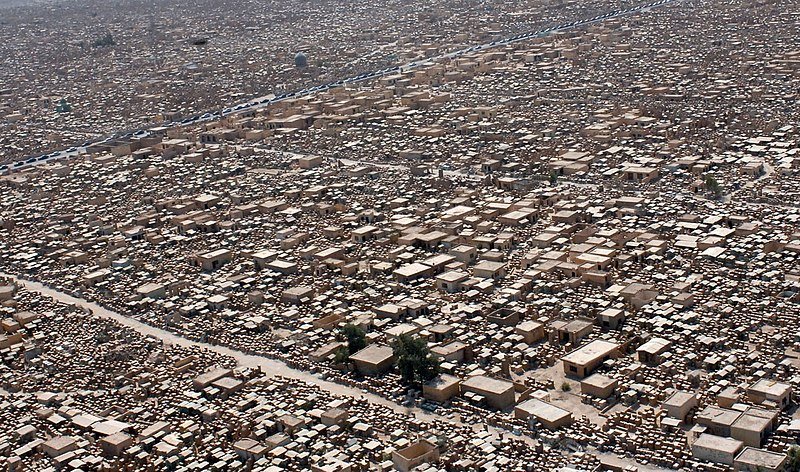
An aerial photograph capturing the majority of the cemetery.
Wadi-us-Salaam, meaning “Valley of Peace,” is an expansive Islamic cemetery located in Najaf, Iraq. Covering an area of almost 1,500 acres (6.07 km²), it is regarded as the largest cemetery in the world. It holds over six million graves and continues to expand as thousands of new burials take place annually. Due to its religious significance, millions of Shi’ite Muslims visit the cemetery each year to pay respects to their deceased loved ones and spiritual leaders.
Situated near the shrine of Ali ibn Abi Talib, the cousin and son-in-law of the Prophet Muhammad, Wadi-us-Salaam is considered one of the most sacred burial sites in Islamic tradition, particularly among Shi’ite Muslims. Many believers seek to be buried in this cemetery, as it is believed to offer a spiritually rewarding resting place.
Succession Following the Death of the Islamic Prophet Muhammad
Religious Significance of Wadi-us-Salaam
Wadi-us-Salaam holds deep religious importance in Shi’ite Islam. According to Shi’ite traditions, the site was purchased by Prophet Abraham and later designated as a part of paradise by Imam Ali. Many Shi’ite scholars and believers assert that burial in Wadi-us-Salaam ensures a closer connection to the divine, as Imam Ali is believed to intercede on behalf of those resting there.
Another significant belief is that those buried in Wadi-us-Salaam will be resurrected alongside Imam Ali on the Day of Judgment. This conviction draws thousands of individuals from around the world who wish to secure their final resting place within the cemetery. Additionally, it is widely believed that two ancient prophets—Hud and Salih—are also buried within the cemetery grounds, further adding to its sacred status.
READ MORE: Most Famous Prophets in Islam
Funerary Rituals and Burial Customs
Burial in Wadi-us-Salaam follows Islamic customs and includes various rituals performed before interment. These religious rites are deeply rooted in Islamic traditions and include:
- Ghusl (Purification Washing): Before burial, the deceased is washed and purified at the cemetery according to Islamic guidelines.
- Kafan (Shrouding): The body is wrapped in a simple white cloth (kafan), signifying humility and equality in death.
- Salat al-Janazah (Funeral Prayer): The funeral prayer is performed, often in the sacred premises of Imam Ali’s shrine.
- Tawaf (Circumambulation of the Shrine): The deceased is sometimes carried around the shrine of Imam Ali before being transported for burial.
- Recitation of Qur’anic Verses: Specific chapters from the Qur’an, such as Surah Yasin, are recited at the grave as part of the burial rites.
These funerary practices reinforce the spiritual significance of Wadi-us-Salaam and underscore the belief that burial in this cemetery brings divine blessings.
Historical Background
The history of Wadi-us-Salaam dates back more than 1,350 years, making it one of the oldest continuously used cemeteries in the world.
Historical records indicate that burial in Najaf has been practiced since at least the Parthian and Sassanid periods, aligning with ancient Mesopotamian traditions of dedicated necropolises.
Over the centuries, Wadi-us-Salaam has expanded considerably, reflecting the longstanding Shi’ite reverence for Najaf as a sacred city.
Wadi-us-Salaam has witnessed various historical conflicts, including the 2004 Battle of Najaf, where heavy fighting occurred between U.S.-led coalition forces and the Mahdi Army, a Shi’ite militia group. The cemetery served as both a battlefield and a refuge during the intense conflict.
Wadi-us-Salaam, meaning “Valley of Peace,” is the world’s largest Islamic cemetery, located in Najaf, Iraq.
During the Iraq War (2003–2011), the cemetery saw an increase in burials, with as many as 240 bodies interred daily at its peak. Even as the war subsided, the cemetery continued to receive tens of thousands of new burials annually.
In 2014, during the rise of the radical Islamic State of Iraq and the Levant (ISIL), the demand for burial plots surged dramatically, leading to reports of grave theft, illegal resales, and overcrowding.
Architectural Features and Monuments
In addition to individual graves, Wadi-us-Salaam contains numerous crypts, mausoleums, and family tombs. Unlike many other Islamic cemeteries, which typically feature simple grave markers, Wadi-us-Salaam has a variety of elaborate tombs, reflecting different architectural styles.
One of the most significant structures in the cemetery is the shrine of Imam Ali, which attracts millions of pilgrims each year. The shrine serves as a focal point for Shi’ite religious practices and funeral rites.
Tombs of Prominent Religious Figures
Several prominent Shi’ite clerics and scholars are buried in Wadi-us-Salaam. Among them are:
- Grand Ayatollah Muhammad Baqir al-Sadr – A highly influential Shi’ite theologian and political thinker.
- Grand Ayatollah Muhammad Sadiq al-Sadr – A leading cleric whose burial site is one of the most visited in the cemetery.
- Abdul Hosein Amini – A respected scholar known for his religious works.
These individuals’ tombs serve as places of reverence for Shi’ite Muslims who visit to pay their respects and seek spiritual blessings.
Shrine of Prophets Hud and Salih
According to Islamic tradition, the prophets Hud and Salih are believed to be buried in Wadi-us-Salaam. Their shrine, first built in the 18th century, was desecrated during the British occupation of Iraq in 1917 but was later restored in 1918–1919. In recent years, efforts have been made to rebuild and preserve this important religious site.
Sites Dedicated to Imams
The cemetery also includes sites dedicated to Shi’ite Imams, including:
- The Site of Imam al-Mahdi – A location revered by those who believe in the return of the twelfth Imam.
- The Site of Imam Ja’far al-Sadiq – Dedicated to the sixth Shi’ite Imam, known for his contributions to Islamic jurisprudence.
Burial Challenges and Modern Issues
Due to the increasing number of burials, available space within the cemetery has become scarce. Reports suggest that many burial plots are being stolen or sold illegally due to high demand. As of 2014, the situation had become critical, with some gravediggers stating that burial requests had reached unprecedented levels.
The influx of bodies from conflicts, including the Iraq War, sectarian violence, and ISIL attacks, has added pressure to the already limited space in Wadi-us-Salaam. Many bodies arrive from outside Iraq, particularly from Iran and other Shi’ite-majority regions, due to the cemetery’s religious significance.
Recognizing the importance of Wadi-us-Salaam, UNESCO has placed it on its Tentative List of World Heritage Sites. If granted UNESCO status, the cemetery could receive international support for its preservation and maintenance, ensuring that its historical, cultural, and religious legacy is protected for future generations.
Frequently Asked Questions about Wadi-us-Salaam
How large is Wadi-us-Salaam, and how many people are buried there?
The cemetery spans approximately 1,500 acres (6.07 km²) and contains over six million graves. It continues to expand due to the high number of annual burials.
Why do Shi’ite Muslims prefer to be buried in Wadi-us-Salaam?
Shi’ite traditions hold that Imam Ali declared Wadi-us-Salaam a part of paradise. Many believe that those buried there will be resurrected alongside him on Judgment Day and that his intercession helps ease their passage into the afterlife.
What religious rituals are performed before burial in Wadi-us-Salaam?
The deceased undergoes purification washing (ghusl), is wrapped in a shroud (kafan), funeral prayers are conducted, and the body is sometimes circumambulated around Imam Ali’s shrine before burial, followed by Qur’anic recitations at the grave.
Which notable religious figures are buried in Wadi-us-Salaam?
Prominent figures include Grand Ayatollah Muhammad Baqir al-Sadr, Grand Ayatollah Muhammad Sadiq al-Sadr, and Islamic scholars like Abdul Hosein Amini. It also contains the tombs of prophets Hud and Salih.
What architectural features and monuments exist within the cemetery?
The cemetery contains shared crypts, elaborate mausoleums, and shrines, including those dedicated to Imam al-Mahdi, Imam Ja’far al-Sadiq, and the restored shrine of prophets Hud and Salih.
FACT CHECK: At World History Edu, we strive for utmost accuracy and objectivity. But if you come across something that doesn’t look right, don’t hesitate to leave a comment below.





