Were all Native Americans peaceful?
The question of whether all Native Americans were peaceful is a complex one that requires a nuanced understanding of Native American history, cultures, and the contexts in which they lived.
Native American societies were diverse, comprising hundreds of distinct tribes with their own languages, cultures, and ways of life.
To understand their behavior, it is important to recognize the variety of experiences and circumstances that shaped their actions.
Diverse Societies and Cultures
Native American societies were not monolithic; they varied widely across the continent. Some tribes were nomadic, while others were sedentary agriculturalists. Their social structures ranged from small, egalitarian bands to complex hierarchical societies. This diversity influenced their responses to their environments and to other groups, both Native and non-Native.
For instance, the Pueblo peoples of the Southwest lived in settled communities and developed intricate irrigation systems for farming. They are often cited for their peaceful nature, focusing on community cooperation and spiritual life. In contrast, the Comanche of the Great Plains were known for their equestrian skills and warrior culture, which led to frequent conflicts with other tribes and European settlers.
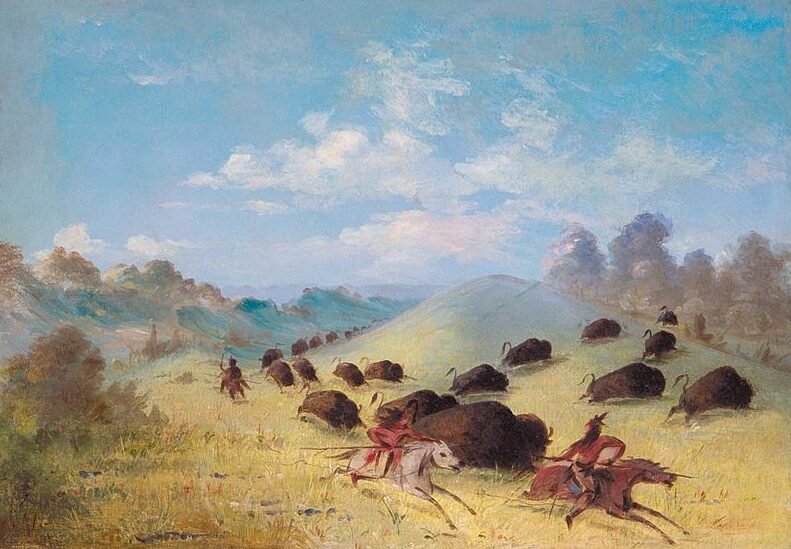
Image: A painting depicting Comanche Indians on a hunting expedition.
Peaceful Practices and Conflict
Many Native American tribes had traditions of peace and diplomacy. They developed sophisticated systems for resolving disputes and maintaining social harmony. The Iroquois Confederacy, also known as the Haudenosaunee, is a prime example. This alliance of six tribes in the Northeastern United States created a political and social system that emphasized peace and consensus-building. The Great Law of Peace, their governing constitution, established norms for conflict resolution and decision-making.
However, the idea that all Native Americans were peaceful does not hold when considering historical evidence of intertribal conflicts and wars. Warfare was a part of life for many tribes, and reasons for conflict varied, including competition for resources, territorial disputes, and retaliation for previous attacks. The Apache and Navajo, for instance, engaged in raiding and warfare as a means of survival and resistance against other tribes and European settlers.
European Colonization and Native Responses
The arrival of Europeans in the Americas dramatically altered the dynamics among Native American tribes. Colonization brought new pressures, such as the introduction of diseases, competition for land, and violent confrontations with settlers and colonial powers. Native American responses to European encroachment ranged from peaceful negotiation and adaptation to armed resistance.
The Powhatan Confederacy in Virginia initially sought peaceful relations with English settlers, engaging in trade and diplomacy. However, as English settlements expanded, conflicts arose, leading to violent confrontations such as the Anglo-Powhatan Wars. Similarly, the Wampanoag, who celebrated the first Thanksgiving with the Pilgrims, later faced devastating wars like King Philip’s War, as their lands and ways of life were threatened.

Not all Native Americans were peaceful. Similar to Europe, the American continent experienced tribal warfare, which could lead to significant human and cultural destruction. Conflicts arose over resources, territory, and retaliation. Image: A photograph of two Southeastern Idaho natives.
Resistance and Survival
Some Native American tribes chose to resist European colonization through warfare. The Seminole Wars in Florida and the Sioux Wars in the Great Plains are examples of prolonged resistance. Leaders like Tecumseh of the Shawnee and Sitting Bull of the Lakota Sioux emerged as prominent figures in the struggle to defend their people and territories.
Tecumseh sought to unite various tribes into a confederation to resist American expansion, advocating for Native American solidarity and military resistance. Sitting Bull, known for his leadership during the Battle of Little Bighorn, resisted U.S. government policies that aimed to confine Native Americans to reservations and undermine their traditional way of life.

Image: A painting of Native American leader Tecumseh.
Adaptation and Diplomacy
While some tribes engaged in conflict, others adapted to changing circumstances through diplomacy and accommodation. The Cherokee, for instance, adopted aspects of European-American culture, including a written constitution and a system of government modeled after the United States. Despite their efforts to assimilate and maintain peaceful relations, they faced forced removal from their lands in the infamous Trail of Tears.
The Choctaw and Chickasaw similarly pursued policies of accommodation and negotiation with the U.S. government, hoping to secure their lands and rights. Despite their efforts, they too were subjected to removal and loss of territory.
Misconceptions and Stereotypes
The perception of Native Americans as uniformly peaceful or warlike is often influenced by stereotypes and oversimplifications. These views can obscure the realities of Native American life and the diversity of their responses to historical events. The “noble savage” stereotype romanticizes Native Americans as inherently peaceful and in harmony with nature, while the “bloodthirsty savage” stereotype portrays them as violent and barbaric. Both perspectives fail to capture the complexity of Native American societies and their varied experiences.
Historical Impact and Legacy
The history of Native American conflict and peace has had a lasting impact on their communities and their relationship with the United States. The consequences of colonization, including land loss, cultural disruption, and population decline, continue to affect Native American communities today. Despite these challenges, Native Americans have shown remarkable resilience, preserving their cultures and advocating for their rights.
Modern Native American activism, such as the American Indian Movement (AIM) and protests against environmental destruction and pipeline projects, reflects ongoing efforts to assert sovereignty and protect their lands and cultures. These movements highlight the enduring spirit of resistance and the desire for peaceful resolution of conflicts through legal and political means.
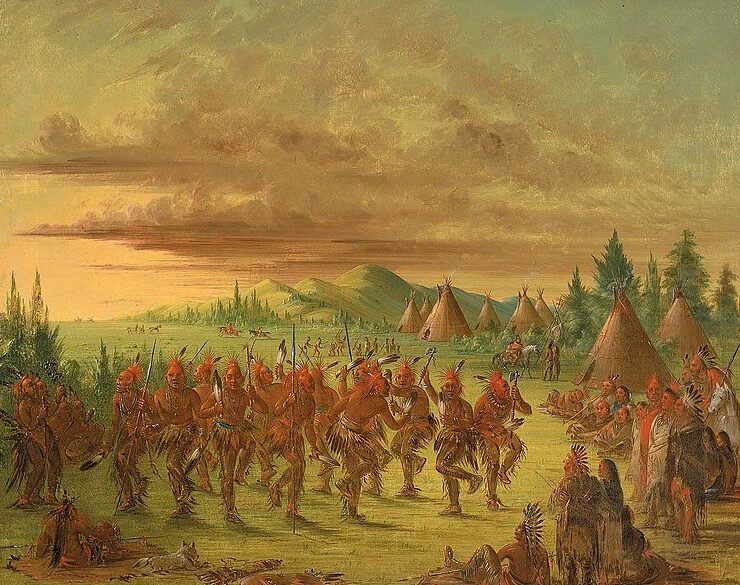
Image: An illustration by American artist George Catlin, depicting the famous “Eagle Dance” of the Sac and Fox Indians.
Conclusion
In conclusion, the question of whether all Native Americans were peaceful cannot be answered with a simple yes or no. Native American societies were diverse, with varying practices and responses to their environments and external pressures. While many tribes valued peace and diplomacy, others engaged in conflict and warfare for survival and defense. The arrival of Europeans introduced new challenges and opportunities, leading to a range of responses from accommodation to resistance.
Understanding the complexity of Native American history requires moving beyond stereotypes and recognizing the diversity of their experiences. Their legacy is one of resilience, adaptation, and the ongoing pursuit of justice and sovereignty.
Historians at World History Edu firmly maintain that the story of Native Americans is not one of inherent peace or violence but of dynamic and multifaceted societies navigating a changing world.
U.S. States that derive their names from Native American languages





None of them were. They were all violent, genocidal, conquering, enslaving animals just like every other race was, including whites, asians, arabs, blacks amd anyone else you people want to whine about as being so pure they could’ve done no wrong, something this trash article completely ignores and washes over. In fact they committed some of the most horrific atrocities against other human beings known in the history of mankind. Just look at what Commanche women did to whites who were captured by their warriors. They were all animals as was every other race and people group back then. You all like to think you all would’ve been somehow different while saying that with your modern mental context. Even for the level of violence that acceptable by anyone back then American Indians dialed that up to 500 and showed no mercy or remorse for it. Prisoners having parts of their faces and bodies slowly carved off, The most despicable torture. These people were just as despicable, violent and genocidal who’d enslave their prisoners which were often OTHER TRIBES. Anyone who teies to argue otherwise is too ignorant to have an opinion.