What is the Mshatta Facade?
The Mshatta Facade originates from the 8th-century Umayyad palace of Qasr Mshatta, located approximately 30 kilometers south of Amman, Jordan. Constructed during the reign of Caliph Al-Walid II (743–744), the palace was intended as a winter residence and administrative complex. However, its construction was abruptly halted following Al-Walid II’s assassination. The unfinished palace was later damaged by an earthquake, leaving much of the structure in ruins.
The name “Mshatta” is derived from the Bedouin name for the site, as the original name of the palace remains unknown. The decorated portion of the southern palace wall, known as the Mshatta Facade, was rediscovered during excavations in the mid-19th century.
In 1903, the Ottoman Sultan Abdul Hamid II gifted the facade to German Emperor Wilhelm II as a gesture of goodwill. The facade was dismantled, transported to Berlin, and reconstructed, initially in the Kaiser-Friedrich-Museum. In 1932, it found a permanent home in the Pergamon Museum, where it remains part of the Museum of Islamic Art’s collection.
READ MORE: 10 Greatest Ottoman Sultans and their Accomplishments
Description
The Mshatta Facade is an extraordinary example of early Islamic architectural decoration, spanning 33 meters in length and 5 meters in height. It consists of two large flanking walls and a central portal, originally part of the palace’s southern exterior. The facade showcases intricate relief carvings composed of geometric patterns, vegetal motifs, animals, and mythical creatures.
The facade’s most prominent feature is its alternating upright and inverted triangles, separated by zigzag lines of acanthus leaves. Within each triangular section, elaborate carvings are centered around a rosette, bordered by more acanthus leaves. The designs include swirling grape vines, vases, and amphorae with sprouting foliage, birds, and predatory animals engaging in lifelike activities, such as drinking from ornate bowls.
Interestingly, the left side of the facade is adorned with figural representations, including animals and mythical creatures like griffins and the simurgh. In contrast, the right side contains only vegetal motifs, with no figural imagery. This asymmetry has led to much scholarly interpretation and debate.
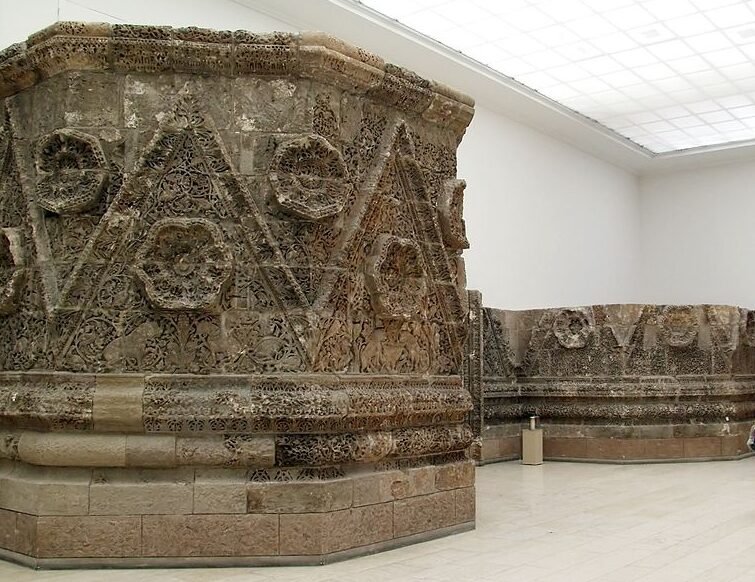
Image: Mshatta Facade
Interpretation
The asymmetry of the Mshatta Facade has been interpreted as a deliberate design choice rooted in Islamic religious principles. Scholars suggest that the right side of the facade, featuring non-figural designs, may have been situated near a mosque within the palace complex. In Islamic tradition, religious spaces avoid figural representations, particularly on the qibla wall facing Mecca. Thus, the asymmetry could reflect the separation of secular and sacred spaces within the palace.
Another theory proposes that the difference in design represents an incomplete phase in the facade’s construction, possibly indicating a planned transition toward a uniform design scheme.
The cultural and artistic influences seen in the facade offer further insights into its interpretation. The grape vines, acanthus leaves, and amphorae are motifs widely seen in Greco-Roman and Byzantine art, while mythical creatures like the griffin and centaur demonstrate classical European influence. The inclusion of the simurgh, a mythical bird from Zoroastrian mythology, points to the artistic traditions of the Sasanian Empire, which heavily influenced early Islamic art.
Some scholars argue that the facade’s combination of Greco-Roman, Byzantine, and Sasanian elements reflects the multicultural nature of the Umayyad Caliphate, which ruled over diverse regions with rich artistic legacies. It is also believed that the craftsmen employed to create the facade included Coptic Christian and Orthodox artisans, familiar with classical decorative styles.

Image: Gold coin of Caliph Al-Walid II.
Significance
The Mshatta Facade is a key monument in the study of early Islamic art and architecture, showcasing the Umayyad dynasty’s ability to blend diverse cultural traditions into a unique artistic expression. As one of the finest surviving examples of Umayyad secular architecture, it provides valuable insights into the artistic, political, and cultural landscape of the 8th-century Islamic world.
The facade reflects the synthesis of Greco-Roman, Byzantine, and Sasanian artistic traditions, demonstrating the cultural exchange facilitated by the Umayyad Caliphate’s vast territorial expanse. The incorporation of diverse motifs highlights the adaptability of Islamic art in assimilating and reinterpreting pre-Islamic visual cultures.
The asymmetrical design underscores the importance of Islamic religious traditions in artistic practices. By omitting figural imagery near sacred spaces, the facade conforms to Islamic prohibitions against representational art in religious contexts.
The Mshatta Facade provides evidence of early Islamic palace architecture, particularly the use of decorative facades as an expression of power and sophistication. Its size, scale, and intricate carvings suggest the importance of ornamentation in elite secular buildings.
The multicultural imagery on the Mshatta Facade may have been a deliberate effort by Caliph Al-Walid II to represent the diverse subjects under Umayyad rule. By integrating motifs from conquered territories, the facade symbolized the Caliphate’s political dominance and cultural inclusivity.
The facade also illustrates how artistic techniques, such as relief carving and decorative patterns, were transmitted across cultures and adapted to suit Islamic aesthetics. The presence of mythical creatures and vegetal motifs demonstrates the transition from pre-Islamic artistic traditions to Islamic art forms.
Legacy in Modern Times
Despite suffering damage during World War II, the Mshatta Facade remains one of the most celebrated exhibits in the Pergamon Museum. Its preservation and display offer an invaluable opportunity for scholars and visitors to appreciate the richness and complexity of early Islamic art. The facade serves as a testament to the artistic achievements of the Umayyad Caliphate and the broader cultural exchanges that shaped the Islamic world.
Additionally, the facade’s journey—from Jordan to Berlin—raises important discussions regarding the preservation, ownership, and relocation of cultural heritage. While its presence in Berlin has facilitated its study and conservation, some advocate for the return of such artifacts to their countries of origin as part of ongoing global debates on cultural restitution.
Frequently Asked Questions
Who commissioned the Qasr Mshatta palace, and why was it incomplete?
The palace was built during the reign of Caliph Al-Walid II (743–744), but it was left incomplete after his assassination and later damaged by an earthquake.
How was the facade brought to Berlin?
The Ottoman Sultan Abdul Hamid II gifted the facade to German Emperor Wilhelm II in 1903. It was transported to Berlin and reconstructed in the Pergamon Museum.
What makes the Mshatta Facade’s design significant?
The facade features alternating upright and inverted triangles adorned with geometric patterns, grape vines, animals, and mythical creatures, reflecting artistic complexity and cultural fusion.
Why is there asymmetry in the facade’s design?
The left side includes animals and figural depictions, while the right side contains only vegetal motifs, likely due to the presence of a mosque behind the right section, adhering to Islamic traditions.
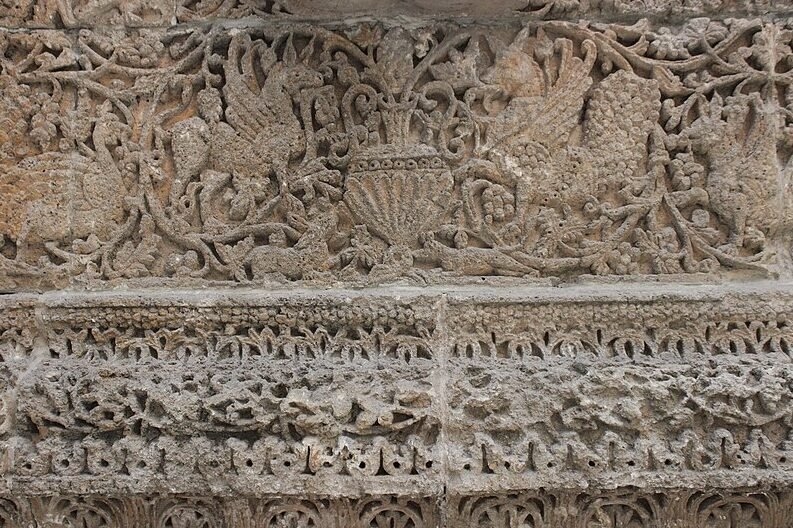
Image: A detail look at the Mshatta Facade.
What cultural influences are reflected in the facade’s decoration?
The facade blends Greco-Roman, Byzantine, and Sasanian artistic traditions, incorporating motifs like grape vines, amphorae, griffins, and the simurgh.
Who were the likely craftsmen behind the facade?
The Umayyads employed Coptic Christian and Orthodox architects familiar with classical Greco-Roman designs, possibly drawing on Sasanian textiles or manuscripts for inspiration.
Why is the Mshatta Facade historically significant?
The facade exemplifies early Islamic art’s multicultural roots and the Umayyad Caliphate’s cultural and political reach, symbolizing the synthesis of artistic traditions from diverse empires.





