How did the Yom Kippur War lead to the Camp David Accords?
The Yom Kippur War, also known as the October War or the Ramadan War, was a pivotal conflict in the Middle East that took place from October 6 to October 25, 1973. The war had far-reaching consequences and played a significant role in leading to the Camp David Accords, a landmark peace agreement between Israel and Egypt. Understanding the connection between the Yom Kippur War and the Camp David Accords requires an examination of the conflict’s causes, the war’s impact, and the diplomatic efforts that followed.
READ MORE: Major Accomplishments of U.S. President Jimmy Carter
Background and Causes of the Yom Kippur War
The Yom Kippur War was fought between Israel and a coalition of Arab states led by Egypt and Syria. The roots of the conflict lay in the unresolved issues from the Six-Day War of 1967. During that war, Israel achieved a decisive victory, capturing the Sinai Peninsula from Egypt, the Golan Heights from Syria, and the West Bank from Jordan. The territories captured were of strategic and symbolic significance, but their occupation created lasting tensions.
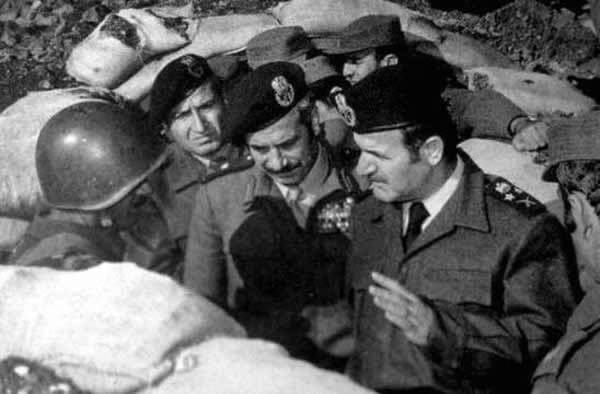
Syrian President Hafez al-Assad (right) with soldiers, 1973
In the years following the Six-Day War, Egyptian President Anwar Sadat and Syrian President Hafez al-Assad sought to reverse the losses suffered by their countries. Both leaders believed that military action was necessary to reclaim their territories and restore national pride.

Sadat’s position, meanwhile, was that Egypt had done its best to fight two wars for the Palestinian cause and could not be expected to deliver justice alone.
The Yom Kippur War was launched on October 6, 1973, during the Jewish holy day of Yom Kippur, catching Israel off guard.

Some historians have stated that the 1967 War had bloated Israel’s confidence in its military might, and the recently formed state was convinced it was invincible. The October War changed that perception quickly. Image: Israeli forces during the Six-Day War.
The Course of the War

The war began with a surprise attack by Egyptian and Syrian forces. Egyptian troops crossed the Suez Canal and advanced into the Sinai Peninsula, while Syrian forces launched an assault on the Golan Heights.
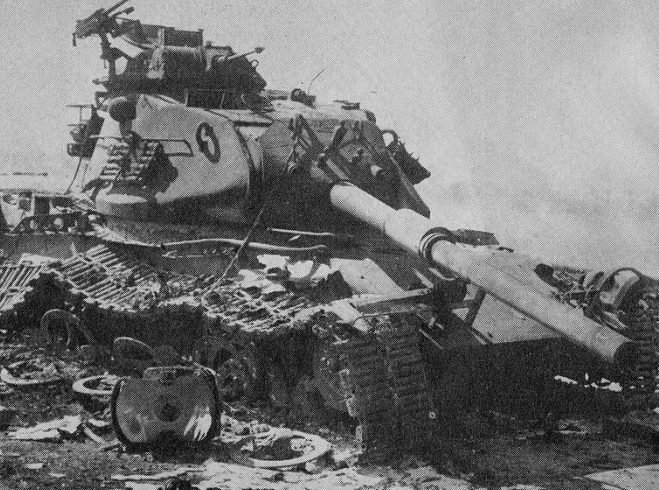
Egypt and Syria launched a two-pronged surprise attack on Israel, kickstarting the 1973 War. However, the conditions that precipitated the war were established six years prior in the Six-Day War. Egypt and Syria lost Sinai and the Golan Heights, respectively. Image: A destroyed Israeli M60 Patton tank in the Sinai during the Yom Kippur War
Initially, the Arab forces achieved significant gains, with the Egyptians successfully breaching Israel’s Bar Lev Line and the Syrians capturing parts of the Golan Heights.
However, Israel’s military, although initially surprised, quickly regrouped and launched counteroffensives. By the end of the war, Israeli forces had pushed back the Syrian troops and crossed the Suez Canal into Egypt, encircling the Egyptian Third Army. The war ended with a United Nations-brokered ceasefire on October 25, 1973.
Aftermath and Impact of the War
The Yom Kippur War had profound effects on the region and on international diplomacy. While the war ended in a military stalemate, it had significant political and strategic consequences.
- Psychological Impact: The surprise nature of the war and the initial successes of the Arab forces had a profound psychological impact on Israel. It exposed vulnerabilities in Israeli military preparedness and intelligence, leading to a period of introspection and reassessment within Israel.
- Shift in U.S. Policy: The United States, a key ally of Israel, was deeply involved in the conflict. The U.S. provided substantial military and financial support to Israel during the war. However, the oil embargo imposed by Arab states in response to American support for Israel had a major impact on global oil prices and the U.S. economy. This led to increased pressure on the U.S. to address the underlying issues of the Arab-Israeli conflict.
- Diplomatic Openings: The war demonstrated that a military solution alone could not resolve the longstanding conflict between Israel and its Arab neighbors. The need for a diplomatic solution became increasingly apparent.
The Path to the Camp David Accords
The Yom Kippur War set the stage for a new era of diplomacy in the Middle East. Several factors contributed to the eventual negotiation of the Camp David Accords.
Anwar Sadat’s Shift in Policy
Egyptian President Anwar Sadat emerged as a key figure in the peace process. Following the war, Sadat recognized that military confrontation alone would not restore Egypt’s pre-1967 borders or secure a lasting peace. In 1971, Sadat made a dramatic shift in policy by announcing his willingness to negotiate with Israel.
Sadat’s bold move was driven by several factors:
- Desire for Peace: Sadat sought to end the state of war with Israel and improve Egypt’s economic and political situation.
- Strategic Considerations: Sadat recognized that a negotiated settlement would likely yield better results than continued conflict.
- International Pressure: The oil embargo and the resulting economic impact highlighted the need for a diplomatic resolution.
In November 1977, Sadat made a historic visit to Israel, addressing the Knesset (Israeli parliament) and expressing a desire for peace. This visit marked a turning point in the peace process and set the stage for subsequent negotiations.
U.S. Mediation and the Role of Henry Kissinger
The United States played a crucial role in mediating the peace process between Israel and Egypt. U.S. Secretary of State Henry Kissinger, who had been involved in shuttle diplomacy during and after the Yom Kippur War, was instrumental in facilitating negotiations.
Kissinger’s shuttle diplomacy involved traveling between Israel and Arab capitals to bridge gaps and build trust. His efforts led to the signing of the Sinai Interim Agreement in 1975, which was a significant step toward a more comprehensive peace settlement.
The Camp David Summit

Menachem Begin, Jimmy Carter and Anwar Sadat at Camp David, 1978
The Camp David Accords were the culmination of intense negotiations held at Camp David, the presidential retreat in Maryland, in September 1978. The summit brought together U.S. President Jimmy Carter, Egyptian President Anwar Sadat, and Israeli Prime Minister Menachem Begin.
The negotiations were challenging, with deep-seated distrust and conflicting interests among the parties. However, President Carter’s personal diplomacy and the commitment of Sadat and Begin to achieve a peace agreement were critical to the success of the summit.
The Camp David Accords, signed on September 17, 1978, consisted of two main agreements:
- The Framework for Peace in the Middle East: This framework addressed the broader Arab-Israeli conflict and proposed a comprehensive peace plan for the region.
- The Framework for the Conclusion of a Peace Treaty between Egypt and Israel: This agreement specifically outlined the terms for the peace treaty between Egypt and Israel, including the withdrawal of Israeli forces from the Sinai Peninsula and the normalization of diplomatic relations.
Aftermath of the Camp David Accords

Egyptian President Anwar Sadat and Israeli Prime Minister Menachem Begin
The Camp David Accords led to the signing of the Egypt-Israel Peace Treaty on March 26, 1979. The treaty marked the first time an Arab country officially recognized Israel and established diplomatic relations. Key provisions of the treaty included:
- Israeli Withdrawal: Israel agreed to withdraw from the Sinai Peninsula, which was returned to Egypt.
- Normalization of Relations: Both countries agreed to establish diplomatic relations, including the exchange of ambassadors and the promotion of trade and cooperation.
- Security Arrangements: The treaty included provisions for the establishment of demilitarized zones and international monitoring to ensure compliance with the terms.
The peace treaty was met with mixed reactions. In Egypt, Sadat’s decision to make peace with Israel was controversial and led to domestic opposition. Sadat’s willingness to pursue peace was viewed by some as a betrayal of the Arab cause, and he faced criticism from other Arab states. In October 1981, Sadat was assassinated by Islamic extremists who opposed his peace initiative.
For Israel, the peace treaty with Egypt was a significant achievement. It provided a degree of stability and security along Israel’s southern border and allowed Israel to focus on other strategic concerns. The treaty also contributed to a broader shift in Israeli diplomacy and security policy.
Legacy and Impact
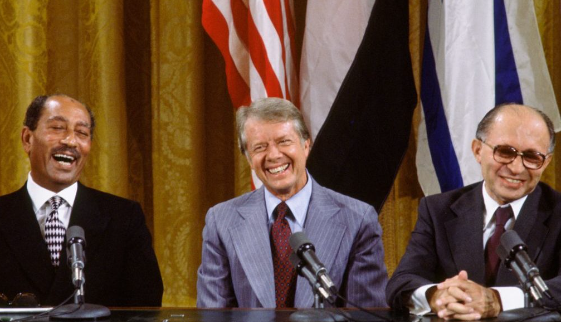
Image (L-R): Egyptian President Anwar Sadat, U.S. President Jimmy Carter, and Israeli Prime Minister Menachem Begin
The Camp David Accords and the subsequent peace treaty between Egypt and Israel had a lasting impact on the Middle East and international diplomacy.
- Peace and Stability: The peace treaty between Egypt and Israel has endured for decades, providing a measure of stability in a region that has often been plagued by conflict. It demonstrated that negotiated agreements could achieve lasting peace and served as a model for future peace processes.
- Diplomatic Precedent: The accords set a precedent for future negotiations and peace agreements in the Middle East. The framework established at Camp David influenced subsequent peace initiatives and diplomatic efforts in the region.
- U.S. Influence: The successful mediation of the Camp David Accords showcased the role of the United States as a key mediator in the Middle East peace process. The U.S. continued to play a significant role in subsequent negotiations and peace efforts.
- Regional Dynamics: The peace treaty shifted the dynamics of the Arab-Israeli conflict and altered the relationships between Israel and other Arab states. It contributed to a realignment of alliances and priorities in the region.
In summary, the Yom Kippur War was a catalyst for change in the Middle East, leading to the Camp David Accords and the eventual peace treaty between Egypt and Israel. The war exposed the limitations of military solutions and highlighted the need for diplomatic engagement. The Camp David Accords represented a historic achievement in international diplomacy, providing a framework for peace and stability in the region.
Questions and Answers
The Yom Kippur War shattered the perception of invincibility that surrounded the IDF. Despite ultimately repelling the Arab forces and gaining a military advantage by the end of the conflict, the initial successes of the Egyptian and Syrian armies exposed vulnerabilities in Israel’s defense and highlighted the need for diplomatic solutions to ensure long-term security.
Below are some frequently asked questions:
What impact did the Yom Kippur War have on Egyptian President Anwar Sadat’s leadership?

Leaders and commanders of the Arab coalition during the October 1973 War
The war enhanced Sadat’s prestige, as he demonstrated military initiative and bravery. This newfound political capital enabled him to pursue a diplomatic approach to resolving the conflict with Israel, marking a significant shift from his previous position.

What strategic shift did Sadat make following the Yom Kippur War?
Realizing that a military victory over Israel was unlikely and that the status quo was unsustainable, Sadat shifted from military conflict to diplomacy. His strategic change was marked by his historic visit to Jerusalem in November 1977, where he addressed the Israeli Knesset and called for peace.

An Israeli Centurion tank operating in the Sinai during the October 1973 War
How did U.S. involvement evolve after the Yom Kippur War?
The Yom Kippur War heightened tensions between the Cold War superpowers, with the U.S. supporting Israel and the USSR backing the Arab states. The U.S., recognizing the risks of escalating Middle Eastern conflicts, took a more active role in mediation. President Jimmy Carter, in particular, was motivated to broker peace in the region.
What role did U.S. mediation play in the lead-up to the Camp David Accords?
U.S. mediation, especially through President Jimmy Carter, was crucial in facilitating bilateral negotiations between Egypt and Israel. Carter’s involvement helped set the stage for the Camp David summit by bringing both sides to the negotiating table.

What was the significance of the Camp David Summit held in September 1978?
The Camp David Summit, held at President Carter’s retreat, was a pivotal event where Sadat and Israeli Prime Minister Menachem Begin engaged in nearly two weeks of intense negotiations.
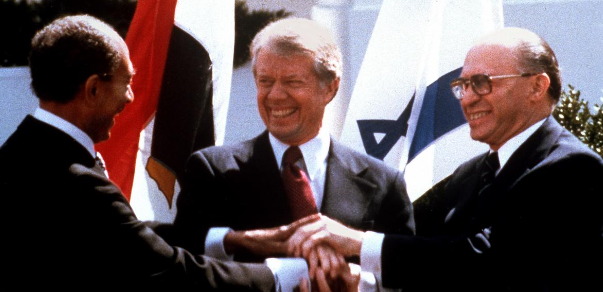
The Yom Kippur War, by highlighting the limits of military solutions and the potential dangers of escalating conflicts in the Middle East, acted as a catalyst for diplomatic efforts. The war’s aftermath, combined with the leadership of Sadat and Begin and the mediation efforts of Carter, eventually resulted in the Camp David Accords—a significant step towards peace in a region marked by longstanding conflicts. Image: Sadat, Carter and Begin shaking hands after signing Peace treaty between Egypt and Israel in the White House, March 27, 1979
The summit resulted in two key framework agreements: one for peace between Egypt and Israel and another addressing the broader Palestinian issue.

Camp David, presidential retreat in Maryland, US.
What were the key outcomes of the Egypt-Israel Peace Treaty signed in March 1979?
The Egypt-Israel Peace Treaty marked the formal end of hostilities between the two nations. Key outcomes included Israel’s agreement to withdraw from the Sinai Peninsula, which it had occupied since the 1967 Six-Day War, and the normalization of relations between Egypt and Israel. This treaty was a significant step in the broader process of Middle Eastern diplomacy.