Who was Despoina?
Despoina, meaning “The Mistress” in Greek, is a lesser-known but highly significant deity in ancient Greek religion, particularly within the context of Arcadian mythology.
Unlike the more famous goddesses such as Athena or Aphrodite, Despoina’s worship was deeply rooted in local, mystery-based religious traditions that were specific to certain regions, most notably in Arcadia.
Despoina’s true name was never spoken, known only to those initiated into her mysteries. As such, she is almost always referred to by her title “Despoina,” a term which emphasizes her authority and power, much like a ruler or a lady of a household. This name, derived from the Proto-Indo-European roots dem- (household) and potniha- (mistress), positions her as a figure of dominance, much like a master or lord would be to his domain.
Origins and Family
Despoina’s origins are complex, reflecting her unique position within the Greek pantheon as both a daughter of two powerful deities and a figure who blends older religious traditions with classical mythology. In Arcadian mythology, Despoina was the daughter of Demeter, the goddess of agriculture, and Poseidon, the god of the sea. This parentage gives her an important place within the mythological framework, connecting her both to the land and the sea—two crucial elements in ancient Greek life.
According to myth, Poseidon fell in love with Demeter and pursued her. To avoid his advances, Demeter transformed herself into a mare, but Poseidon, in turn, became a stallion and mated with her. From this union came two offspring: Despoina and a divine horse named Arion. This story reveals several key aspects of Despoina’s character. First, her birth is associated with transformation and concealment, a common theme in myths surrounding mystery cults. Secondly, her association with horses and Poseidon Hippios (Poseidon in his horse form) links her to chthonic (underworld) forces and to nature, particularly animals, rivers, and fertility.
The myth also reflects older Indo-European motifs in which gods of nature—often associated with animals—represent primal, raw forces that shape the world. Poseidon’s dual connection to the sea and horses (both representing untamed natural elements) further deepens Despoina’s role as a deity associated with both chaos and control, a theme that appears in her connection to nature and her mother Demeter’s dominion over agriculture.

Despoina was the daughter of Demeter and Poseidon and sister to the horse Arion. Her real name was kept secret, known only to those initiated into her mysteries, and was lost when the Eleusinian religion faded. Image: Bust of Demeter (left) and Despoina’s veil (right).
Role in Arcadian Worship
Despoina’s worship was localized primarily in Arcadia, a mountainous and relatively isolated region of Greece. In Arcadian mythology, Despoina was not a well-known deity across the broader Greek world, unlike goddesses such as Persephone or Hera. However, within Arcadia, she held immense religious significance. Her primary worship site was the Sanctuary of Despoina at Lycosura, one of the oldest religious centers in ancient Greece. This sanctuary was home to a mystery cult dedicated to Despoina, where rituals and ceremonies were performed to honor the goddess.
The sanctuary at Lycosura included a temple, altars, and a megaron (a large hall), and it was believed to be one of the most ancient and sacred sites in all of Greece. Pausanias, a second-century CE Greek traveler and geographer, visited the site and described it in detail, offering one of the few surviving accounts of Despoina’s cult. According to Pausanias, the sanctuary contained a statue group attributed to the sculptor Damophon, featuring Despoina seated alongside her mother Demeter. The statue was an impressive work, showing Despoina in a position of authority, further emphasizing her role as “The Mistress” in both a literal and metaphorical sense.
The rituals associated with Despoina’s cult were kept secret, as was common in Greek mystery religions. Like the Eleusinian Mysteries, which were dedicated to Demeter and Persephone, the Mysteries of Despoina involved an initiation process that likely included rites of passage, symbolic death and rebirth, and a deeper understanding of life, death, and the afterlife. Because her mysteries were so closely guarded, much of what we know about Despoina’s worship comes from external accounts, such as that of Pausanias, rather than detailed descriptions from within the cult itself.
Connection to Other Deities
Despoina’s identity is often conflated with other deities, particularly Persephone. Both Despoina and Persephone are daughters of Demeter, and both are associated with mystery cults and the cycle of life and death. However, unlike Persephone, whose abduction by Hades and subsequent marriage to him forms the basis of the Eleusinian Mysteries, Despoina’s story centers more on her Arcadian heritage and her connection to local traditions. Over time, Despoina was likely absorbed into the broader mythological narrative, with many of her attributes being transferred to Persephone.
There are also strong connections between Despoina and Artemis, the goddess of the hunt and wild animals. In fact, Despoina is often depicted alongside Artemis in representations of the two goddesses with animals, further reinforcing Despoina’s link to nature and her role as a protector of the natural world. Artemis, known as Potnia Theron (Mistress of Animals), shares the title “Potnia” with Despoina, suggesting that the two goddesses may have shared similar roles in certain local cults. Both were associated with wild animals, nature, and the protection of rural life, although Despoina’s role was more secretive and mysterious due to her association with the chthonic realm.
Chthonic Aspects and Mystery Cult
Despoina’s connection to the chthonic, or underworld, aspect of Greek religion is central to her character. Her father, Poseidon Hippios, in his horse form, is associated with the wild, uncontrollable forces of nature, and her mother, Demeter, represents the earth and fertility. Together, they give Despoina dominion over both life and death, particularly in the context of agricultural cycles and the mysteries surrounding the afterlife.
Mystery religions in ancient Greece often dealt with these cycles of life, death, and rebirth, and Despoina’s role in such a cult situates her as a key figure in this tradition. As with the Eleusinian Mysteries, which focused on Persephone’s descent into the underworld and return to the surface, the Mysteries of Despoina likely involved themes of renewal, transformation, and the changing of the seasons.
The name “Despoina” itself, meaning “mistress,” is a title that emphasizes her authority over these chthonic forces. In ancient Greek religious thought, chthonic deities were often feared and revered because of their association with death and the underworld, but they were also seen as necessary for the regeneration of life. Despoina’s mysteries likely focused on this duality, presenting her as both a fearsome and benevolent figure.
Her association with the underworld and death also connects her to the broader theme of the numinous in Greek religion, where certain gods and goddesses are associated with elemental and untamed forces. In Despoina’s case, this includes her link to horses, which in ancient Greek thought were often connected to the underworld. This association is evident in her mythological birth from the union of Poseidon Hippios (the horse form of Poseidon) and Demeter in her mare form. The resulting birth of Despoina and the divine horse Arion symbolizes both the taming of wild forces and the intimate connection between life and death in the natural world.
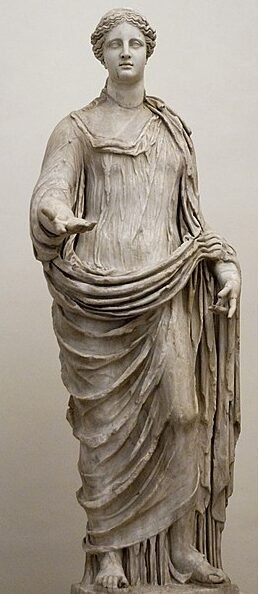
Image: Statue of Demeter.
Artistic Depictions and Legacy
The sanctuary of Despoina at Lycosura contained artistic depictions of the goddess that reflect her importance in Arcadian religion. One of the most notable features of the sanctuary was the veil of Despoina, an intricately decorated artifact that depicted figures with animal heads, possibly representing worshippers in masks or hybrid creatures engaged in ritual dances. This suggests that Despoina’s cult involved symbolic representations of transformation, connecting her to both human and animal realms, and reinforcing her role as a figure of mystery and power over nature.
These artistic depictions, including statues and reliefs found at the site, provide insight into the religious practices of the time. Despoina is typically shown as a serene, seated figure, often alongside Demeter, emphasizing her role as a goddess of authority and power. Unlike some other Greek deities who are depicted in active or warlike poses, Despoina’s posture is calm and commanding, reflecting her status as a ruler of life and death. The fact that she is often shown in the presence of other deities, such as Artemis and Demeter, underscores her importance within this local pantheon.
Though the cult of Despoina was highly localized and never spread across the broader Greek world in the way that other religious practices did, it remains an essential part of the study of ancient mystery religions. The sanctuary at Lycosura, described by Pausanias as one of the most sacred places in Greece, continues to be a key archaeological site for understanding the religious life of ancient Arcadia and its connections to older Minoan and Mycenaean traditions.
In the centuries following the decline of ancient Greek religion, Despoina’s legacy persisted, though she became more obscure as figures like Persephone and Artemis took on many of her attributes in broader Greek mythology. Her role in the mystery cults, however, has left a lasting mark on the understanding of Greek religious practices, particularly in how local and regional traditions contributed to the overall tapestry of Greek spiritual life.
Modern Legacy
In modern times, Despoina’s legacy continues to endure in various ways. For example, one of Neptune’s moons is named Despina, a reflection of the enduring influence of ancient Greek mythology in both scientific and cultural contexts.
Frequently Asked Questions

What is the origin of the name “Despoina”?
The name “Despoina” comes from Proto-Indo-European roots, where dem- means “house” or “household,” and pot-niha- means “mistress” or “lady.” The term translates to “lady” or “queen” in Greek, and is related to titles of household rulers in various ancient languages.
What role did Despoina play in ancient mystery cults?
Despoina was central to the mystery cult at Lycosura in Arcadia. She embodied nature, birth, and death, merging pre-Greek beliefs with Greek religious traditions. Her cult reflected older Minoan and Mycenaean traditions.
How is Poseidon connected to Despoina in Arcadian mythology?
In Arcadian myth, Poseidon, in his form as Poseidon Hippios (the horse-god), pursued and mated with Demeter. This union produced Despoina and the divine horse Arion, emphasizing Poseidon’s association with horses, water, and the underworld.

Image: Poseidon
How did Despoina’s worship evolve in classical Greek religion?
In classical Greek religion, deities like Despoina, originally connected to nature and animals, took on more human forms but retained their links to nature. Despoina, alongside Demeter and Artemis, continued to be worshipped as a goddess of animals, springs, and rivers.
What artistic representation of Despoina is found at Lycosura?
A marble relief at Lycosura shows Despoina’s veil, depicting human figures with animal heads, likely in a ritual dance. These figures reflect similar processions found in Mycenaean frescoes and art, where daemons or worshippers wore animal masks.
What was the significance of Despoina’s sanctuary at Lycosura?
Despoina’s sanctuary at Lycosura was a key religious site, where she was worshipped alongside her father, Poseidon Hippios. Though her cult remained regional, it is important for studying ancient mystery religions in Greece.
How did Despoina’s identity differ from Kore?
Despoina was a chthonic goddess worshiped by the Arcadians. Unlike Kore, who was the daughter of Zeus and Demeter, Despoina was considered the daughter of Poseidon Hippios and Demeter. Her true name was sacred and only revealed to those initiated into her mysteries at Lycosura.





