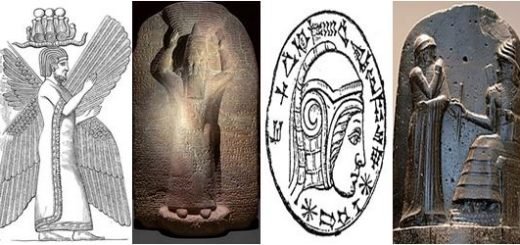
Dumuzid in Ancient Mesopotamia
Dumuzid, also known as Tammuz in later Akkadian traditions, is a central figure in the mythology of ancient Mesopotamia. His story, woven with elements of love, death, resurrection, and the cycles of nature, embodies the early development of religious and agricultural traditions in the region.
Dumuzid’s mythology and worship were widespread throughout the ancient Near East, encompassing not only the Sumerians, but later the Akkadians, Babylonians, and even neighboring cultures like the Canaanites and Greeks.
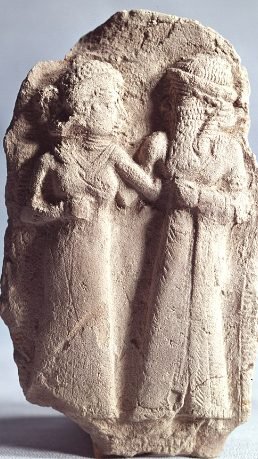
Ancient Sumerian depiction of the marriage of Inanna and Dumuzid
Origins and Early Cult of Dumuzid
Dumuzid is one of the oldest deities in the Mesopotamian pantheon, dating back to the early dynastic periods of Sumer. The Sumerian King List places Dumuzid as the fifth antediluvian king of Bad-tibira, a city located in southern Mesopotamia.
The above suggests that he may have been worshiped as a historical figure or a divine king before his mythological status was solidified. In this role, Dumuzid appears not only as a figure of kingship but as a god of fertility and vegetation, particularly tied to the agricultural cycles of Sumer.

Dumuzid also appears as a legendary king of Bad-tibira and Uruk in the Sumerian King List. Image: The Sumerian King List (SKL) – an ancient literary composition in Sumerian, created to legitimize power claims of southern Mesopotamian city-states.
In addition to his association with Bad-tibira, Dumuzid also appears as an early king of Uruk, one of the most important cities in ancient Sumer. He was said to come from Kuara, a nearby village, and is famously described as the consort of the goddess Inanna (later known in Akkadian as Ishtar).
This connection with Inanna elevated Dumuzid’s status, as she was a major deity associated with love, fertility, and war. Their relationship, both in myth and cult practice, reflects the themes of life, death, and rebirth, central to the agricultural societies of ancient Mesopotamia.
READ MORE: Most Notable Cities in Ancient Mesopotamia
Dumuzid the Shepherd and Agricultural God
Dumuzid is often referred to as “Dumuzid the Shepherd” in Sumerian literature, a title that underscores his connection to pastoralism and the provision of milk. In the hot and arid environment of southern Mesopotamia, milk was a precious and seasonal commodity, valued for its nutritive properties. As a provider of milk, Dumuzid symbolized the nurturing aspects of nature, making him an essential figure in ensuring the survival of communities through the lean summer months.
However, Dumuzid’s role extended beyond shepherding. He was also closely associated with agriculture and the growth of crops. As a god of fertility, Dumuzid was responsible for the health and productivity of plants, particularly during the fertile spring months. In Sumer, the spring was a time of abundance when the land was fertile, and Dumuzid’s presence was thought to ensure the prosperity of crops.
However, as the hot, dry summer approached, the land would become barren, and it was believed that Dumuzid “died” during this time, descending into the underworld. This cyclical death and rebirth mirrored the seasonal changes in the environment, with Dumuzid’s death symbolizing the onset of drought and his return marking the rejuvenation of life.
To the Sumerians, Dumuzid was known as Dumuzid the Shepherd and was the first consort of the goddess Inanna (later known as Ishtar).
The month of Dumuzid, which fell in the middle of the summer, was a time of mourning throughout Mesopotamia. His death was mourned as a communal event, and rituals associated with his passing were central to the religious calendar.
In Lagash, for example, the month of Dumuzid was the sixth month of the year, and it was during this period that people would mourn his descent into the underworld, reflecting the broader Mesopotamian understanding of the relationship between death, fertility, and the renewal of life. The mourning for Dumuzid was not only a reflection of agricultural concerns but also connected to human mortality, as his story emphasized the inevitable cycles of life and death.
The Identification with Other Deities
Dumuzid was not a monolithic figure in Mesopotamian religion. Like many ancient deities, his identity shifted over time and place, and he was sometimes merged with other gods.
One such identification was with the god Ama-ušumgal-ana, a local deity worshiped in the city of Lagash. In this form, Dumuzid was associated with the date palm, a symbol of stability in the region because it could be harvested year-round, even during the harsh summer months.
The above aspect of Dumuzid’s cult emphasized prosperity, joy, and the continual cycles of life, in contrast to his darker associations with death and the underworld. In the role of Ama-ušumgal-ana, Dumuzid was celebrated for the bountiful gifts of the earth, particularly the life-giving fruits of the date palm.
In certain Sumerian texts, Dumuzid is also referred to as “my Damu,” a term meaning “my son.” This name connects Dumuzid with the natural processes that cause sap to rise in plants and trees. The name Damu is often associated with Dumuzid’s return in the autumn after the dry summer season. This role emphasized the exhaustion and relief of the community following the harsh summer months, a time when the land, like Dumuzid himself, seemed to come back to life.
Dumuzid in the Sacred Marriage
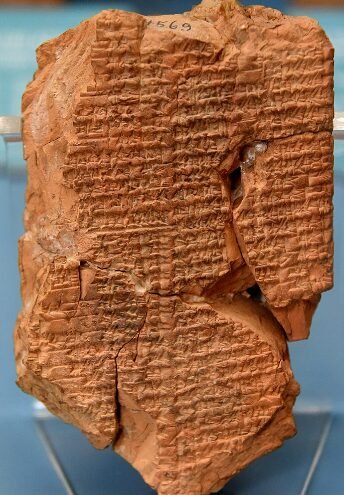
Original Sumerian tablet of the Courtship of Mesopotamian deities Inanna and Dumuzid.
One of the most significant aspects of Dumuzid’s mythology is his role in the sacred marriage with Inanna, a central theme in Mesopotamian religion.
According to some scholars, this ritual, which may have originated towards the end of the third millennium BCE, involved the king of Uruk assuming the role of Dumuzid and engaging in ritualized sexual union with the high priestess of Inanna. This symbolic act was thought to ensure the fertility of the land and the prosperity of the people, embodying the divine union between earth and sky, male and female, death and rebirth.
In Sumerian mythology, Dumuzid’s sister was Geshtinanna, the goddess of agriculture and fertility.
The sacred marriage was typically performed during the Sumerian new year festival, the Akitu, which took place at the spring equinox. Although earlier scholars interpreted this union as a physical act of sexual intercourse, recent studies suggest that the ritual may have been more symbolic than literal, representing the union of divine forces rather than a physical coupling between king and priestess.
Regardless of its actual form, the sacred marriage was a crucial part of Dumuzid’s mythos, linking him to the prosperity and fertility of the land.
Inanna’s Descent into the Underworld

The Adda Seal, an ancient Akkadian cylinder seal showing (from left to right) Inanna, Utu, Enki, and Isimud (circa 2300 BC)
One of the most famous stories involving Dumuzid is Inanna’s Descent into the Underworld. In this myth, Inanna (Ishtar) descends to the underworld to visit her sister Ereshkigal, the queen of the dead. As Inanna descends, she passes through seven gates, stripping off a piece of clothing at each one until she stands naked before her sister. Ereshkigal strikes her dead, and Inanna’s corpse is hung on a hook. However, the god Enki (Ea) sends two beings to retrieve her body, and they manage to revive her with the food and water of life.
Upon her return, the galla demons demand that someone else take her place in the underworld, as no one can leave without sending another in their stead. Inanna first tries to send her loyal servant Ninshubur, but cannot bring herself to do so, as Ninshubur had mourned her absence. She then finds her husband Dumuzid, who, rather than mourning her death, is sitting beneath a tree, adorned in fine clothes and seemingly unaffected by her ordeal. Inanna, furious at his lack of grief, decrees that the demons take him instead. However, she later regrets this decision and allows Dumuzid to spend half of the year in the underworld, while the other half he would spend with her, symbolizing the cycle of death and rebirth.
Dumuzid was closely associated with fertility and the harsh summer heat of Mesopotamia was believed to be caused by his yearly descent to the underworld.
This myth of Inanna and Dumuzid is one of the earliest examples of the theme of a dying-and-rising god, a motif that would later appear in many other religions. Dumuzid’s descent into the underworld and eventual return mirrored the seasonal changes in Mesopotamia, where the harsh summer gave way to the cooler, more fertile months. His story explained the agricultural cycles and provided a religious framework for understanding the mysteries of life, death, and renewal.

In “Inanna’s Descent,” Dumuzid’s failure to mourn leads demons to take him, later sharing time in the underworld with his sister, Geshtinanna, symbolizing seasons. Image: Ancient Sumerian cylinder seal impression depicting Dumuzid being tortured by galla demons in the Underworld.
Dumuzid’s Death and the Afterlife
The mythological accounts of Dumuzid’s death are numerous and varied, with different traditions presenting alternate versions of his demise.
In “The Dream of Dumuzid,” the shepherd god has a premonition of his death in a terrifying dream, after which he is pursued by the galla demons sent to take him to the underworld. Despite attempting to flee, Dumuzid is captured and taken to the realm of the dead. In another version, “The Return of Dumuzid,” his sister, Geshtinanna, mourns his death alongside Inanna and Dumuzid’s mother, Sirtur. Eventually, Dumuzid is found, and the arrangement is made for him to spend half of the year in the underworld and half in heaven with Inanna.
Another narrative, “Inanna and Bilulu,” tells of Dumuzid’s murder at the hands of Bilulu, an old bandit woman. In this version, Inanna avenges her husband’s death by transforming Bilulu into a waterskin, forcing her to pour libations in Dumuzid’s honor. These various accounts emphasize the god’s inevitable fate and his integral connection to the cyclical nature of life and death in Mesopotamian cosmology.
Spread of the Cult of Tammuz
As Mesopotamian culture spread across the Near East, so too did the cult of Dumuzid. The Babylonians adopted him as Tammuz, and his worship extended to the Levant and beyond.
In Canaan, Dumuzid became known as Adon, and in Greek mythology, he was identified with Adonis, the lover of Aphrodite. The Greek myth of Adonis, who was killed by a wild boar and subsequently mourned by Aphrodite, closely mirrors the Mesopotamian stories of Tammuz’s death and rebirth.

Image: Attic red-figure aryballos by Aison (c. 410 BC) depicting Adonis with Aphrodite in intimate companionship.
The Hebrew Bible also references Tammuz, particularly in the Book of Ezekiel, where women are described as mourning his death. This passage highlights the persistence of his cult well into the first millennium BCE, even as other gods and religious practices rose to prominence. The weeping for Tammuz, along with the baking of cakes for Ishtar, formed a central part of this tradition, carried on by women who lamented his death each year.
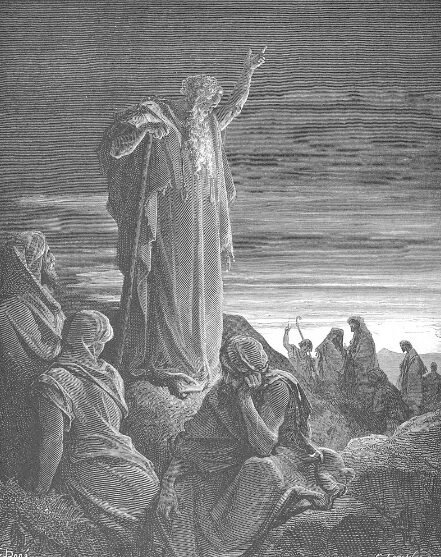
Dumuzid’s cult spread throughout the Levant and Greece, where he was known as Adonis. His legacy endured through ritual mourning and even found mention in the Hebrew Bible. Image: Prophet Ezekiel witnesses women mourning Tammuz’s death outside the Jerusalem Temple (Ezekiel 8:14) (illustration by French artist Gustave Doré, 1866).
Conclusion
Dumuzid’s significance in ancient Mesopotamian religion lies in his role as both a pastoral and agricultural deity, a divine shepherd who was essential to the survival of Sumerian society. His association with fertility, death, and the cycles of nature is reflected in the numerous myths and rituals surrounding his figure.
Whether as a figure of seasonal renewal, a symbol of kingship and divine marriage, or a tragic character in the underworld, Dumuzid’s story speaks to the deep connection between human life and the natural world in ancient Mesopotamia.
Frequently Asked Questions

Ancient Mesopotamian clay tablet from the Amorite Period (c. 2000-1600 BC), lamenting Dumuzid’s death, Louvre Museum.
How was Dumuzid’s death commemorated in Sumer?
Dumuzid’s death was mourned across Sumer during the midsummer month named after him, particularly in Lagash. This mourning was central to his cult, symbolizing the dry and barren summer months.
What types of prayers were typically directed toward Dumuzid?
Most prayers directed to Dumuzid involved requests for provisions such as milk, crops, and animals. He had little power outside of these specific responsibilities.
How was Dumuzid’s cult associated with women?
Women were primarily responsible for mourning Dumuzid’s death and participated in rituals, such as the preparation of cakes for his consort, Ishtar, during his month.
What ritual involved planting miniature gardens in honor of Dumuzid?
A ritual involved planting miniature gardens of quick-growing plants like lettuce and fennel, which sprouted in the sun and quickly withered. This symbolized Dumuzid’s life cycle and was connected to the Greek festival of Adonia.
What was Dumuzid’s role in the Sumerian sacred marriage ceremony?
Dumuzid’s role in the sacred marriage involved ritualized sexual union between the king of Uruk (playing Dumuzid) and the high priestess of Inanna, symbolizing the union of the god and goddess to ensure fertility of the land.
What myth describes Dumuzid competing for Inanna’s hand in marriage?
The myth Inanna Prefers the Farmer describes Dumuzid competing with the farmer Enkimdu for Inanna’s hand in marriage. Inanna eventually chooses Dumuzid, symbolizing divine favor toward the shepherd.
How does the myth “Inanna’s Descent into the Underworld” involve Dumuzid?
In this myth, Inanna allows demons to drag Dumuzid to the underworld as her replacement after she returns from the dead. However, she later decrees that Dumuzid will spend half of the year in the underworld and the other half with her, symbolizin.
How was Dumuzid associated with Gilgamesh in the Epic of Gilgamesh?
In the Epic of Gilgamesh, Ishtar (Inanna) is reminded of Dumuzid’s tragic death, linking the two figures through their connection to the goddess.
How did Dumuzid’s cult spread beyond Mesopotamia?
Dumuzid’s cult spread to the Levant and Greece, where he became known as Adonis. His worship persisted in Mesopotamia and the Levant until the eleventh century AD and influenced later Christian and Islamic traditions.
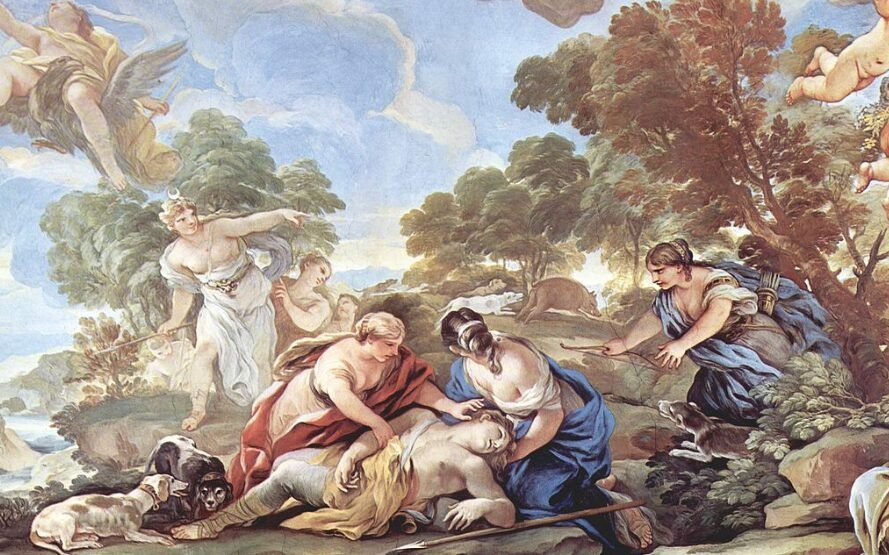
Death of Adonis (1684–1686) by Italian painter Luca Giordano.