Who was Sauromates II?
Tiberius Julius Sauromates II Philocaesar Philoromaios Eusebes, commonly referred to as Sauromates II, was a Roman client king who ruled the Bosporan Kingdom from 172 to 210/211 AD. His reign, known through inscriptions and coinage, highlights his contributions to the kingdom’s military, economy, and cultural ties with Rome. The following sections explore his lineage, life, and legacy.
Lineage and Background
Sauromates II was the son of Rhoemetalces, a previous Bosporan king, and possibly succeeded his uncle Eupator. The name “Sauromates” suggests alleged Sarmatian lineage, though it primarily reflected royal marriages to Sarmatian princesses rather than direct ethnic descent.
The Bosporan royal dynasty, established in the 1st century AD by Tiberius Julius Aspurgus and his son Mithridates, had deep connections with other ruling families. They were descendants of Mithridates VI Eupator of Pontus, a notable figure with Persian and Seleucid-Greek ancestry. Through the lineage of Antonia Tryphaena, Queen of Thrace, the family also claimed ties to the Roman triumvir Mark Antony and Pythodorida of Pontus. These connections reinforced the kingdom’s multicultural identity and political alliances with both Rome and neighboring regions.
Reign and Military Achievements
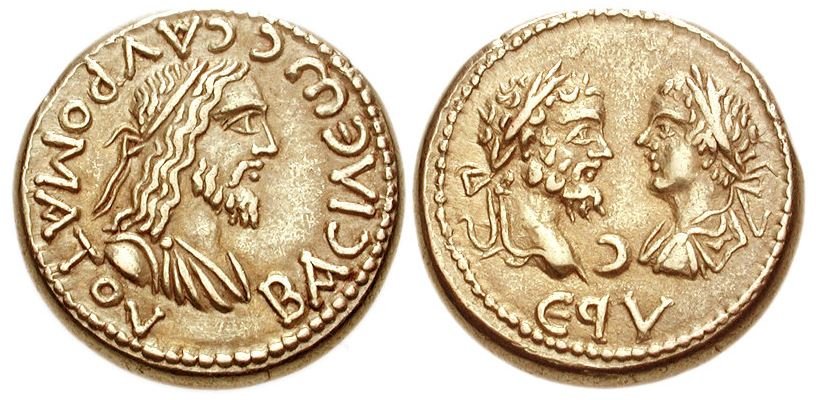
Sauromates II ascended to the throne around 172 AD, following the death of Eupator. His reign coincided with the rule of several Roman emperors, including Marcus Aurelius, Commodus, and Septimius Severus. As king, he adopted the title “Basileus Sauromatou,” prominently displayed on his coinage.
Sauromates II’s achievements—military victories, economic stabilization, and cultural integration—left an enduring impact on the Bosporan Kingdom.
A notable military achievement during his reign was the campaign against the Scythians and Sirachi tribes, culminating in a decisive victory by 193 AD. This success, commemorated by an inscription in Tanais, demonstrated his military acumen and commitment to securing the kingdom’s borders. The campaign likely began in 186 AD and had significant economic implications, as the kingdom faced financial strains during this period.
Economic Reforms
The Bosporan Kingdom encountered a financial crisis in the mid-2nd century, prompting Sauromates II to implement economic reforms starting in 186 AD. These reforms focused on adjusting the kingdom’s currency system. Over the course of a decade, the weight of bronze coins was reduced while the circulation of gold staters increased. This approach aimed to stabilize the economy and ensure the kingdom’s monetary system could sustain its needs.
The coinage of Sauromates II also reflected his ties with Rome. Gold staters from his reign often featured the portraits of Roman emperors, particularly Septimius Severus. While it is unclear whether this was a directive from Rome or a gesture of loyalty by the Bosporan king, it symbolized the kingdom’s close relationship with the Roman Empire.
Religious Devotion
Sauromates II appeared to be a deeply religious ruler, with strong ties to the cult of Aphrodite. Coins and inscriptions from his reign indicate his devotion to the goddess, which may have served both personal and political purposes. By aligning himself with a widely revered deity, Sauromates II reinforced his legitimacy and sought to unite his diverse subjects under shared religious traditions.
Legacy and Succession
The reign of Sauromates II concluded around 210/211 AD. His successor was his son, Rhescuporis III, whose name is preserved in historical records. The identity of Sauromates II’s wife remains unknown, but their lineage continued the dynasty’s legacy.
Questions and Answers
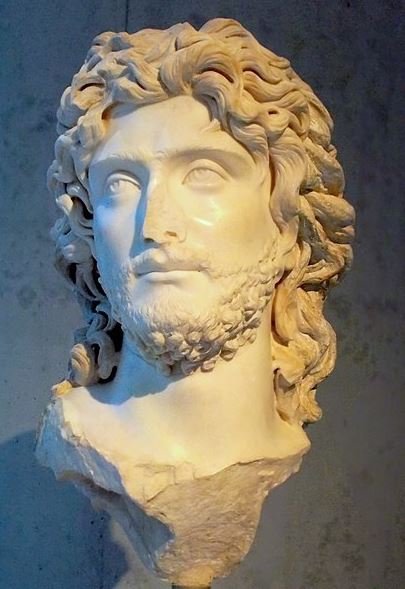
Bust of Sauromates II
What does his name and titles signify?
His epithets “Philocaesar Philoromaios Eusebes” mean “friend of Caesar, friend of Rome, pious one,” reflecting his allegiance to the Roman Empire.
What was his lineage?
He was the son of King Rhoemetalces, descended from a dynasty tracing back to Mithridates VI Eupator of Pontus and the Roman triumvir Mark Antony.
What marked his reign economically?
He initiated monetary reforms to address a financial crisis, reducing the weight of bronze coinage while increasing the circulation of gold staters.
What military achievements is he known for?
In 193 AD, he defeated the Scythians and Sirachi tribes, as commemorated by an inscription in Tanais.
How did religion feature in his reign?
He was devoted to the worship of the goddess Aphrodite, as reflected in his coinage and other dedications.
What was the significance of his coinage?
His coins featured his image alongside Roman emperors like Septimius Severus, symbolizing his alignment with Rome.
Who succeeded him?
His son, Rhescuporis III, succeeded him as Bosporan King after his death in 210/211.





