Who was the Pythia, and what was her role at Delphi?
The Pythia, often referred to as the Oracle of Delphi, was the high priestess of the Temple of Apollo at Delphi, serving as one of the most important religious figures in ancient Greece. She held a unique and revered position, delivering prophecies believed to be inspired by the god Apollo. Her role as the Pythia played a crucial part in Greek politics, culture, and religion, and the Oracle’s influence extended well beyond the boundaries of Delphi.

The prophecies of the Pythia shaped political and personal decisions, influenced the course of wars, and guided the foundation of new cities. Image: A drawing of the consultation of the Pythia by French artist Eugène Delacroix.
READ MORE: Differences between Apollo and Helios
Historical Context of the Pythia
The Pythia’s origins can be traced back to at least the 8th century BCE, though the site of Delphi was considered sacred long before that time. Delphi was located on the slopes of Mount Parnassus, in central Greece, and was originally dedicated to the Earth goddess, Gaia. However, over time, it became associated with Apollo, the god of prophecy, healing, music, and the sun.
According to mythology, Apollo claimed Delphi by slaying the serpent Python, a monstrous being that guarded the site. The name “Pythia” is believed to derive from Python, signifying the connection between the priestess and this mythological event.
The Temple of Apollo became the heart of the Delphic Oracle, where pilgrims from all over the ancient world came to seek guidance on matters ranging from personal dilemmas to state affairs. The Pythia was the mouthpiece through which Apollo communicated with the human world, making her a central figure in Greek spiritual and political life.
READ MORE: Offspring of Gaia in Greek Mythology
The Process of Divination
The process of divination at Delphi was highly ritualistic. The Pythia would sit on a tripod positioned above a deep fissure in the earth, from which intoxicating vapors were believed to rise. It was thought that the fumes, possibly ethylene or other gases, induced a trance-like state in the priestess, enabling her to channel Apollo’s divine wisdom. She would then deliver her prophecies, often in cryptic or ambiguous phrases.
The Pythia’s sessions of prophecy typically took place on the seventh day of each month, a day sacred to Apollo. Before the Pythia could deliver her oracles, a series of purification rituals were performed. She would cleanse herself in the Castalian Spring, burn laurel leaves, and offer a sacrifice of barley and a goat or other animal to Apollo. Only then would she take her seat on the sacred tripod.
The questioners, known as theopropoi, would present their inquiries through a series of intermediaries, usually male priests, who would translate the Pythia’s often incoherent or ecstatic utterances into more understandable forms. The responses, though often vague, were regarded with utmost seriousness, and the interpretations could have far-reaching consequences.
The Role and Power of the Pythia
The Pythia was not just a religious figure but also held significant political influence. Leaders, generals, and kings from across the Greek world and beyond would consult the Oracle before making major decisions, such as waging war, founding colonies, or undertaking religious reforms. The Oracle’s responses were believed to reflect the will of the gods, and no major political or military decision was made without seeking her counsel.
One famous example of the Pythia’s influence occurred before the Battle of Thermopylae in 480 BCE. When the Persian King Xerxes threatened Greece, the Spartans consulted the Oracle about the outcome of the war. The Pythia famously prophesied that either Sparta would fall or its king would die, a prophecy fulfilled when King Leonidas and his 300 soldiers sacrificed themselves at Thermopylae.
Similarly, the Oracle played a key role in the establishment of Greek colonies. Settlers would seek her advice on where to establish new cities, and her guidance was crucial in expanding Greek influence throughout the Mediterranean and Black Sea regions.
While the Pythia’s authority was deeply respected, her prophecies were often deliberately ambiguous. This allowed for multiple interpretations, making it difficult to predict the exact meaning of her words until after the events had unfolded. Her enigmatic statements were not seen as a flaw but as a reflection of the complex and mysterious nature of divine knowledge.
Greco-Persian Wars: Why did the Persian kings wage war against the Greeks?
Selection and Role of the Priestess
The Pythia was typically an older woman, selected from among the local population of Delphi. Contrary to earlier beliefs that she had to be a young virgin, historical evidence suggests that she was more likely a post-menopausal woman, often of humble origins, who lived a celibate life after taking on her role. It was believed that her life experience and distance from the passions of youth made her a more suitable vessel for divine communication.
The selection of the Pythia was a process shrouded in mystery. Although the specific criteria for choosing the priestess are not fully known, the position was highly prestigious, and the Pythia was treated with great respect. Her role was lifelong, and while there is some evidence that multiple Pythias could serve simultaneously or in succession, the office was generally held by a single individual at any given time.
Though she was seen as a direct conduit for Apollo’s wisdom, the Pythia herself did not wield independent power. She was part of a larger religious structure that included the temple priests, who managed the day-to-day operations of the sanctuary and often served as interpreters of her oracles. Despite this, the Pythia was viewed as an essential and sacred figure in the Greek religious landscape.
Decline of the Oracle
The influence of the Pythia and the Delphic Oracle gradually waned over the centuries. During the classical period of Greece, the Oracle reached the height of its power, but by the Hellenistic period (323–31 BCE), its influence began to decline. Several factors contributed to this, including the rise of rational philosophy, the increasing dominance of other forms of divination, and the spread of monotheistic religions such as Christianity.
By the Roman period, the Oracle still retained some prestige, but its prophecies were less frequently sought. The Emperor Julian (reigned 361–363 CE), known as Julian the Apostate for his efforts to revive paganism, famously consulted the Oracle, only to receive a prophecy that the Oracle’s power had faded and that “the springs of prophecy had dried up.” This marked the symbolic end of the Oracle’s influence.
The final blow came with the rise of Christianity in the Roman Empire. Pagan temples were closed or repurposed for Christian worship, and the Delphic Oracle was officially disbanded by Emperor Theodosius I in 393 CE, as part of his efforts to suppress pagan practices.
How did Constantine’s vision at Milvian Bridge facilitate the spread of Christianity?
Legacy of the Pythia
Though the Oracle of Delphi ceased to function in the late Roman period, the legacy of the Pythia has endured throughout history. The concept of the oracle as a mouthpiece for divine wisdom has inspired countless works of literature, art, and philosophy. The ambiguous nature of the Pythia’s prophecies continues to captivate the imagination, symbolizing the elusive nature of truth and the interplay between human free will and divine intervention.
In ancient Greece, the Pythia was a symbol of the intersection between the divine and mortal worlds. She represented the idea that the gods were not distant, but actively involved in human affairs, guiding individuals and nations alike. Her role as the Oracle of Delphi made her a central figure in shaping the course of Greek history and influencing decisions that reverberated across the ancient world.
The physical site of Delphi itself has become a significant archaeological and tourist destination, preserving the memory of the Pythia and the sacred traditions of the Oracle. The ruins of the Temple of Apollo, the remains of the theater, and the famous Omphalos stone, believed to mark the center of the world, are all reminders of the profound religious and cultural significance of Delphi.

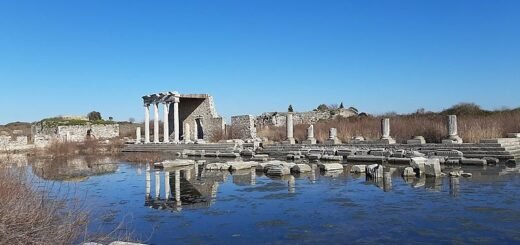
Image: Temple of Apollo in Delphi, Greece.
Theories about the Pythia’s Inspiration
One of the enduring mysteries surrounding the Pythia is the nature of the trance or altered state she entered during her prophetic sessions. Ancient sources describe her as being in a frenzied, ecstatic state, speaking in a voice not her own. For centuries, scholars have debated the cause of this phenomenon.
One popular theory, based on ancient accounts, is that the Pythia was exposed to intoxicating vapors emanating from the ground beneath the temple. These vapors, possibly composed of gases such as ethylene, could have induced a state of altered consciousness. In 2001, a geological study found evidence that fault lines beneath the temple could have released such gases into the air, lending some credence to this hypothesis.
Other theories suggest that the Pythia may have entered her trances through more conventional means, such as ritualistic breathing, chanting, or consuming psychoactive substances. However, there is no conclusive evidence to support these ideas, and the exact nature of the Pythia’s prophetic state remains a subject of speculation.

Cultural and Religious Significance
The Oracle of Delphi was more than just a place to seek answers; it was a symbol of the broader religious and cultural values of ancient Greece. The Pythia’s role as a mediator between the human and divine realms reflected the Greek belief in the importance of maintaining harmony with the gods. The practice of consulting the Oracle was a way for individuals and states to align their actions with divine will, ensuring the favor of the gods and avoiding divine retribution.
The Oracle also embodied the Greek emphasis on sophrosyne, or moderation and self-restraint. The often cryptic nature of the Pythia’s prophecies encouraged questioners to reflect deeply on their choices and to approach important decisions with humility and caution. This emphasis on deliberation and wisdom resonated with the broader Greek philosophical tradition, which valued knowledge and self-awareness.
In many ways, the Pythia can be seen as a symbol of the ancient Greek worldview, in which human life was shaped by forces beyond individual control. Fate, destiny, and the will of the gods played central roles in Greek thought, and the Oracle of Delphi was a tangible expression of these ideas. Through the Pythia, the Greeks sought to understand their place in the world and to navigate the uncertainties of life with the guidance of the divine.

Questions and Answers on the Archaeological Site of Delphi and the Pythia

The Pythia, as the Oracle of Delphi, was a powerful figure in ancient Greek society, serving as the intermediary between the mortal and divine worlds.
Where is the archaeological site of Delphi located?
Delphi is situated over 1750 feet above sea level on the southwestern slope of Mount Parnassus in central Greece, approximately 6 miles from the Corinthian Gulf.
How old is the temple complex of Delphi, and why was it significant in ancient Greece?
The temple complex at Delphi dates back more than 2700 years. It was famous throughout ancient Greece as the home of the Oracle of Apollo, where people sought prophecies from the god of prophecy, music, healing, and light.
What theories exist about the cause of the Pythia’s trance state?
Scholars have proposed several theories regarding the cause of the Pythia’s trance, including the chewing of laurel leaves, the waters of the Castalian Spring, and vapors rising from an underground cavern. However, laurel leaves are not hallucinogenic, and there was no initial evidence of fissures producing toxic gases beneath the temple.
Is it true that the Pythia’s prophecies were incoherent and required interpretation by priests?
No, this is a misconception. According to some classical scholars, Pythia’s responses were often clear and coherent, delivered in straightforward prose. She was portrayed as speaking lucidly, in her own voice, rather than in an incomprehensible frenzy.
How does the literary tradition of Apollo-induced possession relate to Pythia?
In Classical Greek literature, Apollo-induced possession was commonly depicted, as seen in the case of Cassandra, the daughter of Priam and Hecuba of Troy. Like the Pythia, Cassandra was possessed by Apollo when delivering her prophecies. This tradition shows that such possession, though often intense, was not necessarily incoherent.
What is the concept of pneuma, and how might it relate to the Pythia’s trance state?
Pneuma refers to the divine breath or vital spirit, often associated with a sacred vapor in antiquity. It is possible that the Pythia’s trance was influenced not by toxic gases, but by this concept, representing the divine wisdom or breath of Apollo flowing through her as she delivered prophecies.