Why did Alexander Hamilton and Aaron Burr duel?
The duel between Alexander Hamilton and Aaron Burr is one of the most infamous events in American history. It was the culmination of a long-standing personal and political rivalry that had festered over many years.
To understand why these two prominent figures ended up facing each other with pistols at dawn on July 11, 1804, American historians at World History Edu delve into the complex web of political intrigue, personal animosity, and cultural norms of our early Republic.
The Early Years
Hamilton and Burr both had distinguished careers and similar beginnings. Alexander Hamilton, born in the Caribbean and orphaned at a young age, rose to prominence through sheer intellect and determination.
He was a key figure in the American Revolutionary War, served as George Washington’s aide-de-camp, and was instrumental in the drafting and ratification of the U.S. Constitution. Hamilton’s vision for America was one of a strong central government, a robust financial system, and a nation that would become a global economic power.
Aaron Burr, born into a prestigious family in New Jersey, was the grandson of theologian Jonathan Edwards and the son of Princeton University’s second president.
Burr, like Hamilton, fought valiantly in the Revolutionary War and pursued a career in law and politics. Burr’s charm, intelligence, and ambition quickly propelled him to high office, and he became Vice President of the United States under Thomas Jefferson.
Political Differences
Despite their similar trajectories, Hamilton and Burr had starkly different political philosophies. Hamilton was a Federalist, advocating for a strong centralized government, a national bank, and close ties with Britain. Burr, although not strictly aligned with any party for much of his career, leaned towards the Democratic-Republicans, who favored states’ rights and a more agrarian-based economy. These ideological differences often placed them at odds in the political arena.
Personal Animosity
Their rivalry was not merely political; it was deeply personal. Hamilton never trusted Burr, whom he considered unprincipled and dangerously ambitious. Burr, on the other hand, resented Hamilton’s influence and the slights, both real and perceived, he received from Hamilton over the years.
The Election of 1800
The election of 1800 was a critical moment in American history and a pivotal point in the Hamilton-Burr relationship. The election ended in a tie between Thomas Jefferson and Aaron Burr, both Democratic-Republicans.
The tie had to be broken by the House of Representatives, where Hamilton, despite being a Federalist, played a significant role in swaying the vote. Hamilton detested Jefferson but considered him a lesser evil compared to Burr, whom he deemed dangerously unfit for the presidency. Hamilton’s lobbying against Burr was a severe blow to Burr’s ambitions and further deepened the animosity between the two men.
The New York Gubernatorial Race
By 1804, Burr’s political career was in decline. He had fallen out of favor with Jefferson and his own party and sought the governorship of New York as a means to regain political power.
Hamilton, who wielded considerable influence in New York politics, once again opposed Burr. During the campaign, Hamilton made derogatory remarks about Burr, which were published in a newspaper. The most damaging was an account of a dinner party at which Hamilton allegedly said he held a “despicable opinion” of Burr. These comments were seen as a direct attack on Burr’s honor.
The Code of Honor
In the early 19th century, dueling was a common practice among gentlemen to settle matters of honor. While illegal, it was socially accepted in certain circles.
For many men of their stature, public reputation and personal honor were paramount, often taking precedence over life itself.
Burr, feeling that his honor had been irreparably damaged by Hamilton’s comments, demanded a retraction. Hamilton, bound by his principles and personal code, refused to apologize, though he tried to defuse the situation by providing a somewhat conciliatory but vague response. Burr, unsatisfied and still enraged, challenged Hamilton to a duel.
The Duel
On the morning of July 11, 1804, Hamilton and Burr met at the dueling grounds in Weehawken, New Jersey. It was a secluded spot that had hosted other duels, including one in which Hamilton’s son, Philip, had been killed three years earlier.
The circumstances of the duel are still debated. Some historians believe Hamilton intended to deliberately miss Burr by firing into the air, as a way to adhere to his moral opposition to dueling while still meeting the challenge. This practice was known as a “delopement.” Burr, however, took aim and shot Hamilton in the abdomen. Hamilton was gravely wounded and died the next day.

The duel between Alexander Hamilton and Aaron Burr was the result of a long-standing personal and political rivalry, culminating in Burr challenging Hamilton after a series of public insults and political conflicts. Image: A portrait of Hamilton by American painter John Trumbull.
Aftermath and Legacy
The duel had profound consequences for both men. Hamilton, already a towering figure in American history, became a martyr, his death evoking widespread mourning and solidifying his legacy as a Founding Father. Burr’s career, however, was ruined. He was charged with murder in both New York and New Jersey, though the charges were eventually dropped. His political prospects were irreparably damaged, and he became a pariah in American society.
Burr’s later years were marked by further controversy, including his involvement in a mysterious and ultimately unsuccessful scheme to establish an independent nation in the western territories, for which he was tried and acquitted for treason. He lived the rest of his life in relative obscurity, dying in 1836.
Cultural and Historical Impact
The duel between Hamilton and Burr has been the subject of extensive analysis and interpretation. It symbolizes the volatile nature of early American politics, the intense personal rivalries that shaped the nation’s history, and the extreme measures taken to defend personal honor during that era.
The event has also been immortalized in literature, film, and, most notably, the Broadway musical “Hamilton,” which has brought renewed interest to the lives and legacies of both men.
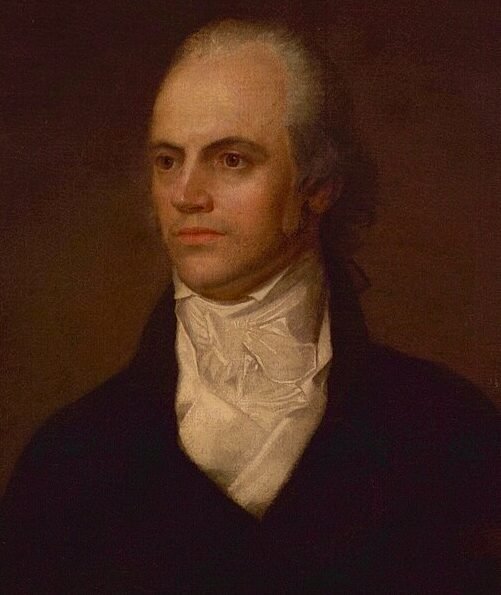
The duel between Alexander Hamilton and Aaron Burr was the tragic endpoint of a bitter and multifaceted rivalry that intertwined personal animosities, political conflicts, and the cultural mores of the time. Image: An 1803 portrait of Aaron Burr.
Frequently Asked Questions about Alexander Hamilton
Where was Alexander Hamilton born?
Hamilton was born on January 11, 1755 (or 1757, the exact year is disputed) in Charlestown, Nevis, in the Caribbean.
What was Alexander Hamilton’s educational background?
Hamilton attended King’s College (now Columbia University) in New York City, where he studied law and quickly became involved in revolutionary activities.
What was Alexander Hamilton’s role in the American Revolution?
Hamilton served as an aide-de-camp to General George Washington and played a crucial role in the Revolutionary War, including leading an attack at the Battle of Yorktown.
What were Hamilton’s contributions to the U.S. financial system?
Hamilton established the national bank, advocated for a strong central government, and laid the foundation for the modern financial system, including the creation of the U.S. Mint and the First Bank of the United States.
What is “The Federalist Papers”?
“The Federalist Papers” is a series of 85 essays written by Hamilton, James Madison, and John Jay promoting the ratification of the United States Constitution. Hamilton wrote 51 of these essays.
Who were Alexander Hamilton’s main political opponents?
Hamilton’s main political opponents included Thomas Jefferson and James Madison, who were leaders of the Democratic-Republican Party, which opposed Hamilton’s Federalist policies.
How did Alexander Hamilton die?
Hamilton died on July 12, 1804, after being mortally wounded in a duel with Vice President Aaron Burr.
What was Alexander Hamilton’s stance on slavery?
Hamilton was an outspoken critic of slavery and a founding member of the New York Manumission Society, which worked to end the practice of slavery in New York.
Was Alexander Hamilton ever President of the United States?
No, Alexander Hamilton never served as President. He did, however, have a significant impact on the early development of the nation’s government and policies.
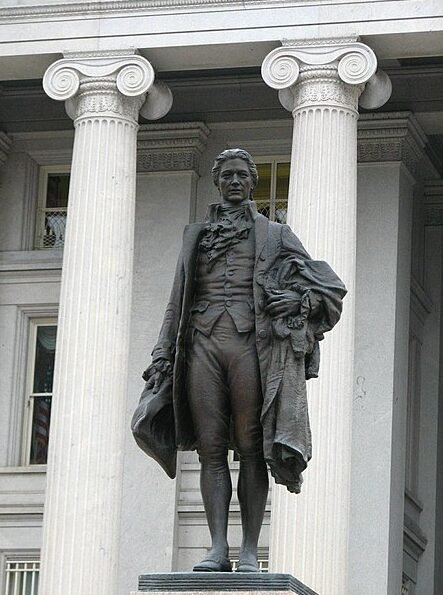
Hamilton’s legacy includes his contributions to the establishment of the U.S. financial system, his role in the creation of the Constitution, and his influence on American political thought. His life and work have also been popularized by the Broadway musical “Hamilton.” Image: Statue of Hamilton.





