10 Fiercest Greek Mythological Creatures and Monsters
Greek mythology is replete with a myriad of fascinating and terrifying creatures, each uniquely embodying human fears, challenges, and the chaotic nature of the world. This vast pantheon has given us monsters that have become iconic symbols in literature, art, and popular culture.
Below, World History Edu delve deep into the tales of ten of the fiercest creatures from Greek mythology:
The Minotaur

The Minotaur is perhaps one of the most notorious Greek monsters. Born from the union of a bull and Queen Pasiphaë of Crete, the Minotaur possessed the body of a man and the head of a bull. Image: The Minotaur, tondo of an Attic bilingual kylix.
In Greek mythology, the Minotaur is a monstrous creature with the head of a bull and the body of a man. This fearsome beast was the offspring of Pasiphaë, the wife of King Minos of Crete, and a magnificent bull sent by the god Poseidon. Minos, having promised to sacrifice the bull to Poseidon and then reneging on his vow, incited the god’s wrath. As punishment, Poseidon caused Pasiphaë to fall in love with the bull, leading to the birth of the Minotaur.
To contain the beast, King Minos commissioned Daedalus, a skilled craftsman, to construct the Labyrinth—a vast maze of bewildering complexity beneath the royal palace at Knossos. The Minotaur was confined within this maze, where it was fed a regular tribute of youths and maidens sent as sacrifice from Athens, a penance for the death of Minos’ son at Athenian hands.
The Minotaur’s story concludes with the hero Theseus of Athens, who volunteers to confront the creature. Aided by Minos’ daughter, Ariadne, who provides him with a ball of thread to navigate the labyrinth, Theseus slays the Minotaur, thus ending its reign of terror and freeing Athens from its harsh tribute.

King Minos, embarrassed by its existence, had the Labyrinth constructed to contain it. Heroes ventured into this maze either as sacrifices or in attempts to kill the beast, but many met their demise until Theseus, with the help of Ariadne, successfully slayed the creature. Image: Theseus Slaying Minotaur (1843), bronze sculpture by Antoine-Louis Barye
Medusa

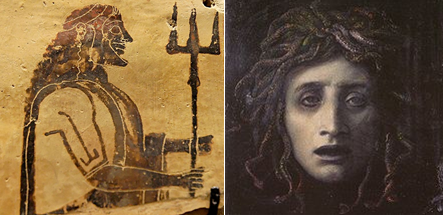
Medusa was absolutely lovely and beautiful. She was undoubtedly one of the most beautiful women in Greek mythology, up there with the likes of Helen of Troy and maiden deities like Artemis and Athena. Medusa being punished for the atrocities of Poseidon epitomizes what many people like to call rape-victim blaming. Image: Medusa by Swiss symbolist painter Arnold Böcklin, circa 1878
Medusa is one of the three Gorgons and the only mortal among them. She is famously known for her hair of living snakes and a gaze that could turn onlookers to stone. Originally a beautiful maiden, Medusa’s transformation into a monster is a tale of beauty, betrayal, and curse.
Medusa’s story begins with her serving as a priestess in Athena‘s temple. Her beauty caught the eye of Poseidon, who pursued her. The union between Medusa and Poseidon, often described as a violation, occurred within the sacred confines of Athena’s temple.
Enraged by this desecration, Athena cursed Medusa, turning her lovely hair into serpents and making her gaze lethal, ensuring that no man could look at her without suffering a petrified fate.

Once a beautiful maiden, Medusa was transformed into a Gorgon by Athena as punishment for desecrating her temple. With serpents for hair and a gaze that could turn anyone to stone, Medusa became a symbol of terror.
Medusa’s tragic story concludes with Perseus, a hero tasked with obtaining her head as part of a quest to save his mother from an unwanted marriage. With help from divine gifts, including a mirrored shield from Athena, winged sandals from Hermes, and a sword from Hephaestus, Perseus beheaded Medusa while looking only at her reflection. Her head was later used by Perseus to perform feats and was eventually placed on Athena’s shield, the aegis.

It was the demigod Perseus who, with divine assistance, managed to behead her, using her severed head later as a weapon and ultimately gifting it to Athena. Image: Greek hero Perseus holding the Severed Head of Medusa.
Hydra

The Lernaean Hydra was a water serpent with multiple heads. When one head was cut off, two more would sprout in its place. This creature terrorized the region of Lerna until Hercules, as one of his Twelve Labors, took on the task of defeating it. Painting: French artist Gustave Moreau’s 19th-century depiction of the Hydra, influenced by the Beast from the Book of Revelation
The Hydra was a fearsome, serpent-like monster with multiple heads. It dwelled in the swampy waters of Lerna, a region reputed to be an entrance to the Underworld. The Hydra was infamous for its regenerative ability—cut off one of its heads, and two more would sprout in its place. This feature made it nearly impossible to kill, and it terrorized the local populace.
The Hydra’s story is most famously recounted in the myths of Heracles (Hercules in Roman mythology), specifically in his Twelve Labors. The Hydra was the second labor assigned to Heracles by King Eurystheus. The challenge was not only to defeat the beast but to conquer its regenerative powers. With the aid of his nephew Iolaus, Heracles found a way to overcome the monster.
As Heracles severed each head, Iolaus cauterized the neck stumps with a torch, preventing new heads from growing. Finally, Heracles dipped his arrows in the Hydra’s poisonous blood, giving them lethal powers. This labor highlighted Heracles’ strength and ingenuity, securing his place as one of mythology’s greatest heroes.

With the help of his nephew Iolaus, Hercules found a way to cauterize the neck stumps, preventing new heads from growing, and eventually killed the monster. Image: Pollaiuolo’s Hercules and the Hydra (c. 1475). Uffizi Gallery, Florence, Italy
Chimera

A fire-breathing monster, the Chimera had the body of a lioness, a goat’s head protruding from its back, and a serpent as its tail. Bellerophon, with the help of the winged horse Pegasus, managed to slay this creature. Image: The Chimera on a red-figure Apulian plate, c. 350–340 BC
The Chimera is a monstrous fire-breathing hybrid creature, composed of parts from multiple animals. Typically depicted with the body and head of a lion, a goat’s head protruding from its back, and a serpent or dragon for a tail, the Chimera is a symbol of hybrid terror and chaos.
This creature’s origins are tied to the myths of Lycia in Asia Minor. It was considered an offspring of Typhon, a monstrous giant, and Echidna, often described as a half-woman, half-serpent. The Chimera’s tale is most famously linked to the hero Bellerophon, a figure tasked with slaying the beast as a nearly impossible challenge imposed by King Iobates of Lycia.
Equipped with the winged horse Pegasus, which he tamed with the help of the goddess Athena and her golden bridle, Bellerophon was able to attack the Chimera from above, out of reach of its fiery breath. He ultimately killed the creature by using a spear tipped with lead that melted when exposed to the Chimera’s fiery exhalations, suffocating the beast.

The Chimera’s frightening appearance and its amalgamation of different animals symbolize the unpredictable and chaotic nature of the world. Image: Bellerophon riding Pegasus and slaying the Chimera, central medallion of a Roman mosaic from Autun, Musée Rolin, 2nd to 3rd century AD
Cerberus

Cerberus is the multi-headed hound that stands guard at the gates of Underworld (i.e. Hades). Image: Cerberus, with the gluttons in Dante’s Third Circle of Hell. English poet and painter William Blake.


Sirens

The Sirens were often depicted as women with bird-like features, lured sailors to their deaths with their enchanting music and voices. Their songs were irresistible, leading many to shipwreck on rocky coasts. Image: Odysseus and the Sirensvase of the Siren Painter, c. 475 BC
The Sirens are creatures with the heads of women and the bodies of birds. They dwell on an island in the sea, from where they lure sailors with their enchanting music and singing voices. The Sirens’ songs are irresistible, bewitching all who hear them and drawing them towards dangerous rocks, leading to shipwrecks.
The Sirens are often associated with the challenges faced by the hero Odysseus during his return from the Trojan War, as recounted in Homer‘s “Odyssey.” Forewarned by the sorceress Circe, Odysseus orders his men to plug their ears with beeswax and has himself tied to the mast of his ship. This way, he can safely listen to the Sirens’ song without succumbing to their spell, successfully navigating past the peril while still experiencing their alluring melodies. This episode highlights the themes of temptation and the hero’s cunning to overcome it.

Odysseus, curious to hear their song but aware of the danger, had his crew plug their ears with beeswax and tie him to the ship’s mast, ensuring a safe passage.
Harpies

Often portrayed as birds with the heads of women, Harpies were known for their speed and their role as agents of punishment. They would steal food, torment wrongdoers, and carry evildoers away to the Furies. Image: Mirror with figure of a Harpy, 11–12th century CE, Termez, Uzbekistan.

Cyclopes

The Cyclopes are a group of one-eyed giants. While some were known as skilled blacksmiths and craftsmen, others were shepherds with a taste for human flesh. Image: A first century AD head of a Cyclops from the Roman Colosseum
Cyclopes are a race of giants each with a single eye in the middle of their forehead. They are known for their immense strength and skill as craftsmen. Cyclopes are divided into two distinct groups: the primordial Cyclopes and the Sicilian Cyclopes. The primordial ones, sons of Uranus and Gaia, are divine craftsmen who forged Zeus’s thunderbolts. The Sicilian group, however, are depicted as more barbaric shepherds.
The most famous Cyclops is Polyphemus, encountered by Odysseus in Homer’s “Odyssey.” Polyphemus imprisons Odysseus and his men, intending to eat them. Using cunning, Odysseus blinds Polyphemus and escapes, showcasing the hero’s ingenuity against brute force. This story underscores themes of intelligence overcoming might.

One famous Cyclops, Polyphemus, trapped Odysseus and his men in his cave, planning to eat them. Using wit and cunning, Odysseus managed to blind the monster and escape. Painting: Guido Reni’s painting in the Capitoline Museums.
Gorgons

Medusa is the most famous, but there were three Gorgon sisters: Medusa, Stheno, and Euryale. With snakes for hair and a gaze that turned men to stone, these sisters were formidable creatures. Image: plate from Kameiros, Rhodes, British Museum A 748 (late seventh century BC)
Gorgons are terrifying female creatures known for their hair of living snakes and their ability to turn anyone who looks directly at them into stone. There are three Gorgon sisters: Stheno, Euryale, and the most famous, Medusa, who is mortal unlike her immortal siblings.
Their origins are linked to ancient protective and destructive powers. Gorgons are typically depicted with wide, glaring eyes, fangs, and a lolling tongue, symbolizing the ultimate in horror and repulsion.
The myth of Perseus, who beheaded Medusa with the help of divine artifacts, including a mirrored shield, highlights the theme of overcoming monstrous forces through cunning and bravery.

While Medusa was mortal and met her end at the hands of Perseus, her sisters were immortal
Nemean Lion
In Greek mythology, the Nemean Lion is a fearsome beast with impenetrable golden fur and sharp claws, terrorizing the region of Nemea. This lion is a symbol of ultimate strength and invulnerability, as no weapon could pierce its hide. It was Hera, the queen of the gods, who sent the lion to Nemea as a challenge to test heroes. The Nemean Lion becomes the first of Heracles’ Twelve Labors. Heracles defeats the lion by strangling it with his bare hands and then uses its own claw to skin it, thereafter wearing its hide as armor.

With impenetrable golden fur and sharp claws that could cut through any armor, the Nemean Lion was a creature that many heroes tried and failed to defeat. Painting: Hercules’ fight with the Nemean lion by Flemish painter Sir Peter Paul Rubens.