Were Africans in America Before 1619?
Yes, Africans were present in parts of what is now the United States before 1619. The year 1619 occupies an important place in American history. In August of that year, a ship carrying more than 20 captive Africans arrived at Point Comfort, in the English colony of Virginia.
This event is frequently described as the beginning of African American history or even the arrival of the “first Africans in America”. But neither description is entirely accurate.
Africans had already traveled through and lived in territories that would eventually become part of the United States decades before the Virginia arrival. Some came as enslaved people accompanying Spanish colonists. Others participated in European expeditions. One of the best-known early Africans traveled across enormous portions of the American South and Southwest during the 1500s. There were Africans in an attempted Spanish colony in 1526, and some were part of Spanish Florida before the end of the 16th century.
So if Africans were already in America, why does almost everyone know about 1619? The answer lies partly in the difference between the history of the land that became the United States and the history of the English colonies that eventually formed that country.
First, What Do We Mean by “America”?
There is an important historical distinction to make. The United States of America did not exist in 1619. The British colonies did not declare independence, thus forming the United States, until 1776.
So of course, it didn’t exist in 1526 either. Therefore, when we ask whether Africans were in “America” before 1619, what we usually mean is, were people of African descent present in the territory that is now the continental U.S. prior to 1619?
The answer to that question is clearly yes. North America in the early 1500s was inhabited overwhelmingly by indigenous peoples belonging to numerous nations and societies. European powers were only beginning their attempts to explore, conquer and colonize parts of the continent.
Spain was among the most active. And because Africans were already deeply entangled in the Spanish and Portuguese colonial worlds, people of African descent participated in some of their early expeditions and settlements. This brought Africans onto the continental U.S. long before the establishment of the country itself.
Africans Were Part of the Spanish Colonial World
European contact with Africa had intensified before the colonization of mainland North America. Portuguese traders had established extensive commercial relationships along the African coast during the 1400s, and the Transatlantic Slave Trade was also developing.
Following European voyages to the Americas, enslaved Africans were transported into Spanish and Portuguese colonies in the Western Hemisphere in increasing numbers. They therefore became part of the European colonial expansion into the Americas, almost from its earliest stages.
This is important to note, because popular American history is often told through the experiences of the English colonies. From that perspective, students of history are already well aware of Jamestown, the Pilgrims, the 13 Colonies, the American Revolution, etc.
But Spain had established colonies and conducted expeditions on the continental U.S. before many famous English settlements existed. Africans were involved in that Spanish history, with one of the earliest examples occurring nearly a century before 1619.
Enslaved Africans Were in a North American Colony in 1526
In 1526, Spanish colonizer Lucas Vázquez de Ayllón attempted to establish a settlement called San Miguel de Gualdape. The exact location of the settlement remains uncertain. Historians generally place it somewhere along the southeastern coast of the U.S., with proposed locations being present-day Georgia or the Carolinas.
Ayllón brought hundreds of colonists with him. Among them were enslaved Africans. That alone establishes an African presence in the region approximately 93 years before they had arrived in Virginia in 1619.
But the story becomes even more remarkable. San Miguel de Gualdape was a catastrophe. The colonists suffered from disease, hunger and internal disputes. Ayllón died shortly after the settlement was established.
During the chaos, the enslaved Africans rebelled. Some escaped from the colony. The surviving Spanish colonists eventually abandoned San Miguel de Gualdape and returned to the Caribbean. The colony lasted only a matter of months.
What happened to the Africans who escaped is uncertain, but the episode is historically significant nonetheless. It represents one of the earliest documented instances of enslaved Africans being brought to the continental United States. And it may also represent the first recorded slave rebellion in that territory, with all of this happening in 1526.
Why Isn’t 1526 as Famous as 1619?
If Africans were present in 1526, an obvious question follows. Why didn’t we grow up hearing about that year instead of 1619?
One major reason is that San Miguel de Gualdape failed. It disappeared almost immediately. The colony did not develop into a permanent settlement that eventually became part of the United States.
But Virginia was different. The English settlement at Jamestown, founded in 1607, survived. And Virginia subsequently became one of the most important English colonies in North America, with its political, economic and social institutions contributing directly to the development of the United States (besides remaining extant to this day).
The Africans who arrived in Virginia in 1619 therefore entered a colonial society that continued to grow. Their arrival became part of the story of the population that eventually developed into the Black American community. That makes 1619 exceptionally important. But important does not mean first.
An African Explorer Arrived in Florida in 1528
Another fascinating figure from this early period was an African man commonly known as Estevanico. His name appears in different forms, including Esteban, Estebanico and Estevan. He is believed to have been born in Azemmour, on the Atlantic coast of Morocco, around the beginning of the 16th century.
Estevanico was enslaved by a Spaniard named Andrés Dorantes de Carranza. In 1528, both men participated in the disastrous Narváez expedition, which attempted to colonize what would become the continental United States. The expedition landed in Florida, and almost everything went wrong.
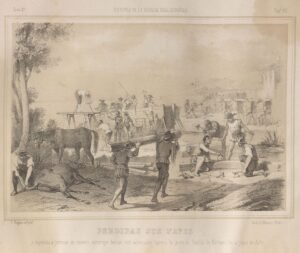
An illustration of the Narváez expedition, in 1528
The explorers encountered food shortages, disease, conflict and the enormous difficulty of traveling through unfamiliar territory. Many died. Others attempted to escape by constructing crude boats and traveling along the gulf coast. Most of those men also died. Only four members of the expedition ultimately survived the extraordinary journey that followed. Estevanico was one of them.
Estevanico Traveled Across the Future United States
For years, Estevanico and the other survivors traveled through what we know today as the southern U.S. and northern Mexico. Their precise route remains debated. But their journey took them along the coast of the gulf of Mexico and deep into the southwest.
Estevanico’s linguistic abilities and interactions with indigenous communities made him particularly valuable to the group. He apparently learned enough native languages and communication techniques to serve as an intermediary.
Eventually, in 1536, the survivors reached Spanish-controlled territory in Mexico. So think about the chronology for a moment. An African man was confidently traveling through parts of the continental U.S. during the 1520s and 1530s.
Jamestown would not be established until 1607, and the Mayflower did not reach New England until 13 years later. Therefore, Estevanico’s story belongs to a period of American history that many people don’t normally associate with Africans at all. And his adventures weren’t finished either.
Estevanico Returned to Explore North America
Several years later, Estevanico participated in another Spanish expedition, north from Mexico. Spanish authorities were interested in reports of wealthy civilizations somewhere to the north. Estevanico traveled ahead of a larger expedition into what is now the American Southwest.
In 1539, he reached the Zuni community of Hawikuh, in present-day New Mexico. He was killed there under circumstances that remain uncertain. But regardless of the fate he met, Estevanico occupies a remarkable place in history.
He was an African who explored substantial parts of North America, generations before the establishment of many famous English colonies. His story makes it impossible to claim that the first African presence in the United States occurred in 1619.
Africans Were Present in Spanish Florida
Africans also became part of Spanish colonial society in Florida. Spain founded St. Augustine in 1565. The settlement survives today and is generally recognized as the oldest continuously-inhabited, European-established locality in the continental United States.
Africans were among the people who were part of the founding of St. Augustine. Some were enslaved, but others eventually lived as free people.
Spanish Florida developed under a different legal and religious system than the neighboring English colonies. Those differences would later have major consequences for enslaved Black people living under British rule in the land.
Florida Became a Destination for Fugitive Slaves
As English plantation slavery expanded in colonies such as South Carolina, some enslaved people began escaping south, towards Spanish Florida. Spain and Britain were imperial rivals, and Spanish authorities realized that fugitives from British colonies could be useful.
By the late 17th century, Spain offered freedom, under certain conditions, to enslaved people escaping from British territories.
Fugitives generally had to accept Catholicism, and the men potentially had to serve Spain militarily.
For an enslaved person in an English colony, Spanish Florida could therefore represent something extraordinary – a possible route to freedom. Slaves risked their lives traveling south, with some successfully reaching St. Augustine. And their presence eventually helped create one of the most remarkable Black communities in colonial American history.
Fort Mose Became an Early Free Black Settlement
In 1738, the Spanish established a settlement north of St. Augustine known as Gracia Real de Santa Teresa de Mose, usually called Fort Mose. Its residents included formerly enslaved Blacks who had escaped from British colonies.
Fort Mose is widely recognized as the first legally-sanctioned free Black settlement on the continental U.S. Its residents weren’t simply refugees. They became part of Spain’s military defense of Florida, with Black militiamen assisting in the defense of the colony against British attack.
Fort Mose demonstrates how complicated early Black history in America actually was. At the same time that Africans and their descendants were being enslaved in English colonies, a community of free Black people existed in Spanish Florida and took up arms against British forces. This history doesn’t fit neatly into the simplified story that many people learn about colonial America.
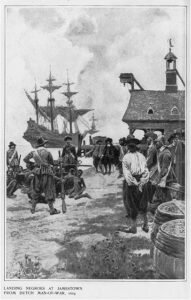
A depiction of African captives arriving in Jamestown, Virginia in 1619
Then What Exactly Happened in 1619?
In 1619, two English privateering ships – the White Lion and the Treasurer – were operating in the Atlantic.
They encountered a Portuguese slave vessel called the São João Bautista. It was carrying hundreds of enslaved Africans across the Atlantic, who were captured primarily from west-central Africa, particularly the region of present-day Angola. The English privateers seized some of the Africans.
In August 1619, the White Lion reached Point Comfort in Virginia, near present-day Hampton. The ship carried “20 and odd” Africans, according to an account from the period.
Some of these captives were exchanged for provisions. The treasurer arrived shortly afterward carrying additional Africans. This event is the source of the famous date of 1619.
Were the 1619 Africans the First Enslaved Africans in America?
No, if “America” means all territory that is now the United States. Enslaved Africans had been brought to the short-lived San Miguel de Gualdape colony in 1526. Africans had also been present in other Spanish colonial territories.
Nor were the Virginia Africans the first to be enslaved in the Americas in general. By 1619, Europeans had already – for generations – been transporting African captives throughout the Caribbean and Latin America. What made Virginia different was its relationship to the future United States.
The English colonies along the Atlantic coast ultimately became the political core of the country. The institution of slavery expanded dramatically within those colonies. The 1619 arrivals therefore became an important, foundational part of the history of slavery within the English colonial system that eventually produced the United States.
Where Did the Africans Who Arrived in Virginia Come From?
The story of the 1619 Africans can be traced surprisingly far.
Many originated in the Kingdom of Ndongo, in what is now Angola. Portuguese forces and their African allies had been fighting wars in the region. Captives from those conflicts were transported toward the Atlantic coast and placed aboard slave ships.
Many were sent through the Portuguese port of Luanda (in Angola). The São João Bautista departed with hundreds of enslaved Africans destined for Spanish America, but the English privateers intercepted the ship before it reached its destination. That is how some of those Angolan captives ended up in Virginia instead.
Their journey illustrates the global nature of the emerging Transatlantic Slave Trade. The different factors involved, even in this relative small transaction (in relation to how many of the captives made it to Virginia), included an African conflict, Portuguese slave traders, a Spanish colonial destination, English privateers and a British settlement in the New World, all connected through international slavery.
Did Slavery Begin in Virginia in 1619?
This question requires some nuance. The Africans who arrived had unquestionably been captured and transported through the Atlantic slave trade. However, Virginia’s system of racialized, hereditary chattel slavery developed later on, gradually during the 1600s.
Early colonial labor arrangements could be complicated, and some Africans eventually became free. One famous example was Anthony Johnson, who arrived in Virginia during the early 17th century.
After becoming free, Johnson acquired land, livestock and established a household. But the opportunities that he enjoyed became increasingly restricted as Virginia’s laws changed.
Over the course of the 17th century, colonial governments created legal distinctions between Europeans and Africans. Slavery became permanent, racialized and perhaps most alarmingly, hereditary. In 1662, Virginia established that a child’s legal status followed that of the mother. Children born to slave women could therefore be enslaved from birth.
By the early 1700s, Virginia had developed a comprehensive legal system of racial slavery. So 1619 is best understood as an early milestone in that process rather than the instance at which every feature of American slavery suddenly emerged.
Africans Were in the Americas Long Before 1619
There is an even larger point worth remembering. If we expand the question beyond the modern borders of the United States, the African presence in the Americas becomes considerably older and larger.
Africans – both free and slave – were present in Spanish and Portuguese territories throughout the Americas during the 1500s. Large numbers were transported to places including the Caribbean, Mexico and Brazil.
The Transatlantic Slave Trade ultimately exported approximately 12.5 million captive Africans toward the Americas, between the 16th and 19th centuries, with roughly 10.7 million surviving the crossing. The overwhelming majority did not arrive directly in what became the United States.
Brazil received the largest share. The Caribbean accommodated enormous numbers as well. Only a relatively small percentage were transported directly to mainland North America. The enormous Black population that developed in the United States resulted mostly from generations of population growth among enslaved people.
Were Africans in America Before Columbus?
This is a separate and much more controversial question.
Claims periodically appear suggesting that Africans crossed the Atlantic and reached the Americas before Christopher Columbus’s voyage in 1492. Some versions argue that West Africans reached the Western Hemisphere centuries before Europeans.
These theories are sometimes connected to accounts concerning the medieval Mali Empire and a ruler who supposedly launched expeditions into the Atlantic. There are also claims based on interpretations of indigenous American art, particularly Olmec sculptures.
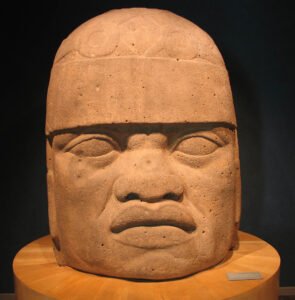
Notice what appears to be African features on this Olmec head, located in Mexico, which dates back to approximately 1000BC
There is currently no broadly-accepted historical or archaeological evidence demonstrating a sustained pre-Columbian African presence in the Americas. But that doesn’t prove that no individual African crossed the Atlantic before Columbus. What it means rather is that historians require convincing evidence before treating such a claim as established history.
Why 1619 Still Matters
Correcting the misconceptions surrounding 1619 shouldn’t lead us to dismiss the date. It remains enormously important.
The Africans brought to Virginia became part of the developing English colonial world. Virginia subsequently became deeply dependent on enslaved labor. Other English colonies expanded plantation slavery. And over generations, enslaved Africans and their descendants developed communities and cultural traditions that eventually contributed to a distinct Black American population.
By the time the United States declared independence in 1776, Black people had already lived in the English colonies for generations.
By 1860, approximately four million lived in the United States, alongside hundreds of thousands of free Blacks.
The population whose history developed through slavery, emancipation, Reconstruction, Jim Crow and the Civil Rights Movement eventually became what is commonly described as the historic African Americans. In modern discussions, some descendants of this population also identify as Foundational Black Americans (FBA). Understanding the pre-1619 African presence doesn’t diminish that history. It makes it richer.
So, Were Africans in America Before 1619?
Yes. That historical record provides clear examples. Enslaved Africans were brought to the attempted Spanish colony of San Miguel de Gualdape in 1526. The African explorer Estevanico arrived in Florida with a Spanish expedition in 1528 and later traveled through substantial areas of North America. Africans were part of Spanish Florida during the 1500s.
All of these events occurred before the famous arrival of Africans in Virginia in 1619. The key is understanding what that year actually represents. It was not the first known African presence anywhere on the continental U.S. Instead, it was a crucial early event in the history of Africans in the English colony of Virginia, which would become deeply connected to the development of the United States and its system of racial slavery.
That distinction gives us a much more accurate picture of early Black American history. Black history on American soil didn’t suddenly begin in 1619. By then, Africans had already been part of the story for nearly a century.





