Why Is the Bab el-Mandeb Strait So Important?
On 11 September 2026, Houthi militants seized control over the Strait of Bab el-Mandeb, connecting the Red Sea to the Indian Ocean.
The Houthis are known to be aggressive towards certain Western nations, such as Israel and the United States. However, they have insisted that this takeover will not affect maritime trade through the strait. But they have already been attacking Saudi oil tankers since July 2026. So that precedent is expected to be continued and exacerbated by the Bab el-Mandeb seizure.
Saudi Arabia is one of the world’s largest oil producers. The countries it exports to most to include China, India and Japan.
The Saudis were already facing problems shipping oil through the Strait of Hormuz, as a consequence of the US invasion of Iran. So what’s being anticipated is the Houthi takeover of Bab el-Mandeb effectively ceasing their ability to ship south and thus to the Far East.
IMPACT OF THE SUEZ CANAL
The creation of the Suez Canal, which passes through Egypt, has made Bab el-Mandeb one of the most-significant chokepoints in the world. As of 2017, “about 9% of total seaborne-traded petroleum” passes through this strait.
It services oil ships from throughout the Middle East. For instance, some outgoing Strait of Hormuz traffic is also dependent on Bab el-Mandeb. They use the Red Sea to get the Suez Canal or its inland alternative, the SUMED Pipeline.
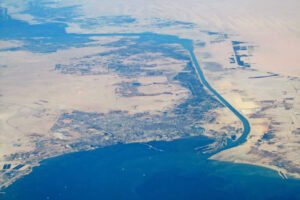
An aerial view of the Suez Canal, running north from the Red Sea into Egypt.
Ships from throughout the Middle East use the Suez Canal to expeditiously sail to the Mediterranean Sea. Oil from this passage is then shipped to Europe, the United States or some other parts of Asia. Well over half of the traffic passing though Bab el-Mandeb heads north, via Egypt, to the Mediterranean.
THE STRATEGIC SIGNIFICANCE OF BAB EL-MANDEB
With Bab el-Mandeb being of such strategic importance, of course it caught the attention of European colonizers during the Age of Expansion. For instance, the British initially setup shop in the region in the late-18th century, in the nearby coastal town of Aden. At first, they didn’t do so primarily for economic reasons per se. Rather, it was to stifle the ambitions of a couple of colonial rivals, most notably France. And England went on to establish its dominance over the strait itself, beginning in 1857, which it maintained for over a century.
The mid-19th century was also when the same time the Suez Canal was built. Initially, the British did not approve to its construction, as they thought it would jeopardize their monopoly over sea routes. So the canal was rather held down by the French and Egyptians. This only lasted for less a than a decade though, as the Egyptians sold their share to the British in 1875.
To put the overall significance of the Bab el-Mandeb into perspective, keep this in mind. There are only about eight maritime chokepoints in the entire world. And the word “chokepoint”, in essence, is a military term.
Whoever owns the chokehold has an advantage that extends beyond economics. For example, a relatively-weak military force like the Houthis can secure and maintain mastery over Bab el-Mandeb.
ENTER YEMEN
In 1967 South Yemen, which would later become Yemen proper, seized control of Bab el-Mandeb. The country secured its freedom from the British Empire by force.
Two East African nations, Eritrea and Djibouti, also border the strait, besides Yemen. Traditionally speaking, no one actually owns the waterway. In fact, before the Suez Canal was constructed, Bab el-Mandeb was avoided due to its dangerous passage.
The title “Bab el-Mandeb” translates to “Gate of Grief”. And it is believed by some it earned this title due to its dangerous navigation. But modern-day maritime commerce, most notably in oil, has a number of ships passing though the strait daily nonetheless.
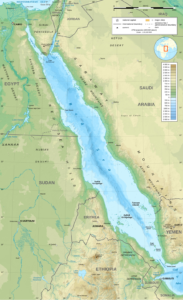
Map of the Red Sea, with the Strait of Bab el-Mandeb in the south
ENTER ISRAEL
To the north of the strait is the Red Sea which, even if only slightly, borders Israel. So the Israeli maritime trade is heavily dependent on this chokehold.
In other words, if Israel wants to ship something to the Indian Ocean in the south (or vice versa), it must pass Bab el-Mandeb. Generally speaking, the Red Sea to Indian Ocean is the preferred maritime route for shipments between the Mediterranean (i.e. Isreal) and Asia, as well as some East African countries.
During the Yom Kippur War of 1973, Israel fought against a number of Arab nations, with the latter shutting down the strait. The Arab belligerents were led, in part, by Egypt, who also imposed restrictions over the Suez Canal. In doing so, they crippled Israel’s importation of oil and trade with the Far East.
So the Houthi seizure of September 2026 isn’t the only time in history that Bab el-Mandeb has been jacked, as inspired by Israel. But to reiterate, it doesn’t have an official owner. For instance, on the Djibouti side, there are now both American and Chinese military bases.
2026 HOUTHI SEIZURE
As of the Houthi seizure in 2026, it is estimated that “a quarter of world shipping passes along” Bab el –Mandel. Nearly 5 million barrels of oil traverse it on a daily basis, but its significance extends beyond the trade in black gold. Most simply put, this is the main maritime connection between Europe and Asia.
As with the Yom Kippur War blockade, this act of aggression on the part of the Houthis was largely promoted by beef with Israel. The Gaza War, which commenced in 2023, has pit Israel against Palestinians in a way some have deemed genocidal. And the Houthis are one of the governments who have militarily sided with the weaker Palestinians.
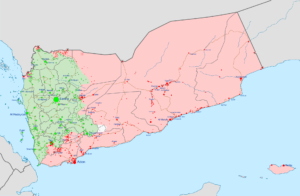
The section of Yemen, in green, that is under the control of the Houthis.
Simply put, the Houthis are a powerful Yemeni rebel group. They have taken over about a third of the country, including most of the coastline Yemen shares with the Strait of Bab el-Mandel. And they established this dominance in 2010.
The Houthis also enjoy the backing of the more potent Iran. And concurrent with the Gaza War, the United States, buttressed by Israel, launched an attack on Iran in 2026.
Iran boasts its own bordering chokepoint, the Strait of Hormuz, in the region. And the Iranians have exerted dominance over Hormuz since the outbreak of the invasion.
Meanwhile, about 30% of the world’s oil comes from the Middle East. So Iran running roughshod over Hormuz is made even more significant by the Houthi takeover of Bab el-Mandeb, and vice versa. This has led to not only increased oil prices but also a shorter supply being exported, most notably to the West.
CONCLUSION
Saudi Arabia can still ship oil north, via the Red Sea and through Egypt. These are exports that will eventually reach Europe and the United States. But as for heading south, to their bigger markets in the Far East, by the looks of things that’s becoming increasingly difficult.
In order for Saudi Arabia to ship south, it must pass either the Strait of Bab el-Mandeb or the Strait of Hormuz. Both, simply interpreted, have now come under de facto control of Iran. The Houthis and Iranians are allies, and they’re both rivals of the Saudis. And together, by taking over these vital chokeholds, they are creating a situation that has noticeably weakened Saudi export capacity.