Why Do Algeria and the UAE Have a Difficult Relationship? A History of Their Growing Rivalry
Unfortunately Algeria, a country found in North Africa, in September 2026, decided to end its diplomatic relationship with the United Arab Emirates, which is located in West Asia. Even though the countries are approximately 5,200 kilometers (3,200 miles) apart, both are more or less considered to be Middle Eastern nations. Resultingly, being neighbors in a hotly-contested region, they’ve had run-ins.
This decision by the Algerian government is based on a number of complex historical factors. It seems that the Algerians are convinced that the Emiratis are indirectly working against them.
A PEACEFUL PAST
The hostilities between these two nations didn’t always exist. President Abdelaziz Bouteflika (1937-2021), who led Algeria from 1999 to 2021, was known to be cool with the UAE. For instance, when Zayed bin Sultan Al Nahyan (1971-2004), the founder and first President of the UAE, passed away in 2004, Bouteflika offered condolences on behalf of all Algerian people. Under the latter’s leadership, strong military ties were formed between the countries. Since the early 21st century, the UAE has been able to establish a notable economic foothold in Algeria. It should perhaps be noted that this aspect of the relationship, i.e. economic trade, seems to benefit the Emiratis a lot more than Algerians.
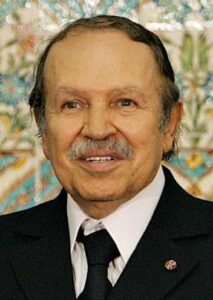
Abdelaziz Bouteflika, the Algerian president who formed strong ties with the UAE
Even after Bouteflika’s reign, into the 2020s, it appears the relationship remained strong. For instance, when the second President of the UAE, Khalifa bin Zayed Al Nahyan (b. 1948), left the mortal plane in 2022, then-President of Algeria, Abdelmadjid Tebboune, went as far as to ‘declare a two-day national mourning’.
THE ARAB VS. ISRAELI FACTOR
But this relationship has been far from just butterflies and roses. For example, considering this is the Middle East and all, the Arab versus Israeli conflict has played a role.
Both Algeria and the UAE are counted as Arab nations. However, in 2020, the UAE “normalized relations with Israel… abandoning the longstanding Arab consensus that normalization should follow the creation of a Palestinian state”. Meanwhile, Palestinian statehood has yet to be achieved. Accordingly, Algeria abstained from making such an agreement with Israel.
Morocco also normalized its relationship with the Israelis in 2020, as did the UAE, under what is known as the Abraham Accords. Morocco is the western neighbor of Algeria. And their agreeing did not sit well with the Algerians at all.

A map of North Africa, an area with notable national beefs.
THE WESTERN SAHARA DISPUTE
This theory of the UAE and Morocco being rivals of Algeria has also appeared in the Western Sahara dispute. Western Sahara, which borders Morocco to the north and a relatively-small section of Algeria to the east, is considered by many to be “Africa’s last colony”. It is defined as a “non-self-governing-territory”, not an independent nation, even though Spanish colonizers pulled out in the 1970s.
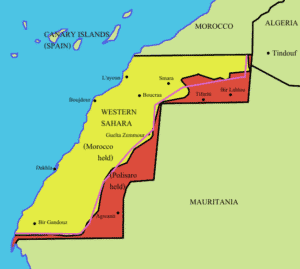
Western Sahara is split between Moroccan occupation (yellow) and the opposing rule of the Polisario Front (red), which Algeria supports.
Upon withdrawing, Spain decided to hand administrative control over to the neighboring countries of Morocco and Mauritania. The latter shortly thereafter exited the scene. But Morocco has maintained a strong, controlling presence in Western Sahara.
Meanwhile, Algeria has been supporting an opposing independence movement known as the Polisario Front. So Western Sahara is a fragmented country, with Morocco holding sway over most of the land, but a solid 30% being under the opposing the Polisario Front. This disagreement even led to the West Sahara War (1975-1991), which lasted well over a decade.
Meanwhile, in 2020, “the UAE became the first Arab nation to open a consulate in Laayoune”. Laayoune is a disputed city, the de facto capital if you will, of Western Sahara. It was formerly under the Polisario Front but subsequently came under the unofficially occupation of Morocco. So when the UAE made that move, the Algerians viewed it as if the Emiratis were siding with the Moroccans, whom Algeria has been beefing with for decades, even prior to the West Sahara War.
Shortly prior to that, in 2019, the UAE provided significant military support to General Khalifa Haftar, in his bid to takeover Libya. The country has become politically fragmented in the aftermath of the assassination of Muammar Gaddafi (1942-2011). Algeria, which shares most of its eastern border with Libya, did not approve of that move, perceiving it as a threat to their own national security.
SUSPECTED UAE INVOLVEMENT IN THE HIRAK MOVEMENT
Also in 2019, mass protests erupted in Algeria which became known as the Hirak movement. This was a largely peaceful affair, with the goal being to prevent the aforementioned Abdelaziz Bouteflika, who had been in power since 1999, from seeking a fifth term.
It was perceived by many protestors that the UAE supported the deposed president, despite popular Algerian sentiment. And the interesting thing about that accusation is that, by the looks of things, it was never conclusively proven. So such beliefs illustrate how Algerians feels that the UAE is a foreign nation acting against their interests.
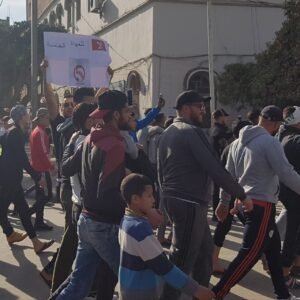
A scene from the Hirek protests, which swept through Algeria beginning in 2019
For instance, in 2022 Algeria applied for membership in BRICS, the largely-economic international cooperative. The following year, BRICS did admit six new member alrights – with Algeria being snubbed. One of the countries that did make it in, however, was the UAE. So again, whereas it has yet, if ever, to be proven, reportedly “sources close to the Algerian government described the exclusion as a betrayal… orchestrated by the UAE”.
Earlier in the century Algeria and the United Arab Emirates appeared to be on friendlier terms. But in more recent times, the former has become increasingly convinced that the latter has been acting against its national interests, including forming alliances with its rivals.
THE FIRES THAT SPARKED THE END OF DIPLOMATIC RELATIONS
As of this writing, there are ‘unprecedented wildfires raging in Algeria’, which have claimed a number of lives. This is besides a tragedy that recently occurred in Mohammadia, the capital of Algeria, in which 11 people lost their lives to fire.
Some Algerians have accused the UAE of politically capitalizing on these misfortunes. They claim the Emiraties did so by “orchestrat(ing) a disinformation campaign targeting Algeria on the occasion of the forest fires… as well as the fire that occurred in a childcare facility in Mohammadia”. This, reportedly, was the straw that broke the camel’s back.
This report came out in mid-June 2026, indicating that Algeria was on the verge of breaking diplomatic relations with the UAE. And sure enough, the Algerians proceeded to do so roughly two months later, on 10 September.
CONCLUSION
Most of us on the outside may have never known that these tensions between Algeria and the UAE have been brewing for years. They do not appear to be direct rivals per se. Rather they seem to be adversaries by proxy, taking opposing sides in other conflicts.
In any event, the Algerians seem to believe that the Emiratis are becoming increasingly aggressive in undermining their domestic security and international interests. In fact, they’ve become so convinced, that they have opted to end diplomatic relations with them altogether.