How Long Have Black People Lived in America?
Black people have lived in what is now the United States for more than 500 years.
That answer may surprise people who were taught that Black American history began in 1619, when a group of Africans arrived in Virginia. That year is of immense importance to American history, but it was not the first time people of African descent set foot in the territory that would eventually become the United States.
Africans participated in some of the earliest European expeditions into North America. Free and enslaved alike lived in Spanish settlements long before the English colonies that would go on to establish the U.S.A.
So why is 1619 so famous? And just how far back does the history of Black people in North America actually go? The answer takes us to the earliest decades of European colonization of the Western Hemisphere.
Black History in America Did Not Begin in 1619
The United States declared independence from Britain in 1776. Therefore, when historians discuss Africans living in the U.S. during the 16th and 17th centuries, they’re referring to those who settled in and traveled to the continental U.S. before the country officially began. That distinction matters. It also allows us to visualize a longer history than what is normally taught to have begun in colonial Virginia.
Spanish explorers and colonists brought free and enslaved Africans to different parts of the Americas beginning in the early 1500s. Some participated in expeditions through what would become the United States, with one of the most remarkable examples being a man remembered as Estevanico.
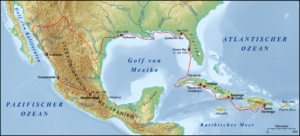
The route of the Narváez-Cabeza de Vaca expedition from the Caribbean – along the Gulf of Mexico and into the mainland – which Estevanico participated in.
Who Was Estevanico?
Esteban de Dorantes, also known as Estevanico, was a slave who became one of the earliest known Africans to extensively explore parts of the continental U.S. He was originally from Morocco and part of the disastrous Narváez expedition, which arrived in Florida in 1528. Most members of the party died.
Estevanico and a handful of survivors eventually, after being captives for almost a decade, traveled across enormous stretches of the North American continent, including areas of what are now Texas and Mexico. And he eventually went on to become a guide for other Spanish colonizers in the area. So this means an African man was confidently traveling throughout the southern U.S. roughly a century before 1619. Estevanico’s story also reminds us that the earliest Black presence in North America wasn’t limited to English slavery.
The 1526 Colony of San Miguel de Gualdape
Spanish colonizer Lucas Vázquez de Ayllón attempted to establish a settlement, called San Miguel de Gualdape, along the east coast. The precise location of that short-lived colony is unknown, only that it was somewhere within the general vicinity of South Carolina. Ayllón brought hundreds of colonists to establish it, and among them were enslaved Africans.
The colony proved to be a disaster. Disease, hunger, internal conflict and harsh conditions devastated the population. Ayllón himself died shortly after establishment.
Among those internal conflicts was the enslaved Africans rebelling and escaping. The settlement collapsed after only a few months.
Although San Miguel de Gualdape wasn’t around for long, its history is significant. It means Africans were present in the United States as early as 1526, up to roughly a century before their arrival in Virginia.
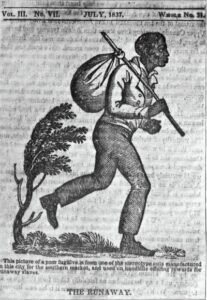
Depiction of a runaway slave, originally published in 1898.
Africans in Spanish Florida
Spain established another important settlement in St. Augustine, Florida in 1565. This locality now holds the distinction of being “the oldest continuously occupied European town in the United States”.
Africans were part of that colony. And Spanish Florida would eventually become important to slaves attempting to escape British colonies.
Under certain conditions, Spain sometimes offered freedom to fugitives from British territories. That eventually contributed to the creation of one of the most-fascinating communities in early Black American history.
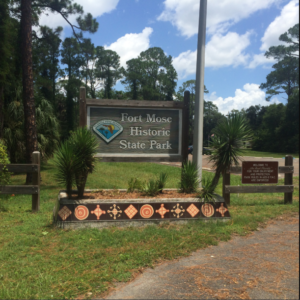
The entrance sign to Fort Mose Historic State Park in St. Augustine, Florida.
Fort Mose: An Early Free Black Community
Near St. Augustine stood Fort Mose, established in 1738. It is often described as the first legally-sanctioned free Black settlement on the continental U.S. Many of its residents were former slaves who had escaped South Carolina and other British colonies to successfully reach Spanish Florida.
The Spanish government granted freedom to qualifying fugitives, partly as a strategy against British rivals. Residents of Fort Mose formed a militia and helped defend Spanish Florida.
This story complicates the simplified idea that early Black Americans were only plantation slaves. Slavery was unquestionably central to Black life in colonial America. But there were also Black explorers, soldiers, craftsmen, farmers, interpreters and freemen.
So What Happened in 1619?
If Africans were already present beforehand, then why is 1619 treated as such an important date? The answer is the related events becoming part of the development of the English colonial system from which the United States would emerge.
In late August 1619, an English privateer ship called the White Lion arrived at Point Comfort in Virginia. On board were Africans who had been taken from a Portuguese slave ship. They were originally captured from west-central Africa, particularly the region of the Kingdom of Ndongo, in what is now Angola.
The White Lion and another English privateer, the Treasurer, intercepted the Portuguese vessel and took some of its African captives. More than 20 were subsequently brought to Virginia. Their arrival became one of the most famous events in African American history.
It did not mark the first African presence on the land. But it was an important early moment in the development of Blacks in the English colonies.
Were the Africans Who Arrived in 1619 Slaves?
Answering this question is more complicated than it may initially appear. Those Africans had unquestionably been captured and forcibly transported across the Atlantic.
But this predated the legal institution of slavery in Virginia, although indentured servitude was common. Under that system, people worked for a specified period of time in exchange for transportation, food or other arrangements.
Some early Africans eventually obtained freedom and property. One of the most famous examples was Anthony Johnson, who arrived in Virginia during the early colonial period.
Johnson eventually became free, acquired land and became a property owner. But these possibilities shouldn’t obscure what happened next.
During the 1600s, Virginia and other English colonies increasingly created laws that specifically associated African ancestry with permanent, hereditary slavery. Race became embedded in the legal structure. And by the beginning of the 18th century, chattel slavery had become firmly established in much of British North America.
How Did Slavery Become Hereditary?
One of the most consequential developments occurred in Virginia in 1662. The colony adopted a law establishing that a child’s status would follow that of the mother. In practical terms, children born to enslaved women would themselves be enslaved, and this legally made slavery hereditary.
The consequences were enormous. An enslaved woman could give birth to a child who legally belonged to another person from birth. That child could grow up, have children, and they would likewise be enslaved. Generations of families could therefore remain trapped.
Colonies then passed additional laws restricting the rights of Africans and their descendants. And over time, slavery became increasingly tied to African ancestry.
Where Did Enslaved Africans Come From?
The Africans brought to mainland North America did not come from one country or a single ethnic group. They originated from numerous societies across western and west-central Africa. Regions involved in providing the Transatlantic Slave Trade with its human cargo included areas corresponding to modern-day Angola, Democratic Republic of the Congo, Republic of the Congo, Senegal, Gambia, Sierra Leone, Liberia, Ghana, Benin and Nigeria.
These people belonged to distinct kingdoms, societies, linguistic groups and cultures. They spoke different languages. They practiced different religions. They had different political traditions. And they did not arrive thinking of themselves simply as members of one single group called “Africans.”
But the experience of slavery gradually forced them together. Over generations, their descendants developed new identities and cultures in America. And this process ultimately contributed to the emergence of a distinct African American population.
Most Enslaved Africans Did Not Come to the United States
Another common misconception is that most victims of the Transatlantic Slave Trade were transported to the continental U.S. They were not.
Roughly 12.5 million Africans were placed aboard slave ships during the Trade, and about 10.7 million survived the voyage to the Western Hemisphere. Only a relatively small proportion of them were transported directly to mainland North America.
Brazil received the most enslaved Africans, by far. The Caribbean island were also enormous recipients. The continental U.S. didn’t receive as much, but their population numbers expanded dramatically through natural growth.
By the beginning of the American Civil War in 1861, approximately 4 million enslaved people lived in the United States. Most were descendants of earlier generations of enslaved Africans.
This distinction is crucial to understanding the evolution of the historic Black American population. By the 19th century, many Black Americans were already generations removed from their ancestors born in Africa.
Black Americans During the American Revolution
By the time the 13 colonies declared independence from Britain in 1776, people of African descent had already been part of colonial society for generations.
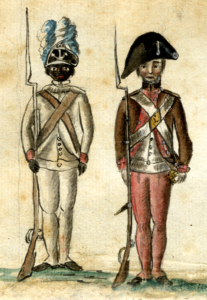
This image, created in 1781, illustrates that there were also Black soldiers fighting on behalf of the United States in its revolutionary battle against Britian.
They participated on both sides of the American Revolution. Thousands served with American forces. Others joined the British after being offered freedom to those willing to escape slavery and serve the Crown.
This created an extraordinary contradiction at the heart of the new nation. American revolutionaries declared that “all men are created equal”, while hypocritically, slavery remained legal.
Indeed, some of the country’s most prominent founders owned slaves. Thomas Jefferson, who drafted the Declaration of Independence, was an owner. George Washington has slave property as well. The contradiction between America’s ideals of liberty and the reality of slavery would remain unresolved for another century.
Free Black Americans Also Existed
Not every Black person in early America was enslaved. Free Black communities developed in both the North and South.
Some enslaved people purchased their freedom. Others were freed by slaveowners. A few were born to free mothers and were therefore legally free.
In the decades leading up to the Civil War, notable free Black populations existed in cities such as Philadelphia, Baltimore, New York and New Orleans. Free Black Americans created churches, schools, businesses, mutual-aid organizations and abolitionist societies.
But they also faced severe discrimination. Freedom did not mean equality. Many states restricted where free Black people could live, work, travel or vote. And there was also the very-real possibility that a free Black would be kidnapped and illegally sold into slavery.
Black Americans and the Civil War
By 1860, the United States had become deeply divided over slavery. The election of Abraham Lincoln helped trigger the secession of southern slaveholding states and the beginning of the Civil War in 1861.
Black Americans played a crucial role in that conflict. As Union forces (the North) moved through Confederate territory (the South), enslaved people escaped plantations in enormous numbers.
After the federal government officially allowed Black enlistment, approximately 180,000 Black soldiers joined the Union Army, with additional serving in the Navy.
The Civil War eventually destroyed legal slavery. Lincoln’s Emancipation Proclamation took effect in 1863 and declared enslaved people in areas under Confederate control free. The 13th Amendment, ratified in 1865, abolished slavery throughout the United States, except as punishment for crime. After centuries of enslavement, millions of Black Americans were legally free. But another long struggle was beginning.
From Emancipation to Jim Crow
The period immediately following the Civil War became known as Reconstruction. Black Americans voted, established schools, built businesses, purchased property and entered politics. Some became state legislators and members of Congress. But these gains faced intense resistance.
White supremacist organizations used terrorism and violence to suppress Black political participation. And after Reconstruction ended, southern states constructed a system of instituionalized racial segregation known as Jim Crow.
Black Americans were separated from White in education, transportation, other service industries and many other areas of public life in general. Voting restrictions effectively disfranchised large numbers of Black citizens, and Jim Crow was reinforced with racial violence. Yet Black communities continued building institutions and fighting for their rights.
The Great Migration Changes Black America
Beginning for the most part during the early 20th century, millions of Black Americans left the South. This enormous population movement became known as the Great Migration.
Approximately six million Black Americans relocated from southern states to cities in the North, Midwest and West between roughly 1910 and 1970. They favored places like Chicago, Detroit, New York, Philadelphia, Cleveland, Los Angeles and numerous other cities that developed large Black communities.
The Great Migration transformed American politics, music, literature, business and culture. It also helped spread cultural traditions developed by Black southerners throughout the country.
The descendants of enslaved Americans were no longer concentrated in the former slave South. Black America had become a truly national population.
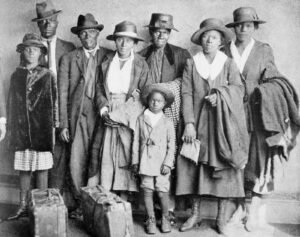
A picture of an African-American family taken in Chicago in 1922.
A Distinct Black American Culture Emerges
Centuries of life in America produced something that did not exist when Africans first arrived – a distinct Black American ethnic and cultural tradition. This culture retained influences from Africa while also being shaped by slavery, Christianity, the U.S. South, emancipation, segregation, migration and urban life.
As an example of how profoundly Black Americans went on to influenced the wider United States, take these musical realities into consideration. Their spirituals contributed to gospel. Their work songs and other musical traditions contributed to blues. Blues helped influence jazz, as well as rock and roll. And Black musical creativity later contributed to soul, funk, disco, house, techno and hip-hop.
And of course, Black Americans also influenced, in a profound way, literature, language, dance, fashion, food, sports, politics across the country. What began as communities formed under slavery eventually became one of the most culturally-influential populations in the modern world.
How Does This Connect to Foundational Black Americans?
This long history helps explain the modern use of the term Foundational Black American or FBA.
FBA advocates use that designation to distinguish descendants of America’s historic Black population from Black Americans whose families immigrated more recently from Africa, the Caribbean or elsewhere. This distinction is based primarily on lineage, not skin color.
For example, a Nigerian immigrant who becomes an American citizen is certainly a Black American. But his family may have arrived in the United States in 2005. Meanwhile, another Black American may be able to trace his ancestors back to 19th century Georgia, 18th century Virginia or even earlier colonial communities. Both are Black Americans while possessing very different relationships to American history.
This is why understanding how long Black people have lived in America is relevant to the FBA identity. The population didn’t suddenly appear during the Civil Rights Movement or after slavery. Its roots stretch back to the earliest centuries of European colonization of North America.
So, How Long Have Black People Been in America?
If by “America” we mean territory that is now part of the continental United States, documented African presence stretches back to the early 1500s. Enslaved Africans were present in the attempted Spanish settlement of San Miguel de Gualdape in 1526. And Estevanico traveled through a lengthy part of continent a few years later.
Africans lived in Spanish Florida during the 1500s. And in 1619, a group arrived in colonial Virginia in an event that became particularly important to the development of the historic African American population.
Therefore, Black history in America is more than simply the history of slavery. It includes explorers, settlers, freemen, soldiers, farmers, craftsmen, business owners, religious leaders, writers, musicians, activists and politicians, besides generations of families whose lives became inseparable from the history of the United States.