Naqsh-e Rostam: The Necropolis of the Achaemenid Dynasty
Naqsh-e Rostam, an archaeological masterpiece situated in Iran’s Fars Province, serves as a profound testament to the region’s illustrious history. This necropolis, carved into the sheer cliffs of a mountain, encapsulates the grandeur of ancient Persian civilizations, particularly the Achaemenid and Sassanid dynasties. As a repository of monumental tombs, intricate reliefs, and enigmatic structures, Naqsh-e Rostam offers invaluable insights into the artistic, political, and cultural achievements of these empires.
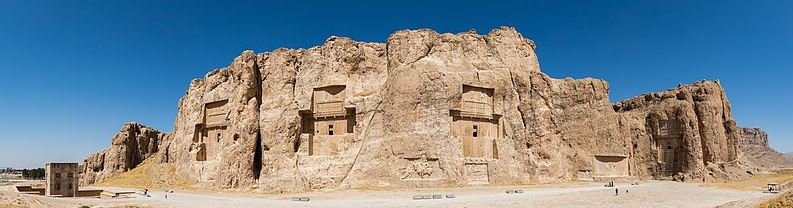
An ancient necropolis, Naqsh-e Rostam features intricate rock reliefs carved into the mountain, serving as the final resting place for four Achaemenid kings, including the renowned Darius the Great and his son Xerxes. Image: A panoramic view of Naqsh-e Rostam.
READ MORE: Passargadae – the First Capital of the Achaemenid Empire
Location and General Overview
Located approximately 13 kilometers northwest of Persepolis, the ceremonial capital of the Achaemenid Empire, Naqsh-e Rostam is nestled in the rugged landscape of the Zagros Mountains. The site spans a vast area, featuring a series of rock-cut tombs and reliefs that have withstood the test of time. Its strategic position not only underscores its importance as a necropolis but also highlights its role as a ceremonial and religious center for ancient Persian rulers.
Early History: Elamite Reliefs
The history of Naqsh-e Rostam extends back to around 1000 BCE, with the earliest known relief believed to be of Elamite origin. Although this initial carving is severely weathered, it depicts a faint figure wearing distinctive headgear, indicative of Elamite cultural influences. This early artwork sets a foundational layer for the site, illustrating the continuity and evolution of artistic expression that would later flourish under the Achaemenid and Sassanid empires.
The Achaemenid Dynasty and Its Necropolis
Architectural Features of the Achaemenid Tombs
Central to Naqsh-e Rostam are the four monumental tombs of Achaemenid kings, meticulously sculpted high above the ground on the mountain face. These tombs are architectural marvels, each designed with elaborate facades that feature large panels depicting scenes of divine investiture.
In these panels, the kings are portrayed receiving authority from gods, symbolizing their divine right to rule. Surrounding the central figures are rows of smaller figures paying tribute, illustrating the hierarchical structure of the empire. The varying sizes of these figures emphasize the paramount status of the kings, creating a visual narrative of power and divine endorsement.
Identification of the Achaemenid Kings
Among the four Achaemenid tombs, one is explicitly identified as that of Darius I (also known as Darius the Great) through an inscription translating to “a Parsi, the son of a Parsi, an Aryan, of Aryan family.” The remaining three tombs are attributed to Xerxes I, Artaxerxes I, and Darius II based on scholarly interpretation and stylistic analysis rather than direct inscriptions. This attribution aligns with historical records, positioning Naqsh-e Rostam as the final resting place for some of the most influential rulers of the Achaemenid Empire.
READ MORE: Rulers of the Achaemenid Empire
The DNa Inscription of Darius I
Content and Significance
Darius I’s tomb is particularly notable for the DNa inscription, located in the upper left corner of its facade. Composed around 490 BCE, likely in the last decade of his reign, this inscription chronicles his extensive conquests and the vast expanse of the Achaemenid Empire. It serves as a proud declaration of Darius’s achievements, detailing the territories under his control and highlighting the divine favor he received from Ahura Mazda, the supreme deity in Zoroastrianism.
Depiction of the Achaemenid Empire
The DNa inscription meticulously lists the regions encompassed by the Achaemenid Empire, ranging from Macedon and Thrace in Europe to Egypt in North Africa, and from Babylon and Assyria in Mesopotamia to Bactria and Gandhara in the Indian Subcontinent. This enumeration underscores the empire’s unprecedented scale, portraying it as the largest of its time. The inscription not only serves as a historical record but also as a political statement, reinforcing the legitimacy and divine sanction of Darius’s rule.
Sassanid Rock Reliefs
Overview of Sassanid Art
Beneath the Achaemenid tombs, at ground level, lie the Sassanid rock reliefs, which exemplify the artistic and political prowess of the Sassanid dynasty. These reliefs are grand in scale, depicting over-life-sized figures that convey the might and glory of the Sassanid rulers. The artistry reflects a sophisticated blend of realism and symbolic representation, aimed at glorifying the empire and its leaders.
Shapur I’s Triumph
One of the most renowned Sassanid reliefs depicts King Shapur I triumphing over the Roman Emperor Valerian and Philip the Arab. This relief commemorates the Battle of Edessa in 260 AD, where Valerian was captured, marking a significant humiliation for the Roman Empire. Shapur I’s victory is not only a military achievement but also a symbolic assertion of Sassanid dominance, linking their reign to the illustrious legacy of the Achaemenids and demonstrating their ability to rival Rome.

Image: Shapur I’s victory over Roman Emperors Valerian and Philip the Arab.
Ardashir I’s Investiture
Another impressive relief portrays Ardashir I receiving the ring of kingship from the god Ohrmazd. This scene symbolizes his divine right to rule and the establishment of the Sassanid Empire. The depiction of divine investiture emphasizes the sacred nature of kingship, reinforcing Ardashir’s legitimacy and the theological foundations of Sassanid authority. This relief serves as a visual proclamation of the new dynasty’s power and religious endorsement.
Bahram II’s Equestrian Reliefs
Bahram II is depicted in grandiose scenes wielding a massive sword, flanked by figures that highlight his authority and martial prowess. The equestrian reliefs showcase Bahram II’s military strength and his role as a warrior king. These artistic representations not only celebrate his reign but also serve as political statements, reinforcing the Sassanid rulers’ legitimacy and their connection to ancient Persian traditions of kingship and valor.
Ka’ba-ye Zartosht: An Enigmatic Structure
Architectural Description
Adjacent to the tombs and reliefs stands the Ka’ba-ye Zartosht, a cube-shaped structure dating back to the 5th century BCE. This enigmatic building is inspired by a similar structure at Pasargadae known as the “Prison of Solomon.” The Ka’ba-ye Zartosht is characterized by its geometric precision and monumental scale, with smooth, carved surfaces that contrast with the ruggedness of the surrounding cliffs.
Theories on Purpose and Function
Several theories exist regarding the purpose of the Ka’ba-ye Zartosht. Some scholars suggest it served as a religious site, possibly dedicated to Zoroastrian rituals, given its association with Ahura Mazda. Others propose it functioned as an administrative center or a symbol of royal authority. The exact function remains a subject of debate, adding to the structure’s allure and mystery within the complex architectural landscape of Naqsh-e Rostam.
Archaeological Excavations and Research
In the early 20th century, German archaeologist Ernst Herzfeld played a pivotal role in documenting Naqsh-e Rostam. In 1923, he made casts of the inscriptions on Darius I’s tomb, preserving invaluable records that are now housed in the archives of the Freer Gallery of Art and the Arthur M. Sackler Gallery at the Smithsonian Institution in Washington, DC. Herzfeld’s meticulous documentation provided a foundation for future research and preservation efforts.
Between 1936 and 1939, a team from the University of Chicago’s Oriental Institute, led by Erich Schmidt, conducted several excavation seasons at Naqsh-e Rostam. Their work uncovered the site’s layered history, revealing the interactions between different empires and cultures over centuries. These excavations unearthed additional reliefs, inscriptions, and structural elements, contributing to a more comprehensive understanding of the site’s historical significance.
In 2019, Mojtaba Doroodi and Soheil Delshad officially recorded the DNf petroglyph at Naqsh-e Rostam, which had been hidden beneath algae and sediments for approximately 2,500 years. This recent discovery adds a new dimension to the site’s historical narrative, highlighting the ongoing efforts to preserve and study this ancient monument. The DNf petroglyph offers fresh insights into the artistic and cultural expressions of the period, enriching the overall tapestry of Naqsh-e Rostam’s heritage.
Cultural and Historical Significance
Naqsh-e Rostam stands as a monumental representation of the Achaemenid and Sassanid empires, showcasing their artistic excellence, political power, and religious beliefs. The site encapsulates the zenith of Persian imperial architecture and relief art, providing a tangible link to the past. Each tomb and relief not only commemorates individual rulers but also symbolizes the enduring legacy of Persian civilization.
Naqsh-e Rostam encapsulates the artistic brilliance and political grandeur of the Achaemenid and Sassanid empires, offering a window into the civilizations that shaped the region’s history.
The artistry at Naqsh-e Rostam is imbued with rich symbolism, reflecting the theological and political ideologies of the time. The divine investiture scenes on the Achaemenid tombs emphasize the sacred nature of kingship, while the Sassanid reliefs celebrate military victories and divine favor. Inscriptions like the DNa inscription of Darius I serve as both historical records and political proclamations, reinforcing the authority and legitimacy of the rulers.
Preservation Efforts and Current Status
Preserving Naqsh-e Rostam is paramount to maintaining Iran’s cultural heritage. Efforts by international and local organizations focus on protecting the site from environmental degradation, vandalism, and the impacts of tourism. Advanced conservation techniques are employed to stabilize the rock-cut structures and preserve the intricate carvings and inscriptions. Ongoing research and archaeological work continue to uncover new aspects of the site, ensuring that Naqsh-e Rostam remains a vital source of historical knowledge for future generations.
Conclusion
Naqsh-e Rostam, as the necropolis of the Achaemenid Dynasty, is a cornerstone of Iran’s archaeological and cultural landscape. Its monumental tombs, intricate reliefs, and enigmatic structures collectively narrate the story of ancient Persian empires, highlighting their artistic achievements, political prowess, and religious beliefs. From the early Elamite reliefs to the grand Sassanid carvings, Naqsh-e Rostam offers a comprehensive window into the civilizations that shaped the region’s history.
Frequently Asked Questions

Naqsh-e Rostam is an extraordinary archaeological site and necropolis located in Iran’s Fars Province, approximately 13 kilometers northwest of the ancient city of Persepolis. Carved into rugged mountain cliffs, it showcases a blend of artistic and historical significance spanning several millennia. Image: Naqsh-e Rostam in 2017.
How old is the earliest relief at Naqsh-e Rostam?
The oldest relief at Naqsh-e Rostam dates back to around 1000 BCE. Although severely damaged, it depicts a faint figure with distinctive headgear, believed to be of Elamite origin.
How many Achaemenid tombs are present at Naqsh-e Rostam, and who are they attributed to?
There are four monumental tombs of Achaemenid kings carved into the mountain face. They are attributed to Darius I, Xerxes I, Artaxerxes I, and Darius II. The identification is based on inscriptions and scholarly interpretation.
What distinguishes the tomb of Darius the Great at Naqsh-e Rostam?
Darius the Great’s tomb is explicitly identified by an inscription that translates to “a Parsi, the son of a Parsi, an Aryan, of Aryan family.” Additionally, it features the DNa inscription that chronicles his vast conquests and the extent of the Achaemenid Empire.
What is the significance of the DNa inscription in Darius I’s tomb?
The DNa inscription, located in the upper left corner of Darius I’s tomb facade, details his extensive conquests, listing territories from Europe to the Indian Subcontinent. It serves as a declaration of his achievements and the divine favor he received from Ahura Mazda, the supreme god in Zoroastrianism.

Image: The location of Naqsh-e Rostam within Iran.
What Sassanid reliefs are found beneath the Achaemenid tombs at Naqsh-e Rostam?
Beneath the Achaemenid tombs, at ground level, are Sassanid rock reliefs depicting the might and glory of the Sassanid dynasty. Notable reliefs include King Shapur I triumphing over Roman Emperors Valerian and Philip the Arab, Ardashir I receiving the ring of kingship from Ohrmazd, and Bahram II wielding a massive sword.
What historical event is depicted in the Sassanid relief of Shapur I at Naqsh-e Rostam?
The relief depicts King Shapur I’s victory over Roman Emperor Valerian and Philip the Arab at the Battle of Edessa in 260 AD. This event marked Valerian’s capture, a significant humiliation for the Roman Empire, and symbolized Sassanid dominance.
What is the Ka’ba-ye Zartosht, and where is it located in relation to Naqsh-e Rostam?
The Ka’ba-ye Zartosht is a cube-shaped structure dating back to the 5th century BCE, located adjacent to the tombs and reliefs at Naqsh-e Rostam. Inspired by a similar structure at Pasargadae known as the “Prison of Solomon,” its exact purpose remains subject to various theories.
Why is Naqsh-e Rostam considered significant to Iranian history and archaeology?
Naqsh-e Rostam is a vital symbol of Iran’s enduring legacy, encapsulating the artistic brilliance and political grandeur of the Achaemenid and Sassanid empires. Its monumental tombs, intricate rock reliefs, and enigmatic structures like the Ka’ba-ye Zartosht offer a comprehensive window into the civilizations that shaped the region’s history, making it a key site for historians, archaeologists, and visitors.





