
This photograph of Ezra Pound was taken in 1913 by Alvin Langdon Coburn.
Ezra Pound was an influential American poet and critic, a central figure in early modernist poetry. He contributed to literary movements like Imagism and helped shape the work of other notable writers, including T.S. Eliot, James Joyce, and Ernest Hemingway.
Early Life and Education (1885–1908)
Ezra Pound was born on October 30, 1885, in Hailey, Idaho Territory. He was the only child of Homer Loomis Pound and Isabel Weston. His paternal grandfather, Thaddeus Coleman Pound, was a Republican congressman and former Lieutenant Governor of Wisconsin. On his father’s side, Ezra descended from Quakers who arrived in America around 1650, while his mother’s lineage traced back to Puritan settlers. Isabel Pound, dissatisfied with life in Idaho, relocated with young Ezra to New York in 1887, and the family eventually settled in Pennsylvania.
Ezra Pound’s formal education began at dame schools and later Cheltenham Military Academy, where he developed an interest in literature. In 1901, he enrolled at the University of Pennsylvania, focusing on Romance languages and literature. There he met Hilda Doolittle (H.D.), who became an important figure in his life and a prominent poet. Pound completed his undergraduate studies at Hamilton College in 1905 and returned to Penn for his master’s degree. His early academic pursuits and European travels significantly influenced his literary aspirations.
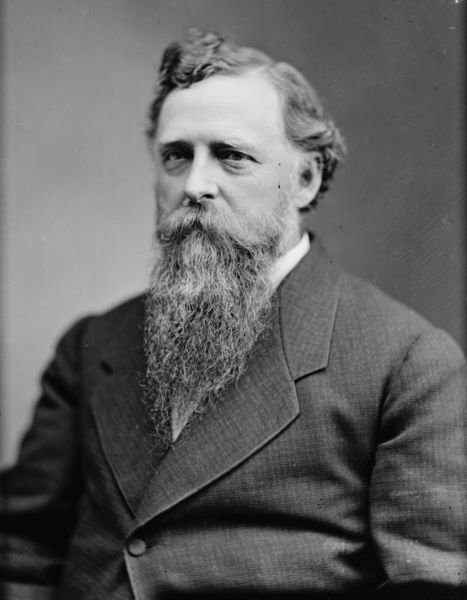
Thaddeus Coleman Pound, Ezra Pound’s paternal grandfather, photographed in the late 1880s.
Career Beginnings and Imagism (1908–1914)
Pound’s career began in earnest when he moved to Europe in 1908. Settling briefly in Venice, he self-published his first poetry collection, A Lume Spento. He later moved to London, where he became part of the city’s literary circle, befriending influential figures such as W.B. Yeats and Ford Madox Ford. His early works, including Personae (1909) and Exultations (1909), showcased his evolving poetic style.
While in London, Pound played a pivotal role in founding Imagism, a literary movement emphasizing clarity, precision, and economy of language. Collaborating with poets like H.D. and Richard Aldington, he established the principles of Imagism, including the importance of direct treatment of subjects and the rejection of unnecessary words. This movement marked a significant departure from the ornate style of Victorian poetry.
Championing Modernist Literature (1914–1924)
Pound’s influence extended beyond his own poetry. As an editor for magazines like Poetry and The Egoist, he helped shape the careers of several key modernist writers, including T.S. Eliot, James Joyce, and Ernest Hemingway. Pound was instrumental in publishing Joyce’s A Portrait of the Artist as a Young Man and Eliot’s “The Love Song of J. Alfred Prufrock.” His advocacy for their work earned him the reputation of a literary midwife to modernism.
In the early 1920s, Pound began work on his epic poem The Cantos, an ambitious project blending history, economics, and personal reflection. The first sections were published in 1925 as A Draft of XVI Cantos. The Cantos would become Pound’s life’s work, spanning decades and reflecting his evolving ideas and interests.
Fascism and Controversy (1924–1945)
Disillusioned by World War I, Pound moved to Italy in 1924, settling in Rapallo. He became an advocate for economic reform, particularly the theory of social credit, which criticized finance capitalism. During this period, he embraced fascism and expressed admiration for Benito Mussolini, whom he met in 1933.
Ezra Pound’s work, particularly The Cantos, reflects both his literary genius and his deeply flawed worldview.
During World War II, Pound delivered propaganda broadcasts for the Italian government, criticizing the United States and promoting anti-Semitic conspiracy theories. These broadcasts led to his indictment for treason by the United States in 1943. Captured by American forces in 1945, Pound was held in a military detention camp near Pisa, where he began writing The Pisan Cantos. His experiences during this time profoundly influenced his poetry.
Post-War Incarceration and The Pisan Cantos (1945–1958)
Declared mentally unfit to stand trial, Pound was confined to St. Elizabeths Hospital, a psychiatric institution in Washington, D.C., from 1945 to 1958. During his incarceration, he continued to write and received the Bollingen Prize for Poetry in 1949 for The Pisan Cantos. The award sparked controversy due to his political views.
Pound’s release was largely due to the efforts of his literary peers, including T.S. Eliot and Archibald MacLeish, who campaigned for his freedom. In 1958, he was discharged from St. Elizabeths and returned to Italy, where he lived for the remainder of his life.
Later Years and Legacy (1958–1972)
After his release, Pound settled in Venice and resumed work on The Cantos. However, he became increasingly reclusive and struggled with depression. His later years were marked by a sense of disillusionment, and he described much of his work as a failure.
Ezra Pound was a complex and polarizing figure, whose achievements in modernist poetry are inseparable from the controversies of his political life.
Ezra Pound died on November 1, 1972, in Venice. Despite the controversies surrounding his political beliefs, his contributions to modernist literature remain significant. Pound’s advocacy for writers like Eliot and Joyce, his innovations in poetic form, and his role in founding Imagism and Vorticism have secured his place in literary history. However, his anti-Semitic rhetoric and support for fascism continue to cast a shadow over his legacy.
Timeline of Ezra Pound (1885 – 1972)
- 1885: Born on October 30 in Hailey, Idaho Territory.
- 1901–1905: Attended the University of Pennsylvania and Hamilton College, earning a PhB in Romance Languages.
- 1908: Published A Lume Spento in Venice, marking his poetic debut.
- 1910–1914: Became central to London’s literary scene, advocating Imagism.
- 1915–1920: Edited works by T.S. Eliot and James Joyce; released Hugh Selwyn Mauberley.
- 1924: Moved to Italy; began supporting Mussolini’s fascist policies.
- 1933: Met Mussolini, cementing his ideological alignment with fascism.
- 1941–1945: Broadcast anti-American propaganda for Fascist Italy.
- 1945: Arrested for treason; detained in a steel cage in Pisa; started The Pisan Cantos.
- 1946–1958: Declared insane and confined to St. Elizabeths Hospital, where he gained literary recognition.
- 1958: Released and returned to Italy; embraced seclusion.
- 1972: Died on November 1 in Venice, leaving a controversial legacy.
Frequently Asked Questions
What are Ezra Pound’s most significant works?
His major works include Ripostes (1912), Hugh Selwyn Mauberley (1920), and The Cantos (c. 1917–1962), an 800-page epic poem considered his magnum opus.
What role did Ezra Pound play in the Imagist movement?
Pound was instrumental in founding Imagism, which emphasized precision, clarity, and economy of language in poetry. His manifesto-like writings and edits shaped the movement’s principles.
How did Pound’s political views impact his career?
Pound’s alignment with fascist ideologies and his pro-Axis propaganda during World War II, including antisemitic radio broadcasts, led to his indictment for treason and long-standing controversy over his legacy.
What was Pound’s relationship with other modernist writers?
Pound mentored and supported writers like T.S. Eliot (editing The Waste Land), James Joyce (promoting Ulysses), and H.D. (establishing Imagism), fostering a vibrant modernist literary network.
What happened to Pound after World War II?
Captured by the U.S. Army in 1945, Pound was deemed unfit for trial due to mental health issues and spent 12 years in St. Elizabeths psychiatric hospital. Upon release in 1958, he returned to Italy.
Why is The Cantos significant?
The Cantos is a vast, experimental poem blending history, culture, and personal reflection. While praised for its innovation, it has been criticized for its complexity and inclusion of Pound’s controversial political views.
FACT CHECK: At World History Edu, we strive for utmost accuracy and objectivity. But if you come across something that doesn’t look right, don’t hesitate to leave a comment below.





