Security and Secrecy in the Papal Conclave
The papal conclave is a highly secretive and ritualistic process that ensures the election of a new pope remains free from external influence. From strict security measures to ancient traditions like the Room of Tears and the Habemus Papam announcement, each step reflects deep historical continuity.
In the article below, World History Edu provides an in-depth look at the historical development of the security measures, traditions, and rituals surrounding the papal election process.

Aerial view of the Sistine Chapel, which has hosted the Papal conclave since the late 1870s.
Ensuring Secrecy in the Conclave
Before the election of Pope Francis, stringent security measures were implemented to ensure the integrity of the papal conclave. The Sistine Chapel, where the voting takes place, was thoroughly checked for any hidden surveillance devices to prevent leaks of confidential proceedings. Although no unauthorized devices were found in 2013, past conclaves had instances where reporters disguised as conclave attendants attempted to infiltrate the process.
The Vatican enforces strict prohibitions on media presence, as outlined in Universi Dominici Gregis, the apostolic constitution governing papal elections. Newspapers, radio, and television are entirely banned from the proceedings.
Additionally, Wi-Fi access is completely shut down in Vatican City, and signal jammers are deployed to prevent any electronic communication to or from the cardinal electors. These measures ensure that the selection of a new pope remains an internal and solemn process, free from external influence.
Universi Dominici Gregis prohibits newspapers, radio, and television during the conclave to maintain confidentiality.
The Symbolic Tradition of the Cardinal’s Zucchetto
A long-standing tradition in papal conclaves involves the newly elected pope presenting his cardinalitial zucchetto (skullcap) to the secretary of the conclave. This act signifies that the recipient will be elevated to the rank of cardinal in the next consistory. Prior to 2013, this tradition was last observed in the 1958 conclave when Pope John XXIII gifted his zucchetto to Alberto di Jorio, who was later made a cardinal.
Following the election of Pope Francis, reports from Vatican Radio indicated that he continued this tradition by bestowing his zucchetto upon Archbishop Lorenzo Baldisseri, the secretary of the 2013 conclave. As anticipated, Baldisseri was officially created a cardinal at Pope Francis’ first consistory on February 22, 2014, assuming the title of Cardinal-Deacon of Sant’Anselmo all’Aventino.
The Room of Tears and Papal Vestments
After accepting his election, the newly chosen pope is led to the Room of Tears, a small chamber next to the Sistine Chapel. This room earns its name from the overwhelming emotions many popes experience upon assuming the highest office in the Catholic Church. Within this room, the pope selects and dons his new vestments, which include a white cassock, a rochet, and a red mozzetta. Traditionally, three sizes of the papal garments are prepared to accommodate different body types.
Additionally, the new pope wears a gold corded pectoral cross, an embroidered stole, and a white zucchetto. However, Pope Francis made a notable departure from tradition by forgoing the red mozzetta, rochet, and gold pectoral cross, opting instead to wear only the white cassock and his personal pectoral cross. He also initially omitted wearing the stole, only donning it briefly for the apostolic blessing before removing it again.
The Announcement: Habemus Papam
Following the dressing ceremony, the senior cardinal deacon, or protodeacon, appears at the loggia of St. Peter’s Basilica to formally announce the election of the new pope. The announcement follows a traditional Latin formula:
Annuntio vobis gaudium magnum;
habemus Papam:
Eminentissimum ac Reverendissimum Dominum,
Dominum [given name]
Sanctae Romanae Ecclesiae Cardinalem [surname]
qui sibi nomen imposuit [papal name].
(I announce to you with great joy; we have a Pope: The most eminent and most reverend Lord, Lord [given name], Cardinal of the Holy Roman Church [surname], who has taken the name [papal name].)
During the election of Pope Benedict XVI, Cardinal Jorge Medina delivered the announcement and greeted the crowd in multiple languages before reciting the Latin formula. However, this was not repeated when Pope Francis was elected.
Historic Instances of the Protodeacon’s Role
On rare occasions, the protodeacon himself has been elected pope. When this occurs, the next senior deacon assumes the duty of announcing the new pope. The most recent instance occurred in 1513 when Giovanni de Medici was elected as Pope Leo X, and the announcement was made by Cardinal Alessandro Farnese, who later became Pope Paul III. Another unusual instance happened in 1878 when Cardinal Protodeacon Prospero Caterini was physically unable to complete the announcement of Pope Leo XIII’s election, requiring another cardinal to finish the declaration.
The Pope’s First Public Appearance
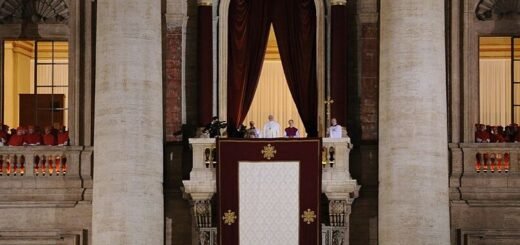
After the announcement, the new pope emerges onto the central balcony of St. Peter’s Basilica. Papal aides unfurl a maroon banner bearing the arms of the late pope, or in some cases, an alternate emblem. During the election of Pope Francis, there was no image of his predecessor’s arms, as Pope Benedict XVI had resigned rather than passed away in office.
The newly elected pope then imparts the Urbi et Orbi blessing, a solemn apostolic benediction for the city of Rome and the world. In some instances, popes have chosen a shorter episcopal blessing for their first official act. Pope Paul VI followed this approach in 1963. Since Pope John Paul II, recent popes, including Francis, have opted to address the crowd before delivering the Urbi et Orbi blessing. In a notable moment, Pope Francis led the faithful in prayers for his predecessor and requested prayers for himself before imparting his blessing.

Portrait of Pope Francis
The Shift from Coronation to Inauguration
Historically, popes were crowned with the triregnum, or triple tiara, in an elaborate papal coronation ceremony. However, since Pope John Paul I in 1978, this practice has been discontinued. Modern popes now undergo a simpler papal inauguration, reflecting a shift towards humility and accessibility in the papacy.
Frequently asked questions about papal conclave
What is a papal conclave?
A papal conclave is a gathering of the College of Cardinals convened to elect the bishop of Rome, also known as the pope. It is the longest-standing method of selecting a head of state, dating back to 1274.
Why are cardinals locked inside during the conclave?
To prevent political interference, Pope Gregory X established in 1274 that cardinals be locked in seclusion cum clave (“with a key”) until a pope is elected. This tradition continues today in the Sistine Chapel.
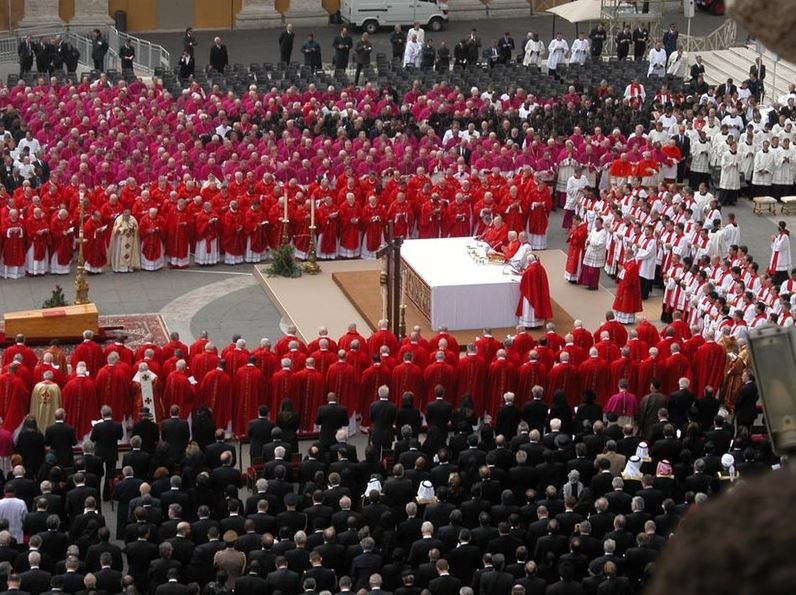
Cardinals gathered for Pope John Paul II’s funeral ceremony.
Who can vote in a papal conclave?
Only cardinals under the age of 80 are eligible to vote, as established by Pope Paul VI in 1970. The total number of electors is generally limited to 120.
What is the required majority for election?
Since 1179, a two-thirds majority has been required to elect a pope. A brief modification by Pope John Paul II in 1996 allowing a simple majority after 33-34 ballots was later revoked by Pope Benedict XVI in 2007.
Can a non-cardinal be elected pope?
Yes, but this is extremely rare. The last pope elected from outside the College of Cardinals was Pope Urban VI in 1378. If a layperson is chosen, he must first be ordained a bishop before assuming office.
How is the election result announced?
Black smoke signals a failed vote, while white smoke indicates a successful election. The Habemus Papam (“We have a Pope”) proclamation is then made from St. Peter’s Basilica.
What happens after the pope is elected?
The new pope chooses a regnal name, dresses in papal vestments in the “Room of Tears,” and gives his first blessing, Urbi et Orbi, to the crowd in St. Peter’s Square.

At the conclusion of the 2013 conclave, Pope Francis made his first public appearance before the crowd in St. Peter’s Square.
Can a pope resign?
Yes. The most recent resignation was Pope Benedict XVI in 2013. The last before him was Pope Gregory XII in 1415. A pope’s resignation must be made freely and properly declared.