Founding Father Charles Thomson
Charles Thomson, born on November 29, 1729, in Maghera, County Londonderry, Ireland, is often overlooked in discussions about the Founding Fathers of the United States. However, his contributions were integral to the formation of the nation, particularly in his roles as the secretary of the Continental Congress and as a co-designer of the Great Seal of the United States. In addition to his political involvement, Thomson made significant contributions to American culture and literature, notably through his translation of the Septuagint.
Below, World History Edu delves into the life and legacy of Charles Thomson, exploring his early life, political career, personal life, and lasting influence.
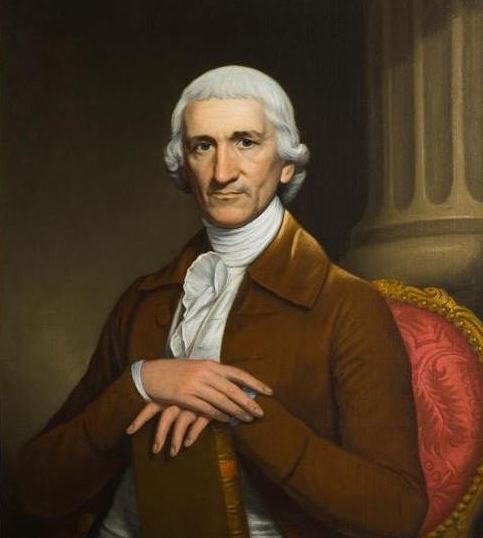
A portrait of Charles Thomson. Artwork by American portrait painter Joseph Wright.
Early Life and Education
Charles Thomson was born to Scots-Irish migrants, John and Mrs. Thomson, in Northern Ireland. The early years of his life were marked by hardship when, in 1739, Thomson’s mother passed away, and his father emigrated to North America with his sons in search of a better life. Tragically, John Thomson died at sea, leaving the boys destitute. Upon arriving in New Castle, Delaware, the Thomson brothers were separated and faced uncertain futures. Charles, however, was taken in by a blacksmith in New Castle and eventually received an education in New London, Pennsylvania.
By 1750, Thomson had become a tutor in Latin at the Philadelphia Academy, an institution that later became part of the University of Pennsylvania. His academic prowess and ability to teach Latin not only shaped his intellectual foundation but also played a key role in his later involvement in public life. This strong academic background paved the way for his entry into the world of politics.
Political Career and Leadership in the Revolution
Opposition to British Colonial Policies
Thomson’s political career began in earnest during the French and Indian War, where he became an outspoken critic of the Pennsylvania proprietors’ treatment of Native American groups. His opposition to the colonial government’s policies and his support for Native American rights made him a notable figure in early American political circles. Thomson played a pivotal role in the Treaty of Easton in 1758 and authored a piece titled An Enquiry into the Causes of the Alienation of the Delaware and Shawanese Indians from the British Interest (1759), which blamed the war on the proprietors’ mismanagement of relations with indigenous peoples.
During this period, Thomson aligned himself with Benjamin Franklin, leader of the anti-proprietary faction in Pennsylvania. However, political differences between the two men began to emerge in the 1760s, particularly over the crisis surrounding the Stamp Act of 1765. As tensions with Britain escalated, Thomson’s commitment to American independence deepened, and he became a prominent figure in the Philadelphia chapter of the Sons of Liberty.
Secretary of the Continental Congress
By the early 1770s, Thomson had cemented his reputation as a key revolutionary figure. His leadership in the cause of American independence earned him the title of “the Samuel Adams of Philadelphia,” as described by John Adams. When the Continental Congress convened in 1774, Thomson was appointed secretary. His role as secretary was not merely administrative; he took an active part in the proceedings, ensuring that the debates and decisions of the Congress were recorded accurately and thoroughly.
Charles Thomson’s life story is one of dedication, intellectual pursuit, and service to the newly formed United States.
Over the next 15 years, Thomson witnessed numerous changes in the composition of Congress as delegates came and went. Yet, his steady presence and meticulous record-keeping provided continuity during a tumultuous period. Thomson’s name, alongside that of John Hancock, was among the first to appear on the printed version of the Declaration of Independence in 1776. This moment was symbolic of his deep involvement in the creation of the United States.
Role in Foreign Affairs and the Great Seal
Thomson’s influence extended beyond the halls of Congress. His involvement in foreign affairs was significant, particularly as the secretary responsible for overseeing diplomatic correspondence. Biographers have even suggested that, at times, Thomson took on a role akin to that of a prime minister, managing critical issues that impacted the fledgling nation’s foreign relations.
One of Thomson’s most notable contributions to the early republic was his design of the Great Seal of the United States. Working alongside artist William Barton, Thomson played a crucial role in creating a symbol that would represent the new nation. The final design featured a pyramid with an eye atop it, a symbol of strength and providence. Thomson, who was fluent in Latin, contributed two Latin mottoes to the Seal: Annuit cœptis (“He has favored our undertakings”) and Novus ordo seclorum (“A new order of the ages”). These mottos reflected the belief that the American Revolution was divinely ordained and marked the dawn of a new era for mankind.
In 1784, the Great Seal was prominently featured in the ratification of the Treaty of Paris, which officially ended the Revolutionary War. However, Thomson’s role in foreign diplomacy was not without its challenges. He encountered friction with British representatives in Paris, who initially disputed the placement of the Seal and the signatures of the Congressional President. Benjamin Franklin ultimately intervened, helping to resolve the dispute.
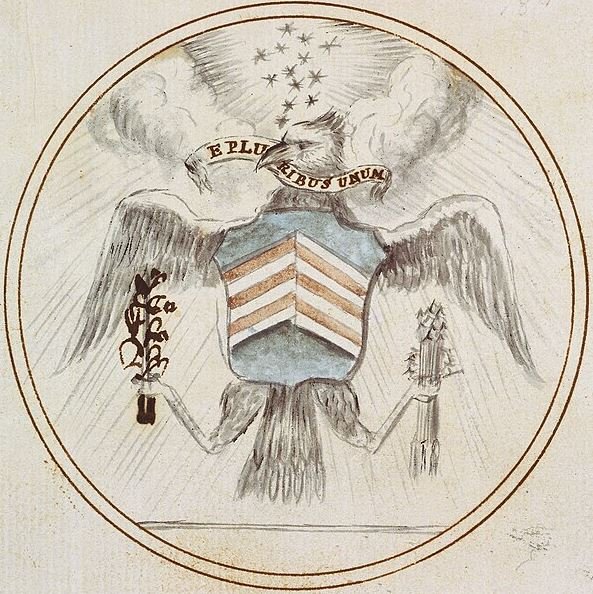
The proposed seal design by Thomson.
The Transition to the U.S. Constitution
Despite his instrumental role in the American Revolution, Thomson’s political career came to an end when the United States Constitution was ratified. He aspired to continue in public service, hoping to secure a position in the new federal government. However, political disagreements and the changing political landscape prevented him from obtaining a post in the new government. Thomson’s failure to secure a position, such as Secretary of the Senate, marked the end of his direct political influence.
Nevertheless, Thomson remained an important figure during the transition from the Articles of Confederation to the Constitution. He retained custody of the Great Seal and continued to sign documents as Secretary of the Continental Congress until he handed over his papers to the newly established U.S. Department of Foreign Affairs in 1789. Thomson’s role in notifying George Washington of his election to the presidency further underscores his lasting influence during the nation’s early years.
History and Major Facts about the Second Continental Congress
Later Life and Writings
Translation of the Bible and Agricultural Interests
In his later years, Thomson turned his attention to scholarly pursuits. He became known for his work in biblical translation, completing the first English translation of the Septuagint, the Greek version of the Old Testament. This was a significant achievement, as Thomson’s translation was the first of its kind to be published in English. Additionally, he published a synopsis of the Four Evangelists in 1815, contributing to theological scholarship in early America.
Thomson’s interests were not limited to religious studies. In retirement, he also pursued agricultural science and beekeeping, reflecting his diverse intellectual pursuits. He was elected to the American Antiquarian Society in 1813, a testament to his ongoing engagement with intellectual and scientific communities.
Personal Life and Family
Thomson’s personal life was marked by both joy and tragedy. He married Ruth Mather in 1758, but she and their twin daughters tragically died in 1769. Several years later, Thomson remarried, this time to Hannah Harrison, the daughter of Richard Harrison, owner of the Harriton Plantation in Pennsylvania. Thomson spent his final years at Harriton House, where he continued his scholarly work and remained involved in local affairs.
In his later years, Thomson’s health began to decline, and he reportedly became senile, unable to recognize even members of his own family. His death on August 16, 1824, marked the end of a life devoted to the service of his country. Thomson was initially interred at the Harrison Family Cemetery in Harriton but was later reburied at Laurel Hill Cemetery in Philadelphia in 1838.
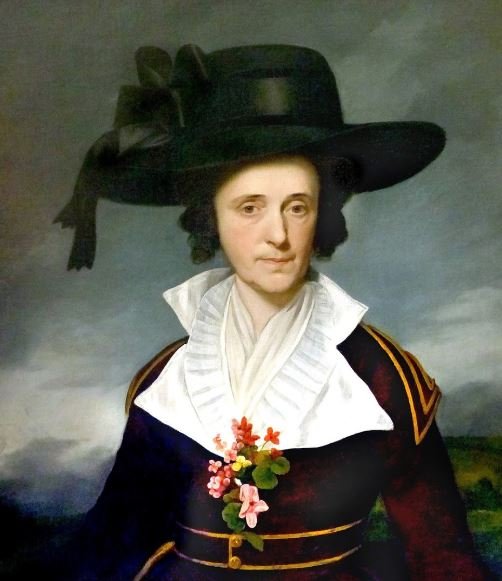
A portrait, by Joseph Wright, of Hannah Harrison.
Legacy and Portrayals
Charles Thomson’s contributions to the United States are often overshadowed by the more widely recognized figures of the American Revolution. Yet his work as the secretary of the Continental Congress, his design of the Great Seal, and his translation of the Septuagint ensure his place in American history. Thomson was portrayed by Ralston Hill in the 1969 Broadway musical 1776 and its 1972 film adaptation, which introduced his role in the founding of the nation to a broader audience.
Though often overshadowed by more prominent figures, Thomson’s legacy as a Founding Father and key figure in the American Revolution is one that deserves greater recognition and appreciation.
Thomson’s image also appeared on a 1975 postal card issued by the U.S. Postal Service, cementing his place in the pantheon of American historical figures. Though his name is not as widely known as some of his contemporaries, his contributions to the creation of the United States remain invaluable. Through his dedication to his work, Thomson played a pivotal role in shaping the early republic and ensuring the continuity of its institutions during its formative years.





