Who Are Foundational Black Americans? The History Behind the FBA Identity
The term Foundational Black Americans (FBA) has become increasingly visible in conversations about Black identity, American history, reparations, immigration and the legacy of slavery in the United States. But what exactly does it mean?
In its modern usage, the term generally refers to Black Americans who are descendants of the Africans who were formerly enslaved in the United States (or in the colonies that preceded it). The term itself is relatively new, but the people it points to are not.
The story behind Foundational Black American identity stretches across centuries of U.S. history – from slavery and the Civil War, to Reconstruction, Jim Crow, the Great Migration, the Civil Rights Movement and the enormous influence Black Americans have had on American culture. Therefore, understanding FBA requires comprehending much more than a label. What’s also necessary is examining the development of a distinct population whose past is intertwined with that of the United States.
What Does Foundational Black American Mean?
Foundational Black American is a modern, lineage-based term popularized by media personality and filmmaker Tariq Nasheed, who began using it around 2019. Nasheed and the official FBA movement describe Foundational Black Americans primarily as descendants of (Black) people who experienced slavery and its aftermath within the United States.
The word “foundational” is important to this concept. It emphasizes that generations of Black Americans were present during the formation and development of the United States. And they contributed significantly to the country’s economy, infrastructure, culture, politics and national identity.
That adjective also distinguishes this particular lineage from the general category of “Black American”. Technically speaking, virtually any Black person who immigrated to the United States and achieved citizenship is a Black American. However, they would not be considered FBA because they’re present under their own will (or that of their parents), not as the descendants of slaves.
So the “foundational” distinction points to historical lineage rather than skin color alone. This differentiation has generated considerable debate, especially in the areas of immigration, reparations and what defines the Black identity in an increasingly-diverse United States.
The History Goes Back Much Further Than the Term
Although “Foundational Black American” is a 21st-century expression, people of African descent have been part of the United States for centuries. According to the mainstream, the starting point of African American history was 1619, when a group of captives from Africa were shipped to colonial Virginia by maritime businessmen operating under a Dutch license. But even prior to that, as recognized by the FBA movement, there were enslaved Africans brought to San Miguel de Gualdape, a Spanish colony just south of Virginia, as early as 1526.
So Black people have now been in the country for half a millennium, with their enslavement proving key in shaping the development of colonial America and later the United States. And after slavery, their descendants remained deeply rooted in American society, despite being denied many of its basic freedoms.
Slavery and the Creation of a Distinct African American Population
The Transatlantic Slave Trade forcibly exported millions of Africans to the Americas. Most did not arrive in the United States. The majority were transported to Brazil, the Caribbean and other parts of the Americas.
Those brought to British North America (i.e. the United States) came from different societies and therefore spoke various languages, besides boasting their respective religions and traditions. Slavery violently uprooted those differences.
Families were separated. African names and tongues were frequently suppressed. Enslaved people from different ethnic groups lived alongside one another, with their generations were born side-by-side. Over time, their descendants developed their own unique cultures, shaped both by ancestral African influences and their peculiar experiences in America.
This gradual development is key to understanding African American identity. The Smithsonian’s National Museum of African American History and Culture verifies that approximately 250 years of slavery profoundly shaped the African American experience.
By the eve of the American Civil War (which commenced in 1861), nearly four million people remained enslaved in the United States. Their toil was deeply connected to the country’s economy, being integral to industries revolving around agricultural commodities such as cotton, tobacco, rice and sugar.
But they were not passive victims of the exploitation of their labor. Many resisted slavery in various ways, such as escaping, sabotaging work, forming independent communities and, in some cases, revolting.
During the Civil War, many enslaved people fled towards the freedom-fighting Union forces, as opportunities emerged. The resulting destruction of slavery would transform their legal status, but it did not immediately create equality.
Emancipation Changed America
The Civil War became the decisive turning point in African American history. President Abraham Lincoln’s Emancipation Proclamation took effect on 1 January 1863, declaring enslaved people free in areas under Confederate control (i.e. the South). And the abolition of slavery nationwide ultimately came with ratification of the 13th Amendment in 1865.
Suddenly, millions of formerly enslaved Black Americans faced a monumental question – what did freedom actually mean? And the answer was far from simple.
They sought to reunite families that were forcibly fragmented, acquire land, receive education, establish businesses, build churches and exercise political rights. The federal government created the Freedmen’s Bureau in 1865 to assist them during the process. Among other activities, the agency provided food and medical aid, helped set up schools, assisted families and empowered Black Americans to navigate labor and legal matters. This period of American history is known as Reconstruction.
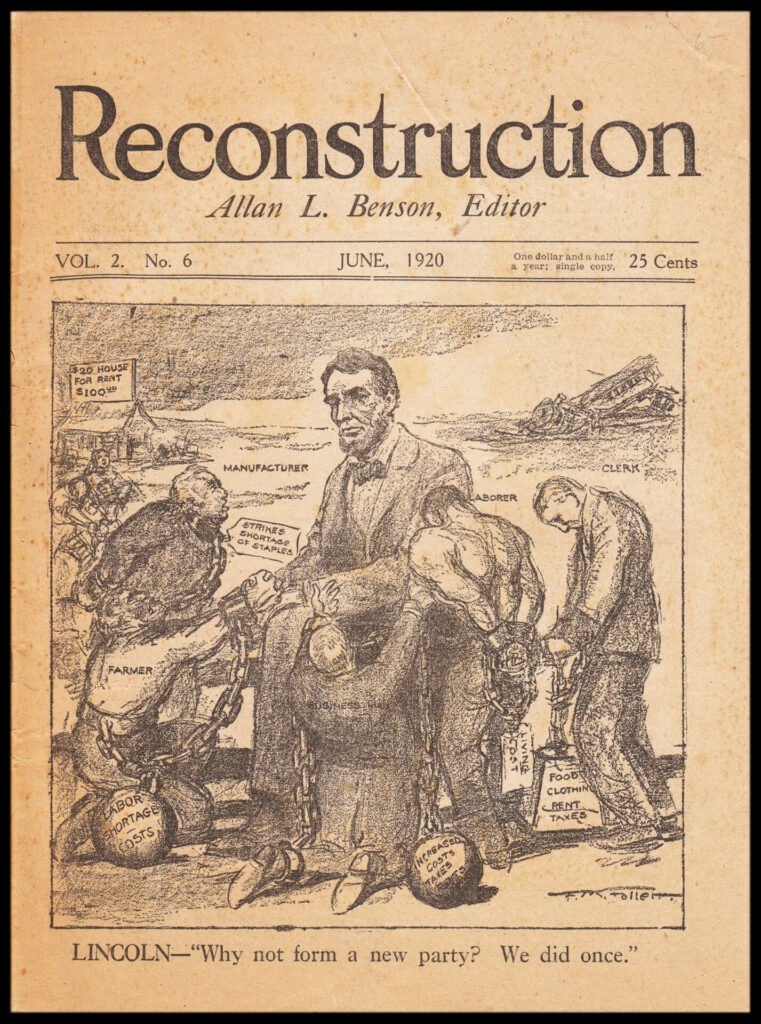
The June 1920 cover of Reconstruction, a publication edited by Allan L. Benson. The illustration reflects continuing debates over the economic and political struggles Americans faced in the decades following the Civil War.
Reconstruction and the First Great Experiment in Black Citizenship
Between 1865 and 1877, the United States attempted to reconstruct the South while determining the political status of approximately four million newly-freed African Americans. Three new constitutional amendments fundamentally changed the country’s laws.
The 13th Amendment abolished slavery, except as punishment for crime.
The 14th Amendment established citizenship and equal protection under the law.
The 15th Amendment prohibited the denial of voting rights based on race, color or previous condition of servitude.
Black Americans seized these opportunities by realizing the aforementioned goals. Black men voted in large numbers in parts of the South and even went on to serve in local, state and federal government. For a brief period, the possibility of a multiracial democracy in the former slave states appeared achievable.
But Reconstruction also generated violent opposition. White supremacist groups and political organizations attempted to restore the old racial hierarchy through intimidation and violence. And eventually, the federal government’s commitment to protecting Black political rights weakened.
The Smithsonian describes Reconstruction as having been a period of extraordinary possibility. But it went on to be followed by voter suppression, racist terrorism and the rollback of many of the gains Black Americans had made. And by the late 19th century, a new system of racial domination had emerged.
From Slavery to Jim Crow
Across much of the South, state and local governments established segregation laws which collectively became known as Jim Crow. Black Americans faced restrictions in politics, employment, education, housing and access to public facilities. For example, poll taxes, literacy tests and other mechanisms were used to prevent Black citizens from voting.
But Jim Crow wasn’t just a set of laws. These statutes were reinforced by ruthless violence. Lynching and massacres sent an unmistakable message to Black communities, highlighting the consequences of challenging the White supremacist order.
Yet African Americans continued building institutions. Black churches became centers of civic life. The people had their own newspapers, which gave voice to their communities. Entrepreneurs founded banks, insurance companies, stores and other businesses. Historically Black colleges and universities educated generations of teachers, doctors, lawyers, ministers and leaders. And these institutions played a crucial role in the struggle against segregation.
The Great Migration Transformed Black America
One of the most important demographic events in African American history began during the early 20th century. Millions of Black Americans left the rural South – where they were concentrated – and moved to cities in the North, Midwest and West. This movement became known as the Great Migration. Approximately six million African Americans decided to leave the South over the course of several decades.
They relocated to cities such as Chicago, Detroit, New York, Philadelphia and Los Angeles, seeking industrial employment, greater political freedom and an escape from the harshest features of Jim Crow. This migration dramatically changed the geography of Black America.
At the beginning, roughly 90 percent of African Americans lived in the South. But by the 1970s, nearly half lived in the North and West.
Entire communities transformed. Chicago developed a powerful Black cultural and political presence. New York City was the center of the Black artistic explosion known as the Harlem Renaissance. Detroit became an important hub of Black industrial labor and later the starting point of Motown music. Los Angeles developed influential Black communities, whose cultural impact extended around the world. The children of the Great Migration became writers, musicians, athletes, politicians, entrepreneurs and activists who contributed to the reshaping of American society.
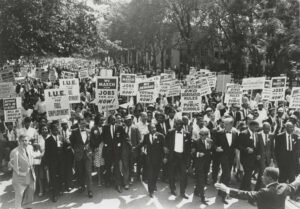
Thousands of demonstrators take part in the March on Washington for Jobs and Freedom in Washington, D.C., on August 28, 1963. The historic civil rights demonstration culminated in Martin Luther King Jr.’s famous “I Have a Dream” speech.
The Civil Rights Movement
But even beyond the South, racial discrimination remained widespread throughout the country. So by the middle of the 20th century, generations of organized resistance to institutionalized racism culminated in what became known as the Civil Rights Movement.
Figures such as Martin Luther King Jr., Rosa Parks, Ella Baker, Thurgood Marshall, Malcolm X, Fannie Lou Hamer and countless lesser-known activists challenged segregation and racial discrimination. And their struggles produced landmark changes.
For example, the Civil Rights Act of 1964 prohibited discrimination in major areas of public life. The Voting Rights Act of 1965 attacked discriminatory practices that prevented Black Americans from exercising political power. The Civil Rights Movement fundamentally changed the law and altered the U.S.’s image, as it proceeded to influence struggles for equality around the world.
Black American Culture Becomes Global Culture
One of the most extraordinary aspects of Black American history is the enormous cultural influence that generated from a population who were just recently, in a historical context, enslaved. African American music traditions produced or shaped many of the world’s most popular genres, including blues, jazz, gospel, rock and roll, soul, funk, disco, house and hip-hop. Black American vocabulary, fashion, dance and comedy have likewise become deeply embedded in global culture.

Hip-hop artists perform before a live audience. Emerging from Black American communities in New York City during the 1970s, hip-hop grew into a global cultural movement that has influenced music, fashion, language and popular culture around the world.
And the influence extends beyond entertainment. Black American activists, writers and intellectuals inspired anti-colonial and civil rights’ movements internationally. Figures such as Frederick Douglass, W.E.B. Du Bois, Martin Luther King Jr., Malcolm X, James Baldwin and Maya Angelou became internationally recognized voices on freedom, race and human dignity.
Why Did the FBA Identity Emerge?
That distinct cultural and political history helps explain the “foundational” adjective at the center of FBA identity. Advocates are not simply describing where their ancestors came from. They are emphasizing what those generations and their descendants contributed to the creation of modern America, i.e. the United States, which is widely considered the greatest country on Earth.
For much of the 20th century, terms such as Negro, Colored, Black and African American were used at different times to describe the historic U.S. Black population. But American demographics have changed considerably over the years.
Following changes to immigration law in the 1960s, immigrants from Africa and the Caribbean came over in their numbers. Consequently, America’s Black population became much more diverse. A Black person living in the U.S. today might have a family that has been in the country for centuries. Or they may have personally arrived from other parts of the world only a short time ago.
Historian Ira Berlin argued that changing patterns of Black immigration have complicated the meaning of “African American”. Unlike times past, that category now includes people from different backgrounds.
It is from this changing environment that “Foundational Black American” emerged. “African American” is a term broadly used to point to Black U.S. citizens. FBA attempts to remove that ambiguity by explicitly emphasizing lineage. This terminology provides a way for supporters to reference a specific ethnic and historical background within the larger “African American” population, because ultimately, identity is both historical and personal.
FBA and the Reparations Debate
The distinction becomes particularly important in discussions about reparations for American slavery and for the government-sanctioned racial discrimination that succeeded it. Many FBA advocates argue that reparations should be based on lineage rather than race.
Under this argument, compensation would not simply go to every Black person who’s a U.S. citizen. Eligibility would be directly connected to the descendants of the victims of slavery and the racist systems it gave birth to.
If the harms being discussed are historical injustices committed by particular institutions against an identifiable population, FBA supporters contend that identifying the descendants of that population becomes necessary when discussing remedies. However, exactly how such a program would work, who would qualify and what form reparations should take remain subjects of significant political and scholarly debate.
A Distinct People Shaped by a Distinct History
The emergence of the term “Foundational Black American” reflects a larger question that has existed throughout American history – how should the descendants of America’s historic Black population refer to themselves? But whether someone prefers FBA, Black American, African American or another description, understanding the history behind the terminology is more important than the label itself.
From slavery and emancipation to Reconstruction, the Great Migration and the Civil Rights Movement, generations of Black Americans participated in virtually every major transformation of the United States. The term “Foundational Black American” may be new, but the history it is attempting to describe is centuries old.





