Slavery in the Roman World
Slavery in ancient Rome was a fundamental component of society, both economically and socially. Roman slavery had unique characteristics that distinguished it from other historical forms of slavery, and it was deeply embedded in nearly every aspect of Roman life.
Origins and Expansion of Slavery in Rome
The origin of slavery in Rome is intertwined with the history of conquest and expansion. Early Romans initially took slaves primarily from among neighboring Latin and Etruscan populations. However, as Rome expanded through military conquests, the sources of slaves became increasingly diverse.
By the late Republic and early Empire, the slave population in Rome included people from across Europe, the Middle East, and North Africa. Slavery was not limited to any one ethnic group; rather, anyone captured in battle, or those who fell into debt, were at risk of becoming slaves.
By the time of the early Empire, it is estimated that between one-third and one-half of the population of Italy were slaves.
A significant number of slaves were acquired through warfare, as defeated enemies were often enslaved. Military victories over Carthage, Greece, and other Mediterranean powers brought large numbers of prisoners of war into Rome, swelling the slave population. Pirates also played a role in the slave trade, as they kidnapped individuals and sold them into slavery.
Roman slavery was unique in its scale and in the degree to which it permeated society. By the time of the early Empire, it is estimated that between one-third and one-half of the population of Italy were slaves. Slavery in Rome was not just a marginal aspect of society; it was central to its functioning.
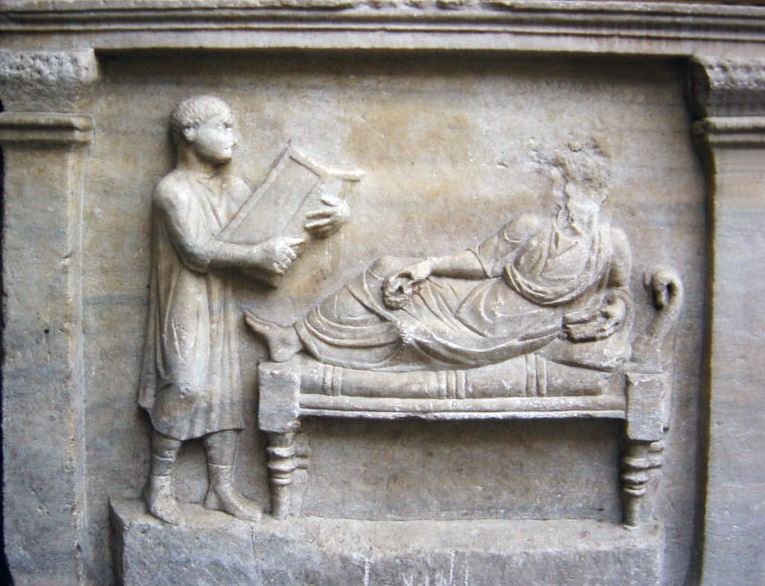
Valerius Petronianus, accompanied by his slave holding writing tablets.
Legal Status and Rights of Slaves
In Roman law, slaves were considered property, not people with rights. They were res, or “things,” and had no legal personhood. Slaves could be bought, sold, punished, or even killed at their owner’s discretion. They could not legally marry, although they often formed informal unions known as contubernium. Children born to enslaved parents were also considered slaves, belonging to the owner of the mother.
While they had no legal rights, some laws protected slaves from extreme mistreatment. For example, Emperor Augustus imposed certain limits on the ability of slave owners to kill their slaves without a justified reason. Later, under Emperor Claudius, a law stated that if a slave was abandoned by his master due to illness or age, he could be considered free. Although these laws represented minimal protections, they marked a shift in attitudes over time, as abuses sometimes led to social tensions and uprisings.
Slaves could, however, sometimes accumulate wealth or possessions, known as peculium, though legally this wealth belonged to the owner. With the peculium, some slaves managed to save enough to purchase their own freedom. This possibility, however limited, was a motivating factor for many slaves and was used by some owners as an incentive for diligent service.
Types of Slavery and Roles of Slaves
Slaves in Rome were employed in a variety of roles depending on their skills, origins, and the needs of their owners. Broadly, Roman slaves fell into two main categories: familia urbana (urban slaves) and familia rustica (rural slaves).
Urban Slaves
Urban slaves were typically household slaves who worked in the homes of their owners, performing tasks like cooking, cleaning, childcare, and other domestic duties. Some were highly skilled artisans, tutors, accountants, and secretaries. Educated slaves, particularly those from Greece, were highly valued and might work as teachers, librarians, or even doctors. These slaves often had closer relationships with their owners and might have more chances to be manumitted (freed) or acquire some autonomy.
Rural Slaves
These slaves worked on farms, plantations, or in mines, and their lives were typically much harsher. They faced grueling work conditions and were often supervised by harsh overseers. Life expectancy for rural slaves was lower than for urban slaves due to the physical toll of their work and harsher treatment. In particular, slaves in mines and large agricultural estates faced some of the worst conditions, with little hope of freedom or improvement in status.
Public Slaves
Some slaves were owned by the state rather than by private individuals. These public slaves performed essential tasks for the government and worked in administrative roles, temple maintenance, construction, and more. Public slaves often had a slightly better standard of living than those working in private households, as their services were considered essential for the operation of the state.
Gladiators
Slaves trained as gladiators had a unique and dangerous role in Roman society. They fought in arenas for the entertainment of the public, often facing brutal and lethal conditions. While the life of a gladiator was perilous, some gained fame, wealth, and, occasionally, freedom.
The Social and Economic Role of Slavery
Slavery was the backbone of the Roman economy, particularly in agriculture, mining, and domestic service. Large estates, known as latifundia, relied heavily on slave labor to produce crops for local consumption and export, particularly in regions like Sicily and southern Italy. Slaves also worked in industries such as textile production, pottery, and mining, which were crucial to the Roman economy. Additionally, slaves performed vital public services, contributing to infrastructure and maintaining public buildings.
Wealthy citizens might own dozens or even hundreds of slaves, while even modest households might own one or two.
The social structure of Rome was profoundly shaped by the presence of slavery. Roman society was hierarchical, with clear divisions between citizens, non-citizens, and slaves. The institution of slavery reinforced these divisions and helped maintain the social order. Wealthy Romans demonstrated their status by owning large numbers of slaves, and slaves were considered essential to the lifestyle of the Roman elite.
Slaves played a role in every aspect of life for the Roman elite. Wealthy citizens might own dozens or even hundreds of slaves, while even modest households might own one or two. Slaves were seen as status symbols, and the more slaves one owned, the higher their social prestige. This widespread ownership created a demand for slaves that fueled the slave trade.
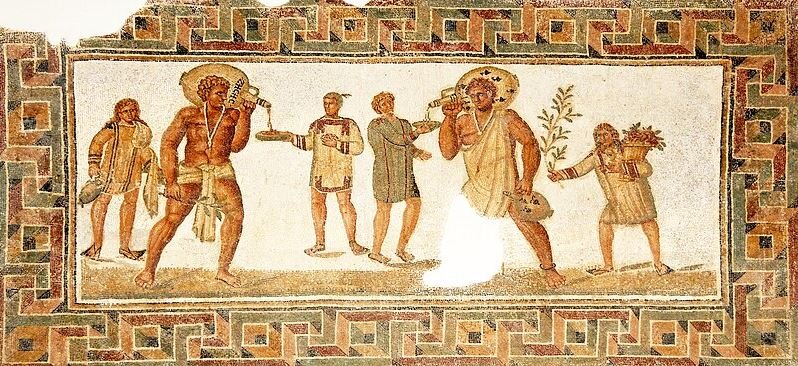
A mosaic floor depicting slaves serving at a banquet.
Manumission and Freed Slaves
Manumission, or the freeing of slaves, was a common practice in Rome and could occur in several ways. Owners might grant freedom as a reward for loyalty or as a provision in their will. Manumission could also be granted through a formal ceremony, where the former slave gained limited legal rights and became a libertus (freedman or freedwoman).
Freed slaves were typically loyal to their patrons, and in some cases, they became wealthy and influential themselves.
Freed slaves occupied a unique social status in Rome. They were not considered full citizens but were often granted certain rights and could engage in business, marry, and own property. Many freedmen continued to work for their former masters or maintained a close relationship with them. Freed slaves were typically loyal to their patrons, and in some cases, they became wealthy and influential themselves. Some freedmen went on to accumulate wealth and social status, even entering politics or other public roles.
Despite their freedom, former slaves were often stigmatized by Roman society and could not hold certain public offices. They remained socially distinct from freeborn citizens, and their descendants did not attain full Roman citizenship until the second generation.
Resistance and Rebellion
Although enslaved people were subject to strict control, resistance and rebellion were not uncommon. Slaves resisted their conditions in both subtle and overt ways. Small acts of defiance, such as sabotage, theft, or faking illness, were common forms of passive resistance. More extreme forms of resistance included running away, though fugitive slaves faced harsh punishment if captured.
The most famous slave revolts in Rome were the Servile Wars. The first major revolt, known as the First Servile War (135–132 BCE), began in Sicily, where large numbers of slaves on agricultural estates rose up against their masters. The Second Servile War (104–100 BCE) also occurred in Sicily and involved thousands of slaves fighting for their freedom.
The most famous and consequential slave revolt was the Third Servile War (73–71 BCE), led by the gladiator Spartacus. This rebellion saw tens of thousands of slaves band together, challenging Rome’s armies in a series of battles. Although ultimately crushed, the Spartacus rebellion shook Rome to its core and demonstrated the potential threat that the enslaved population posed if united in opposition.
In response to these revolts, Roman authorities took steps to strengthen control over the slave population, increasing surveillance and imposing stricter penalties for disobedience.
READ MORE: Events that triggered the Spartacus Revolt
Decline of Slavery in Rome
The decline of slavery in Rome was gradual and closely related to shifts in the Roman economy and society. By the later Empire, the economic system began to shift from slavery to other forms of dependent labor, like serfdom. Economic pressures, declining military conquests, and changing social attitudes contributed to this shift.
With fewer new territories being conquered, the supply of slaves decreased. As the Roman Empire faced internal and external pressures, the costs of maintaining a large slave population grew unsustainable. Landowners increasingly relied on tenant farmers and serfs, who were technically free but bound to the land, rather than maintaining large numbers of slaves. Christianity also played a role in changing attitudes towards slavery, promoting values of compassion and charity that, while not eradicating slavery, softened some aspects of it.
The Legacy of Roman Slavery
Slavery in Rome left a lasting legacy on Western civilization.
Many of the ideas, laws, and practices associated with slavery in subsequent centuries were influenced by the Roman experience.
The concept of slaves as property, the possibility of manumission, and the use of slave labor in agriculture and industry were aspects of Roman slavery that influenced later systems.
Roman slavery also left a deep mark on Roman culture, literature, and philosophy. Writers like Seneca, Cicero, and later Christian thinkers discussed the ethical and social implications of slavery, sometimes calling for more humane treatment of slaves.
While Rome never questioned the institution of slavery itself, these philosophical debates laid the groundwork for later critiques of slavery in Western thought.
Frequently asked questions about the Slavery in the Roman World

What role did slavery play in Roman society?
Slavery was a central institution in Roman society, deeply integrated into almost every aspect of life. Slaves worked in various sectors, including households, agriculture, mines, military camps, workshops, construction, and public services. This forced labor was essential to the Roman economy and social hierarchy.
How prevalent was slavery in the Roman Empire?
In Italy, approximately one-third of the population were slaves, and across the empire, slaves made up about one-fifth of the population. This widespread slave population provided a foundation for Roman economic and social structures.
How was slavery viewed culturally in Roman society?
Slavery was accepted as a natural part of life in Roman society, representing total control (dominium) of one person over another. Romans considered inequality in power and resources as a given, tracing this worldview to mythological stories like Jupiter’s dominance over Saturn.
What justification did Romans use for enslaving others?
Romans justified slavery by believing that their own freedom depended on the subjugation of others. Additionally, they saw it as culturally acceptable to enslave those captured in war, viewing it as a mark of Roman superiority and divine right to rule.
How were slaves acquired in Rome?
Slaves were obtained through various means, including the capture of war prisoners, piracy, trade, kidnapping, and the birth of children to enslaved mothers. These children automatically became slaves, continuing the institution across generations.
What was the Delos market known for?
The Delos market was notorious as a significant slave market, supplied largely by Cilician pirates. Here, slaves were publicly displayed with signs listing their qualities for potential buyers.
Did all Romans own slaves?
Slave ownership was more common among the wealthy, though it extended beyond the elite. Small business owners or veterans might own one slave, while wealthy Romans could have hundreds, with slave ownership serving as a symbol of status.
How did slaves rank in the social hierarchy?
Slaves occupied the lowest social tier in Roman society, with no legal rights or personal property. They were considered property, like any other possession. During the Saturnalia festival, slaves were temporarily given some freedoms, but otherwise, they had no legal individuality.
What types of work did slaves perform?
Slaves worked in almost every sector except public office. They were employed in agriculture, mining, manufacturing, transportation, education, military support, household chores, construction, and even religious rituals. Their labor was crucial in maintaining various industries in Roman society.
What were the living conditions like for agricultural slaves?
Agricultural slaves, known as vincti, often endured harsh conditions, living in prison-like barracks (ergastula) and frequently kept in chains. Archaeological findings from Pompeii reveal chained work gangs and skeletal evidence of malnutrition and overwork.
Was there a path to freedom for Roman slaves?
Yes, a small minority of slaves could gain freedom through manumission, either granted by their owner or purchased with their savings (peculium). Freed slaves, known as liberti, could achieve citizenship, marry, and even own property.
How did freed slaves integrate into Roman society?
Freed slaves often took the first two names of their former master, a mark of trust and respect. Some freed slaves rose to wealth and status, even owning slaves themselves. For example, C. Caecilius Isidorus, a former slave, eventually owned over 4,000 slaves.
How did Roman slaves resist their conditions?
Slaves resisted through various means, including sabotage, theft, and work slowdowns. There were also larger revolts, the most famous being the Third Servile War led by Spartacus in 73 BCE.
Spartacus was a Thracian gladiator who led a major slave rebellion known as the Third Servile War. His army of enslaved and free laborers successfully defeated Roman forces several times before ultimately being defeated by Marcus Licinius Crassus.
What was the overall purpose of slavery in Rome?
Slavery was crucial to maintaining the Roman state and economy, providing a cheap and controlled labor force that supported the wealth and status of the free population. Slaves were valued primarily as economic assets rather than as individuals with rights.
FACT CHECK: At World History Edu, we strive for utmost accuracy and objectivity. But if you come across something that doesn’t look right, don’t hesitate to leave a comment below.