Abu Simbel
Abu Simbel is a remarkable historic site located in the Aswan Governorate of Upper Egypt, near the Sudanese border. Known for its two massive rock-cut temples, this iconic monument sits along the western bank of Lake Nasser, approximately 230 kilometers southwest of Aswan by air and around 300 kilometers by road. Carved directly into the sandstone cliffs during the 13th century BC under the reign of Pharaoh Ramesses II, these temples serve as a testament to ancient Egyptian engineering, art, and political power. The site was originally intended to demonstrate the might of the Egyptian empire and its enduring cultural and religious influence over Nubia, a region vital for its gold and trade routes.
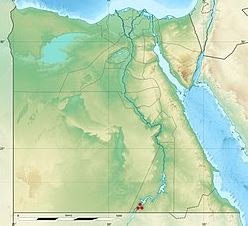
Image: Map showing the location Abu Simbel in Egypt
Historical Significance and Construction
Commissioned during the 19th Dynasty by Ramesses II, Abu Simbel was one of several monumental structures built as part of an extensive building program aimed at solidifying Egypt’s dominance over Nubia. This strategic region was not only a source of immense wealth but also served as a conduit for goods and cultural exchange.
The temples’ construction began around 1264 BC and continued for approximately two decades. Known in ancient times as “The Temple of Ramesses, Beloved by Amun,” the complex comprises two temples: the Great Temple dedicated to Ramesses II himself and the smaller temple dedicated to his beloved wife, Queen Nefertari.
The imposing façade of the Great Temple features four colossal statues of Ramesses II, each standing about 20 meters tall. These figures emphasize his divine status and the grandeur of his reign. Smaller statues of his queen and children are positioned near his feet, symbolizing their subordinate roles while still highlighting the family’s prominence. The smaller temple, located nearby, honors Hathor, the goddess of love and motherhood, with Nefertari portrayed as her earthly counterpart.
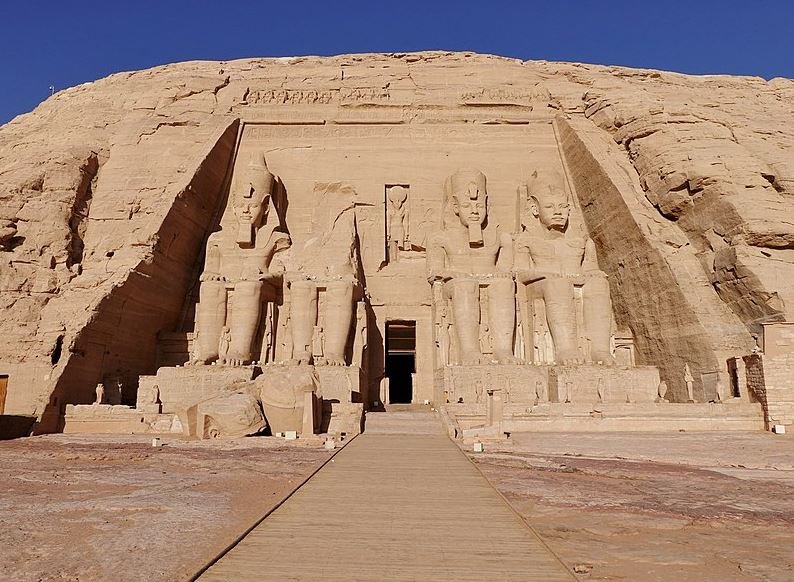
Image: The façade of the Temple of Ramesses II
READ MORE: Amun: Origin Story, Family, Meaning, Symbols, Power, & Facts
Rediscovery and European Interest
For centuries, the temples fell into obscurity, gradually buried under the sands of the Nubian desert. By the 6th century BC, only the heads of the Great Temple’s statues remained visible. European awareness of the site was reignited in 1813 when Swiss explorer Johann Ludwig Burckhardt stumbled upon the smaller temple and parts of the larger one.
However, he was unable to gain access to the interior. Italian adventurer Giovanni Belzoni later succeeded in clearing enough sand to reveal and enter the Great Temple in 1817. These rediscoveries sparked significant interest among European travelers and scholars, contributing to a growing fascination with ancient Egypt.
Edward William Lane’s meticulous documentation and illustrations of Abu Simbel in the early 19th century further elevated its status among Egyptologists and the general public. The combination of scholarly and artistic efforts during this period helped Abu Simbel achieve widespread recognition as one of the greatest archaeological treasures of ancient Egypt.
Architectural and Artistic Features of Abu Simbel
The Great Temple exemplifies the architectural ingenuity of ancient Egyptians. Its layout adheres to a traditional axial design, with a series of progressively smaller rooms leading to the sanctuary at its core. The hypostyle hall is supported by eight Osirid pillars, depicting Ramesses II in the guise of Osiris, symbolizing the eternal nature of his reign. Bas-reliefs throughout the temple illustrate significant events, including the Battle of Kadesh, where Ramesses II claimed a tactical victory against the Hittites.
The sanctuary itself houses four seated statues representing the deified Ramesses II alongside the gods Amun, Ra-Horakhty, and Ptah. Twice a year, the rising sun aligns with the temple’s axis, illuminating these statues while leaving Ptah, the god associated with the underworld, in shadow. This precise solar alignment underscores the astronomical knowledge and engineering expertise of ancient Egyptian builders.
The smaller temple dedicated to Nefertari and Hathor mirrors similar architectural principles but on a less grandiose scale. Remarkably, it is one of the few instances in Egyptian art where a queen is depicted at nearly the same scale as her pharaoh, reflecting Nefertari’s esteemed status. The temple’s interior features vivid reliefs of the royal couple presenting offerings to various gods and goddesses, reinforcing their divine connection.

Ancient Egyptian Queen Nefertari
READ MORE: 20 Important facts about Ptah, the ancient Egyptian god of creation and craftsmen
Relocation and Preservation
Abu Simbel faced a major threat in the mid-20th century due to the construction of the Aswan High Dam. The dam’s reservoir, Lake Nasser, would have submerged the temples entirely.
Recognizing the cultural and historical importance of Abu Simbel, an international campaign led by UNESCO was launched to save it. Between 1964 and 1968, a multinational team meticulously dismantled the temples into large blocks, some weighing up to 30 tons, and reassembled them on an artificial hill 65 meters higher and 200 meters away from their original location.
The relocation project, costing approximately $40 million, is considered one of the greatest feats of modern archaeological engineering. The temples were reconstructed with extreme precision to maintain their original orientation, ensuring that the solar alignment phenomenon continues to occur. The success of this endeavor not only preserved Abu Simbel for future generations but also set a precedent for international cooperation in heritage conservation.
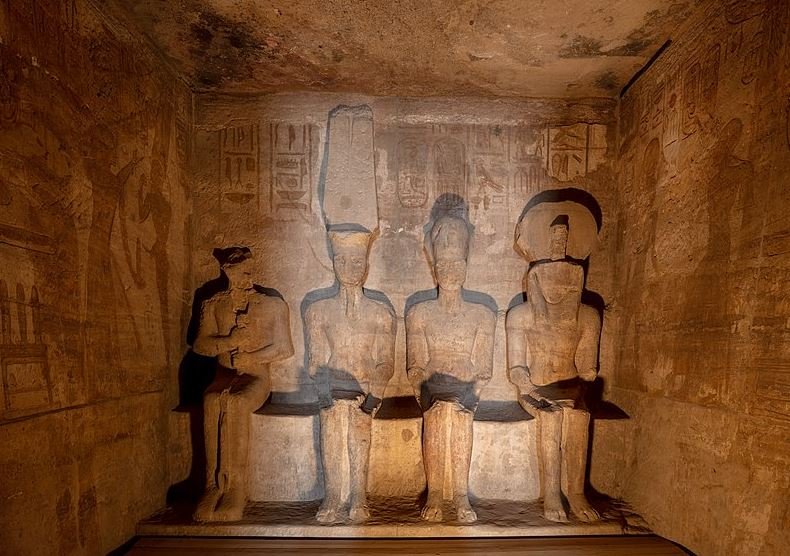
Image: The inner sanctuary of Abu Simbel temple.
Cultural and Tourist Impact
Today, Abu Simbel is part of the UNESCO World Heritage Site known as the Nubian Monuments, which includes other relocated temples such as those at Philae and Amada. The site attracts thousands of visitors annually, drawn by its awe-inspiring scale, intricate artistry, and historical significance. Access to Abu Simbel is typically by road from Aswan or via flights to the nearby Abu Simbel Airport.
The temples continue to serve as a powerful symbol of Egypt’s rich cultural legacy, showcasing the sophistication and ambition of ancient Egyptian civilization. Festivals and events, such as the biannual solar alignment celebrations, draw crowds and highlight the enduring connection between modern Egyptians and their ancestors.
Legacy and Lessons
Abu Simbel is more than just a monument; it represents a confluence of art, religion, and politics. Its construction under Ramesses II demonstrates how architecture was used as a tool of propaganda to project power and divine authority. At the same time, the relocation effort underscores the value of preserving humanity’s shared heritage, illustrating how global collaboration can overcome seemingly insurmountable challenges.
Frequently Asked Questions

Who commissioned the construction of Abu Simbel, and when?
The temples were commissioned by Pharaoh Ramesses II during the 13th century BC as part of his efforts to assert Egyptian power in Nubia.
What are the primary purposes of the temples?
The Great Temple honors Ramesses II and the gods Amun, Ra-Horakhty, and Ptah, while the smaller temple is dedicated to Hathor and Ramesses’ wife, Queen Nefertari, symbolizing their divine connections and authority.
What architectural features make Abu Simbel unique?
The Great Temple features colossal statues of Ramesses II, solar alignment phenomena, and intricate reliefs depicting military victories, while the smaller temple portrays Nefertari on an equal scale with the pharaoh.
READ MORE: Great Royal Wife in Ancient Egypt
Why was Abu Simbel relocated, and how was it achieved?
The temples were relocated between 1964 and 1968 to avoid submersion by Lake Nasser due to the Aswan High Dam. They were carefully dismantled and reconstructed 65 meters higher and 200 meters further inland.
What is the significance of the solar alignment at the Great Temple?
Twice a year, the sun illuminates the sanctuary’s statues of Ramesses II, Amun, and Ra-Horakhty, highlighting ancient Egyptian astronomical and engineering expertise.





