Agesilaus II: King of Sparta

Agesilaus’ reign is remembered for his military leadership and personal virtues, such as frugality and dedication to Spartan ideals. However, his rigid policies and unrelenting hostility toward Thebes are often blamed for Sparta’s decline. Ancient sources like Greek military leader and historian Xenophon idealized him as a heroic leader, while modern historians recognize his limitations as a statesman. His life reflects both the strengths and vulnerabilities of Sparta during its zenith and decline.

Spartan King Agesilaus II
Early Life and Background

Agesilaus II, born around 445/4 BCE, was the younger son of King Archidamus II and his second wife, Eupolia. Despite being lame, which usually led to infanticide in Sparta, Agesilaus survived—possibly due to leniency or Sparta’s declining population. As a younger son, he was not expected to inherit the throne, but he underwent Sparta’s rigorous agoge training, excelling despite his disability. This education earned him great respect, as most Spartan kings were exempt from the agoge. Agesilaus formed a close bond with Lysander, a prominent Spartan leader, which later influenced his political rise.

Ascension to the Throne

Agesilaus became king around 400 BCE following the death of his half-brother, Agis II. He defeated the claim of Leotychidas, Agis’ son, by questioning his legitimacy, a strategy supported by Lysander. This alliance helped Agesilaus secure the throne but later became strained. His reign began during a period of unrest, highlighted by the Conspiracy of Cinadon in 399 BCE, which exposed deep social divisions in Sparta. Although Agesilaus suppressed the revolt, he failed to address its underlying causes.

Early Reign and Campaigns in Asia Minor

In 396 BCE, Agesilaus led a campaign to Asia Minor, aiming to assert Spartan dominance over Persian-controlled Greek cities. This expedition, largely orchestrated by Lysander, initially succeeded, including a notable victory at Sardis. However, Agesilaus’ efforts were undermined by the lack of support from other Greek states and internal Spartan politics. Persian diplomacy and bribes eventually sparked the Corinthian War, forcing Agesilaus to return to Greece. His campaign highlighted his strategic skills but also his limitations in dealing with Persia’s vast resources.

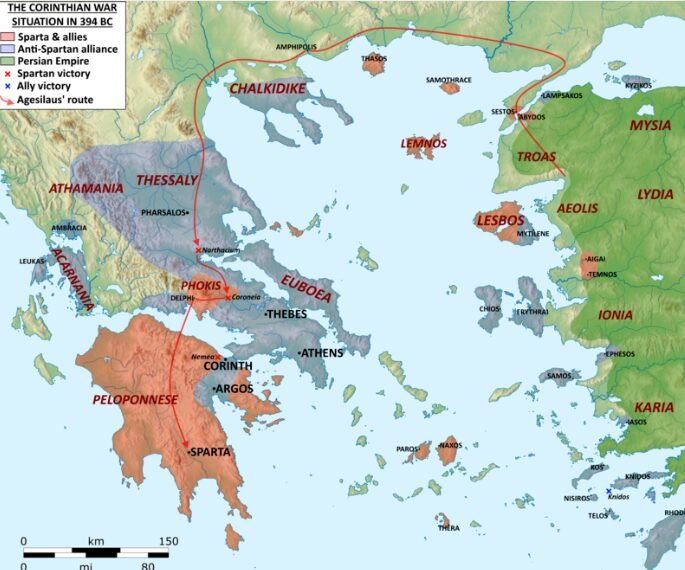
Map of the Aegean in 394 BCE

The Corinthian War (395–387 BCE)

The Corinthian War pitted Sparta against a coalition of former allies, including Thebes, Athens, Corinth, and Argos. Agesilaus achieved a significant victory at the Battle of Coronea in 394 BCE, but Sparta’s naval defeat at Cnidus marked a turning point. The war concluded with the Peace of Antalcidas in 387 BCE, a treaty that temporarily secured Spartan hegemony but ceded control of Greek cities in Asia Minor to Persia. This outcome reflected Sparta’s declining influence and dependence on Persian support.

Challenges and the Decline of Sparta

During the 370s BCE, Agesilaus faced growing challenges, including revolts, invasions, and Thebes’ rise under the leadership of Epaminondas. Despite leading campaigns against Thebes, Agesilaus could not prevent its resurgence. The Battle of Leuctra in 371 BCE, where Cleombrotus, the co-king, was killed, ended Spartan supremacy and marked the decline of its dominance. Agesilaus’ inability to adapt to shifting political dynamics and his hostility toward Thebes contributed to this downfall.

Later Years and Foreign Expeditions

In his later years, Agesilaus participated in campaigns abroad. He supported the Revolt of the Satraps against Persia in 366 BCE and aided Egypt’s Pharaoh Nectanebo II in 362 BCE. These campaigns earned substantial wealth for Sparta but failed to restore its power. Agesilaus died in Cyrenaica around 360 BCE while returning from Egypt, and his body was embalmed and returned to Sparta for burial.

Military Leadership and Strategy

Agesilaus was celebrated for his military leadership, marked by personal bravery and strategic acumen. He led from the front, inspiring his troops with his courage and determination. His campaigns in Asia Minor and Greece showcased his tactical skills, but his focus on land-based warfare limited his effectiveness against naval powers like Persia and Athens. Additionally, his reluctance to adapt to evolving political and military landscapes hindered Sparta’s long-term success.

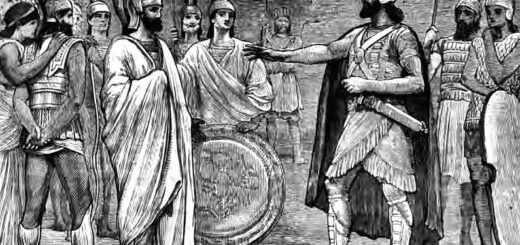
Agesilas (center) and Athenian general Chabrias (left) serving Egyptian King Nectanebo I in Egypt.

Diplomatic Challenges

Despite his military prowess, Agesilaus struggled with diplomacy. His rigid hostility toward Thebes and reliance on alliances that often backfired weakened Sparta’s position. The Peace of Antalcidas, though a temporary solution, underscored Sparta’s dependence on Persian support and diminished its autonomy. Agesilaus’ inability to build enduring alliances or address internal divisions contributed to the decline of Spartan power during his reign.

Legacy and Historical Assessment

Agesilaus is remembered as one of Sparta’s most significant kings, admired for his personal virtues, including frugality, dedication, and bravery. Ancient writers like Xenophon praised him as an ideal leader, while others, such as Plutarch, offered a more critical view, highlighting his role in Sparta’s decline. Modern historians recognize his achievements but also emphasize his limitations as a statesman.

Events that Triggered the Rivalry Between Sparta and Athens

Frequently Asked Questions

Who was Agesilaus II and when did he reign?

Agesilaus II was a Spartan king who reigned from around 400 to 360 BCE, during Sparta’s period of hegemony following the Peloponnesian War.

What was Agesilaus’ greatest military achievement?

Agesilaus led a successful campaign in Asia Minor, including a victory at Sardis in 396 BCE. However, his campaign was cut short by the Corinthian War, which forced his recall to Greece.

What major challenge did Agesilaus face during his reign?

The rise of Thebes, led by Epaminondas, culminated in Sparta’s defeat at the Battle of Leuctra in 371 BCE, ending its dominance in Greece.

How did Agesilaus ascend to the throne despite being the younger son?

Agesilaus became king after his half-brother Agis II’s death by challenging the legitimacy of Leotychidas, Agis’ alleged son. His ally Lysander played a key role in securing his claim.

What role did Lysander play in Agesilaus’ career?

Lysander initially supported Agesilaus’ rise to power but later fell out of favor as Agesilaus sought to assert his independence from Lysander’s influence.

What internal issues did Agesilaus face in Sparta?

Agesilaus dealt with the Conspiracy of Cinadon in 399 BCE, a revolt exposing social tensions in Sparta. Despite suppressing it, he failed to address its root causes, which modern historians criticize.

What were the outcomes of the Corinthian War (395–387 BCE)?

Sparta achieved some military victories, but the naval defeat at Cnidus and the Peace of Antalcidas resulted in the loss of Greek cities in Asia Minor to Persia.

How did Agesilaus contribute to Sparta’s decline?

His uncompromising hostility toward Thebes and inability to adapt diplomatically contributed to Sparta’s defeat at Leuctra and the subsequent decline of Spartan hegemony.

What were Agesilaus’ later accomplishments?

In his later years, Agesilaus supported the Revolt of the Satraps against Persia and aided Egypt’s Pharaoh Nectanebo II, but these campaigns failed to restore Spartan power.

How is Agesilaus remembered by historians?

While admired for his military skills and personal virtues, Agesilaus is also criticized for his poor diplomacy and rigid policies, which accelerated Sparta’s decline.
You may also like...

Leave a Reply

Your email address will not be published. Required fields are marked *
