American Lawyer and Politician Daniel Webster
Daniel Webster (1782–1852) was a prominent American lawyer, orator, and statesman. He represented New Hampshire and Massachusetts in Congress and served twice as U.S. Secretary of State. Webster is renowned for his legal expertise, eloquence, and advocacy for national unity during a period of sectional tensions.
Early Life and Education
Daniel Webster was born on January 18, 1782, in Salisbury, New Hampshire, into a modest farming family. His parents, Ebenezer Webster and Abigail Eastman, emphasized the value of education despite their limited financial means. Daniel was particularly close to his father, a Revolutionary War veteran, who encouraged him to pursue learning beyond the confines of their rural upbringing.
Webster’s intellectual potential became evident at a young age. He attended Phillips Exeter Academy and later enrolled at Dartmouth College, where he graduated in 1801. During his college years, Webster distinguished himself as an eloquent speaker and writer. After graduation, he began studying law under Thomas W. Thompson, a prominent attorney, and was admitted to the bar in 1805.
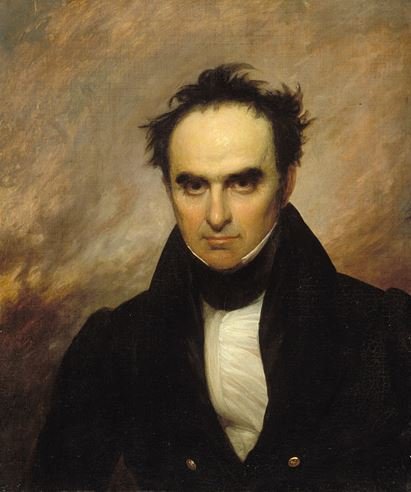
Image: Daniel Webster’s portrait by American artist Francis Alexander.
Legal Career
Webster began his legal practice in Boscawen, New Hampshire, before relocating to Portsmouth, where his career flourished. His reputation as a lawyer grew rapidly, and he became known for his command of constitutional law and persuasive arguments. Over the course of his career, Webster argued more than 200 cases before the U.S. Supreme Court, shaping foundational aspects of American jurisprudence.
His most notable legal victories include:
- Dartmouth College v. Woodward (1819): In this case, Webster successfully defended Dartmouth College against state interference, establishing the principle that private contracts are protected from government intrusion under the U.S. Constitution.
- McCulloch v. Maryland (1819): Webster’s arguments supported the constitutionality of the Second Bank of the United States and reinforced federal supremacy over state actions.
- Gibbons v. Ogden (1824): Webster argued for federal authority in regulating interstate commerce, a key decision in solidifying the constitutional framework of economic regulation.
These cases highlighted Webster’s ability to blend legal acumen with a deep understanding of constitutional principles, earning him national recognition as one of America’s most accomplished attorneys.
Entry into Politics
Webster’s political career began in 1813 when he was elected to the U.S. House of Representatives as a Federalist representing New Hampshire. His early political positions reflected the Federalist Party’s values, including support for a strong central government and opposition to the War of 1812. Webster viewed the war as detrimental to the nation’s economic interests, particularly for New England, which relied heavily on maritime trade.
After serving two terms, Webster chose to step away from politics in 1817 to focus on his legal practice. He moved to Boston, Massachusetts, where his stature as a lawyer and public figure continued to grow.

Image: Daguerreotype of Webster.
Return to Public Service
Webster re-entered politics in 1823, this time representing Massachusetts in the U.S. House of Representatives. By then, the Federalist Party had dissolved, and Webster aligned himself with the emerging National Republican Party, which championed economic modernization and federal investment in infrastructure.
In 1827, Webster was elected to the U.S. Senate, marking the beginning of his role as a national statesman. His legislative priorities included:
- Advocating for protective tariffs to shield American industries from foreign competition.
- Supporting internal improvements such as roads and canals to foster economic growth and national integration.
- Defending the Constitution as the foundation of federal authority.
The Great Triumvirate
During his Senate career, Webster joined Henry Clay of Kentucky and John C. Calhoun of South Carolina in what became known as the “Great Triumvirate.” This trio of influential senators represented different regional and political interests:
- Clay focused on compromise and national unity.
- Calhoun championed Southern states’ rights and slavery.
- Webster emerged as a staunch defender of the Union and the supremacy of federal law.
One of Webster’s most significant moments in the Senate came during the 1830 debate with Senator Robert Y. Hayne of South Carolina. In his Second Reply to Hayne, Webster eloquently refuted the doctrine of nullification, which argued that states could nullify federal laws they deemed unconstitutional. His speech, emphasizing national unity and the inviolability of the Constitution, is regarded as one of the greatest orations in American history. The closing words—“Liberty and Union, now and forever, one and inseparable!”—captured the essence of his lifelong commitment to preserving the Union.
Secretary of State and Diplomatic Success
Webster first served as U.S. Secretary of State in 1841 under President William Henry Harrison and, after Harrison’s death, under President John Tyler. Despite political tensions within the Whig Party, Webster maintained his position and negotiated one of his greatest diplomatic achievements: the Webster–Ashburton Treaty (1842). This agreement resolved long-standing border disputes between the United States and Britain, particularly in the Northeastern states and Canada. The treaty strengthened U.S.-British relations and demonstrated Webster’s skill as a statesman.
The Mexican–American War and Sectional Tensions
Webster returned to the Senate in 1845 as tensions between North and South over slavery and territorial expansion intensified. He opposed the annexation of Texas and the Mexican–American War, arguing that these actions would exacerbate sectional divisions. As a leader of the “Cotton Whigs,” Webster sought to maintain good relations with the South while avoiding policies that might provoke conflict.
Reasons why the United States didn’t annex Mexico following the Mexican-American War
The Compromise of 1850
Webster’s most controversial role came during the debates over the Compromise of 1850, a series of legislative measures designed to address disputes over slavery in the territories acquired from Mexico. The compromise included:
- Admitting California as a free state.
- Strengthening the Fugitive Slave Law, which required Northern states to assist in the return of escaped slaves.
- Allowing territories to decide the slavery issue through popular sovereignty.
Webster’s support for the compromise, particularly the Fugitive Slave Law, alienated many of his Northern constituents. In his famous Seventh of March Speech, Webster argued that preserving the Union required concessions from both North and South. While his stance demonstrated his pragmatism and commitment to unity, it damaged his reputation in the North, where abolitionist sentiment was growing.
Later Years and Decline
Webster sought the Whig nomination for the presidency in 1852 but was thwarted by internal party divisions. The nomination ultimately went to General Winfield Scott. Disappointed and in declining health, Webster retired from public life and returned to his home in Marshfield, Massachusetts.
On October 24, 1852, Webster died at the age of 70. His death marked the end of an era, as sectional tensions were escalating toward the Civil War.
Legacy
Daniel Webster’s contributions to American history are multifaceted and enduring:
- Legal Legacy: Webster’s Supreme Court victories helped define the constitutional framework of federal authority, economic regulation, and individual rights.
- Oratory and National Unity: His speeches, particularly the Second Reply to Hayne, exemplified his eloquence and unwavering dedication to the Union.
- Diplomatic Achievements: The Webster–Ashburton Treaty remains a testament to his ability to resolve complex international disputes.
- Legislative Impact: Webster’s role in the Compromise of 1850 showcased his willingness to prioritize national stability over regional loyalties, even at personal political cost.
Despite his accomplishments, Webster’s legacy is not without criticism. His support for the Fugitive Slave Law and his reluctance to fully embrace abolition tarnished his reputation among Northern contemporaries and later historians. Nonetheless, Webster’s life and career reflect the complexities of a leader navigating an era of profound national transformation.
Frequently Asked Questions
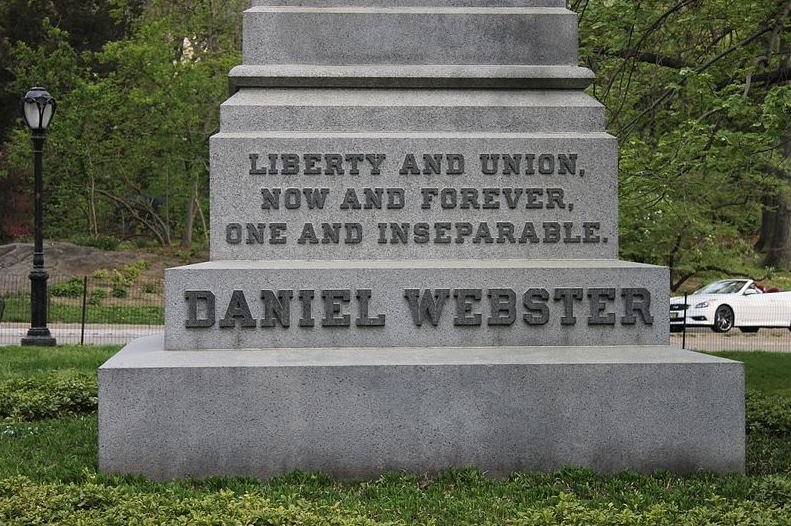
Image: The Daniel Webster Monument stands in Central Park, New York City.
What was Daniel Webster’s early life and education like?
Born in Salisbury, New Hampshire, on January 18, 1782, Webster grew up in modest circumstances. His family emphasized education, and he graduated from Dartmouth College in 1801. After studying law under a prominent attorney, he established a successful legal practice in Portsmouth, New Hampshire.
What were some of Daniel Webster’s most notable Supreme Court cases?
Webster argued over 200 cases before the U.S. Supreme Court. His landmark victories include:
-
- Dartmouth College v. Woodward (1819): Protected private contracts from state interference.
- Gibbons v. Ogden (1824): Reinforced federal authority over interstate commerce.
What role did Webster play in the U.S. House of Representatives during the War of 1812?
As a representative from New Hampshire, Webster opposed the War of 1812. A staunch Federalist, he argued that the war disrupted trade and endangered national stability. He served two terms before leaving Congress in 1817.
What was Webster’s role in the “Great Triumvirate”?
Webster was part of the “Great Triumvirate” alongside Henry Clay and John C. Calhoun. While Clay advocated for compromise and Calhoun represented Southern interests, Webster was known for his defense of the Union and the Constitution.
Why is Webster’s Second Reply to Hayne significant?
In his Second Reply to Hayne (1830), Webster refuted the doctrine of nullification, which claimed states could invalidate federal laws. His speech emphasized national unity and federal law supremacy and is regarded as one of the greatest orations in American history.
What was Webster’s achievement as Secretary of State?
During his first tenure as Secretary of State (1841–1843), Webster negotiated the Webster–Ashburton Treaty (1842), resolving border disputes with Britain and solidifying U.S.-British relations, particularly in the Northeast.
What role did Webster play in the Compromise of 1850?
Webster was instrumental in crafting and advocating for the Compromise of 1850, which admitted California as a free state, strengthened the Fugitive Slave Law, and allowed territories to decide the slavery issue through popular sovereignty. Although controversial in the North, Webster believed the compromise was essential to preserving the Union.
What challenges did Webster face during his later career?
Webster’s support for the Compromise of 1850 alienated many Northern constituents due to the strengthened Fugitive Slave Law. He also sought the Whig nomination for the presidency in 1852 but lost to General Winfield Scott. These setbacks marked a decline in his political influence.





