Thomas Gage
Thomas Gage was a British Army officer and colonial administrator whose career spanned critical moments in North American history, including the French and Indian War, Pontiac’s War, and the early stages of the American Revolutionary War.
Gage’s leadership, marked by both military innovation and controversy, significantly influenced British colonial policy and the unfolding of revolutionary events in the Thirteen Colonies.
In the article below, World History Edu delves into his life, military service, and political career, highlighting his successes, challenges, and legacy.

General Thomas Gage (1719–1787) was a British Army officer and colonial administrator pivotal in the early American Revolution. Image: Thomas Gage’s portrait by English painter Jeremiah Meyer.
Early Life and Background
Thomas Gage was born on March 10, 1719, at Firle Place, Sussex, England, the ancestral seat of the Gage family. He was the second son of Thomas Gage, 1st Viscount Gage, and Benedicta Maria Teresa Hall.
The Gage family had deep aristocratic roots, and Firle Place reflected their long-standing prominence in English society. Despite the family’s Catholic heritage, Gage’s father converted to Anglicanism in 1715, a shift that profoundly influenced young Thomas. Raised in the Anglican tradition, Gage would later exhibit an aversion to Catholicism, likely shaped by both personal conviction and the political climate of the time.
In 1728, Gage enrolled at Westminster School, where he formed connections with influential figures who would later play key roles in British politics and military affairs, such as John Burgoyne and Richard Howe. Westminster provided Gage with an elite education, though little is known about his activities following his departure in 1736 until his entry into the British Army.
Early Military Career
Gage joined the British Army in the late 1730s or early 1740s, purchasing a commission as an ensign. He advanced steadily through the ranks, becoming a lieutenant in 1741 and later a captain-lieutenant in Battereau’s Regiment.
His early campaigns during the War of the Austrian Succession (1740–1748) included participation in the Battle of Fontenoy (1745), where British forces suffered a significant defeat, and the Battle of Culloden (1746), which decisively ended the Jacobite uprising. Gage’s experiences in these conflicts honed his tactical skills and exposed him to the complexities of military leadership.

By 1748, Gage had attained the rank of major in the 55th Foot Regiment, later renumbered the 44th. Stationed in Ireland, he continued his rise to lieutenant colonel in 1751. During this time, Gage also became a member of White’s Club in London, where he cultivated relationships with influential figures, including Jeffery Amherst, a future ally during the French and Indian War.
French and Indian War
Gage’s military career in North America began in 1755 when his regiment joined General Edward Braddock’s expedition to oust French forces from the contested Ohio Country. During the ill-fated Battle of the Monongahela, Gage’s regiment was in the vanguard but was decimated in a French and Native ambush. Although Gage temporarily took command after his superior’s death, he faced criticism for his tactical decisions, which were seen as contributing to the defeat.
Despite this setback, Gage remained active in the French and Indian War. In 1758, he proposed the formation of a light infantry regiment tailored to North American woodland warfare. This idea led to the creation of the 80th Regiment of Light-Armed Foot, which Gage recruited and commanded. His leadership during the war included both successes and failures, such as the disastrous British defeat at the Battle of Carillon (1758) and his cautious approach at Fort La Présentation (1759), where he refrained from attacking a French stronghold.
Gage’s administrative capabilities became apparent when he was appointed military governor of Montreal following the French surrender in 1760. In this role, he managed the transition of power from French to British rule, balancing military and civil governance in the newly acquired territory.
Pontiac’s War and Commander-in-Chief
Following the Treaty of Paris (1763), which ended the French and Indian War, Gage succeeded Jeffery Amherst as commander-in-chief of British forces in North America. One of his first major challenges was managing Pontiac’s War (1763–1766), a widespread Native American uprising against British policies and encroachment on their lands. Gage inherited Amherst’s dismissive attitude toward Native concerns, which had exacerbated tensions.
To suppress the rebellion, Gage employed a combination of military expeditions and diplomacy. Colonels Henry Bouquet and John Bradstreet led campaigns to retake British forts and counter Native advances, while Sir William Johnson negotiated peace treaties. The conflict ended with Pontiac’s formal surrender in 1766, though it underscored the difficulties of maintaining British control over vast and restive territories.
As commander-in-chief, Gage faced additional challenges, including the enforcement of British policies that increasingly alienated the American colonies. His tenure coincided with the introduction of the Stamp Act (1765) and the Quartering Act (1765), both of which provoked widespread resistance. Gage oversaw the stationing of troops in urban centers like Boston and New York, heightening tensions between colonists and British authorities.
Rising Colonial Tensions
Gage initially believed that colonial unrest stemmed from a small group of elites, particularly in Boston. In 1768, he recommended deploying British troops to the city to restore order. This decision backfired, as the military occupation further inflamed tensions, culminating in the Boston Massacre of 1770. The incident, involving soldiers of the 29th Regiment of Foot, damaged Gage’s reputation and highlighted the volatility of the colonial situation.
Over time, Gage came to view democratic ideals and westward expansion as threats to British control. He advocated limiting colonial settlements to areas where the Crown could effectively enforce its authority and expressed disdain for town meetings, which he saw as breeding grounds for rebellion.
Governor of Massachusetts and the American Revolution
In 1774, Gage was appointed military governor of Massachusetts and tasked with enforcing the Coercive Acts (Intolerable Acts), punitive measures enacted in response to the Boston Tea Party. Initially welcomed by some as a replacement for the unpopular Thomas Hutchinson, Gage quickly lost favor due to his enforcement of the Boston Port Act and other measures that curtailed colonial self-governance.
General Gates orders to seize Patriot arms led to the Battles of Lexington and Concord in 1775. Replaced after Bunker Hill, he returned to England, dying in 1787.
Gage’s efforts to confiscate Patriot munitions led to the Powder Alarm in September 1774, a precursor to open conflict. His attempt to seize weapons and supplies stored by colonial militias culminated in the Battles of Lexington and Concord in April 1775. These clashes marked the beginning of the American Revolutionary War, with Gage’s troops suffering heavy casualties during their retreat to Boston.
Following the pyrrhic British victory at the Battle of Bunker Hill in June 1775, Gage faced mounting criticism for his leadership. He was recalled to England in October 1775 and replaced by General William Howe.
Later Years and Legacy
Although Gage’s recall marked the end of his direct involvement in the Revolutionary War, his military career did not conclude entirely. He was briefly reactivated during the early 1780s when Britain faced threats of French invasion. Promoted to full general in 1782, Gage retired to a quieter life in England, where he spent his final years.
Gage’s impact endures in various commemorations, such as Gagetown, New Brunswick, named in his honor, and his influence on British colonial policy.
Gage died on April 2, 1787, and was buried in the family plot at Firle. His legacy is complex, reflecting both his administrative skill and the controversies surrounding his actions in Massachusetts.
While his innovations, such as the creation of light infantry, earned respect, his role in escalating colonial tensions overshadowed these achievements. Gage’s policies and decisions contributed to the colonial grievances that fueled the American Revolution and ultimately led to the independence of the United States.
Conclusion
General Thomas Gage’s life and career encapsulate the challenges of maintaining British authority in North America during a period of profound change.
From his early military service in Europe to his governance of Massachusetts during the Revolution’s onset, Gage’s actions were shaped by a combination of personal conviction, political necessity, and the constraints of his time.
While his legacy remains debated, Gage’s role in shaping the trajectory of British colonial policy and the American Revolution is undeniable.
Frequently Asked Questions
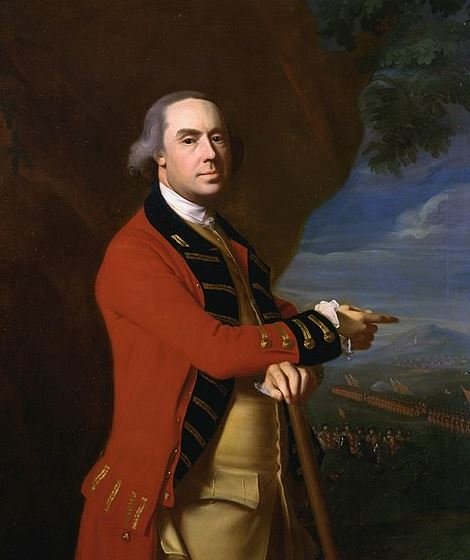
Thomas Gage (1718/19–1787) was a British Army officer and colonial administrator known for his roles in the French and Indian War, Pontiac’s War, and the early stages of the American Revolutionary War. Image: Gage by American painter John Singleton Copley.
Where and when was Thomas Gage born?
He was born on March 10, 1718/19, at Firle Place in Sussex, England, to an aristocratic family.
What was Thomas Gage’s educational background?
Gage attended Westminster School, where he formed connections with influential figures such as John Burgoyne and Richard Howe.
When did Thomas Gage begin his military career, and what was his first rank?
He began his military career as an ensign, later advancing to the rank of lieutenant in 1741.
What were some key campaigns Gage participated in during the War of the Austrian Succession?
Gage fought in the Battle of Fontenoy (1745) and the Battle of Culloden (1746), serving under the Earl of Albemarle.
What role did Gage play in the French and Indian War?
He commanded troops during the Battle of the Monongahela and proposed the creation of the 80th Regiment of Light-Armed Foot to adapt to woodland warfare.

Engraving of Gage.
What was Gage’s position after the French surrendered in 1760?
Gage was appointed military governor of Montreal, overseeing the administration of the newly acquired territory.
What was Pontiac’s War, and how did Gage respond to it?
Pontiac’s War (1763–1766) was a Native American uprising against British expansion. Gage used a combination of military expeditions and diplomacy to suppress the conflict.
What policies did Gage oversee that increased tensions with the American colonies?
Gage enforced the Stamp Act (1765) and Quartering Act (1765), which required colonies to house British troops, contributing to rising unrest.
What role did Gage play in the events leading to the American Revolutionary War?
As governor of Massachusetts, Gage enforced the Coercive Acts and attempted to seize Patriot munitions, sparking the Battles of Lexington and Concord in April 1775.
Why was Gage criticized after the Battle of Bunker Hill?
Although the British won the battle, the high casualties and failure to break the colonial siege led to criticism of Gage’s leadership.
When was Gage recalled to England, and who replaced him?
General Gage was recalled in October 1775 and replaced by General William Howe.
What is Thomas Gage’s legacy?
Gage is remembered for his administrative skills and military innovations, but his actions during the Revolution drew criticism. His role in escalating colonial tensions contributed to the American push for independence.





