Ancient Egyptian City of Sais: History and Major Facts
Sais, known in ancient Egyptian as Sꜣw and in Greek as Σάϊς, was a prominent city located in the Western Nile Delta on the Canopic branch of the Nile River. The city’s rich history spans from the Neolithic period through the Late Period of ancient Egypt, leaving a legacy that has intrigued historians, archaeologists, and scholars for centuries.
Despite the scarcity of physical remnants due to natural and human-induced destruction, the historical significance of Sais is well-documented through ancient texts, archaeological findings, and cultural narratives.
Early History: Neolithic Beginnings
The earliest evidence of human activity at Sais dates back to around 5000 BC, placing it firmly within the Neolithic period. Archaeological discoveries made in 1999 uncovered a settlement that sheds light on the prehistoric occupation of the region. Initially, Sais began as a fishing camp, leveraging the abundant resources provided by the Nile and its delta. This period is categorized as the Early Neolithic phase (Sais I), characterized by a nomadic lifestyle centered around fishing and hunting.
As time progressed into the Middle to Late Neolithic Period, the settlement at Sais transitioned into a more permanent agricultural community, marking the Late Neolithic phase (Sais II). This significant shift from a nomadic to a settled agricultural society is believed to be influenced by climatic changes around 4600 BC.
The onset of the Middle Holocene Moist phase brought about environmental conditions favorable for agriculture, such as increased rainfall and more fertile floodplains. This allowed inhabitants to cultivate crops and domesticate animals, leading to a more stable and sustainable way of life. The development at Sais mirrors similar patterns observed at other Neolithic sites in Egypt, such as Merimde Beni Salama, located approximately 80 km to the south.
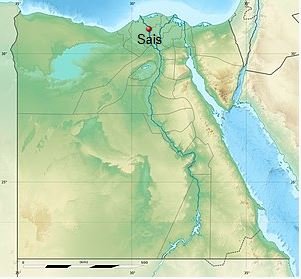
Image: A map showing the location of Sais in Egypt.
Religious and Cultural Importance in Antiquity
By the time of the First Dynasty of Egypt (c. 3100–3050 BC), Sais had grown in both size and significance. The city became a major religious center, chiefly dedicated to the worship of the goddess Neith. Neith was one of the oldest deities in the Egyptian pantheon, associated with war, hunting, and weaving. She was often depicted as a woman wearing the Red Crown of Lower Egypt, emphasizing her importance in the region.
The Greeks, who had considerable interactions with Egypt, identified Neith with their own goddess Athena, suggesting a cultural and religious connection between Sais and Athens. This association is noted by Herodotus, the Greek historian, who wrote extensively about Egypt in the 5th century BC. He recorded that Sais was the location of the grave of Osiris, the god of the afterlife, resurrection, and fertility. According to Herodotus, the sufferings of Osiris were reenacted through mysterious nocturnal rituals on a lake adjacent to the city, highlighting the deep spiritual significance of Sais in Egyptian mythology.
Diodorus Siculus, another Greek historian, recounted a legend that the Athenians had built Sais before a great deluge and that while Greek cities were destroyed in this cataclysm, Egyptian cities like Sais survived. This legend underscores the perceived antiquity and resilience of Sais, further elevating its status in the ancient world.
Architectural Heritage and Destruction
Despite its prominence, few physical traces of Sais predating the Late New Kingdom (c. 1100 BC) have survived. This lack of archaeological evidence is largely due to the activities of the sebakhin during later periods. The sebakhin were farmers who mined ancient mudbrick structures to obtain sebakh, a rich organic fertilizer derived from decomposed mudbricks. This practice led to the dismantling of many ancient buildings, leaving only a handful of relief blocks and fragments in situ. Consequently, much of the city’s early architectural heritage was lost, obscuring our understanding of its physical grandeur.
Today, Sa el-Hagar stands on the ruins of the ancient Egyptian city of Sais.
The modern site of Sa el-Hagar, believed to be where Sais once stood, provides limited archaeological insights due to this extensive destruction. However, some artifacts, such as obelisks now located in Piazza della Minerva and Urbino in Italy, are claimed to have originated from Sais, offering glimpses into the city’s artistic and architectural achievements.
Sais During the Late Period and Dynastic Significance
Sais gained renewed prominence during the Twenty-fourth Dynasty (c. 732–720 BC) and the Saite Twenty-sixth Dynasty (664–525 BC) of Egypt, known as the Late Period. During this time, the city became the capital of Egypt under native rulers who sought to restore Egyptian power and cultural identity following periods of foreign domination.
Pharaohs such as Psamtik I and Amasis II hailed from Sais and played crucial roles in reasserting Egyptian sovereignty. The city became a center of political power, cultural renaissance, and economic activity. This period saw the revival of traditional Egyptian art forms, religious practices, and monumental architecture, reflecting a deliberate effort to connect with the nation’s ancient heritage.
Medical School and Advances in Medicine
One of the notable institutions in Sais was its medical school associated with the Temple of Neith. Ancient Egyptian temples often served as centers of learning, and Sais was no exception. The medical school was remarkable for its inclusion of female students and faculty, particularly in the fields of gynecology and obstetrics. This is evidenced by inscriptions from the period, one of which states:
I have come from the school of medicine at Heliopolis, and have studied at the woman’s school at Sais, where the divine mothers have taught me how to cure diseases.
This inscription highlights the advanced state of medical knowledge at Sais and underscores the important role women played in the medical sciences. The emphasis on gynecology and obstetrics indicates a specialized understanding of women’s health, which was relatively progressive for the time.

Image: A depiction of Neith.
Cultural Depictions and Influence
Sais’s influence extended beyond Egypt, permeating Greek literature and philosophy. In Plato‘s dialogues Timaeus and Critias, written around 395 BC, the city is the setting where the Greek legislator Solon receives the story of Atlantis from an Egyptian priest.
According to Plato, Solon visited Egypt in 590 BC and learned about Atlantis’s military aggression against Greece and Egypt, its eventual defeat, and its destruction by a catastrophic event decreed by the gods. This narrative not only situates Sais at the center of a legendary account but also establishes a cultural bridge between Egypt and Greece.
Plato also notes Sais as the birthplace of Pharaoh Amasis II, further cementing its significance in Egyptian history. Amasis II was known for his diplomatic relations with Greece and for fostering cultural exchanges, which may have influenced Plato’s interest in the city.
Plutarch, a Greek biographer and essayist, mentioned that the shrine of Athena in Sais—whom he identifies with the Egyptian goddess Isis—bore the enigmatic inscription:
I am all that hath been, and is, and shall be; and my veil no mortal has hitherto raised.
This quote reflects the mystical and esoteric traditions associated with Sais’s religious practices, emphasizing the city’s reputation as a center of wisdom and mystery.
Role During the Islamic Conquest and Medieval Period
During the Islamic conquest of Egypt in the 7th century AD, Sais became a battleground between the Rashidun Caliphate and the Byzantine Empire. This is recorded by John of Nikiû, a Coptic bishop and historian, who detailed the conflicts that took place in the region. Despite the upheavals, Sais remained administratively significant, continuing as a pagarchy—a district under a pagan official—and maintaining a Christian bishopric at least through the early 700s.
Medieval scholars like Yaqut al-Hamawi, al-Maqrizi, and al-Qalqashandi attributed the founding of Sais to figures such as “Sā ibn Misr,” blending historical accounts with folklore. Ibn Iyas referred to the founder as “Sā ibn Marqunus.” During this period, the site was extensively used as a stone quarry, contributing to the further degradation of its ancient structures. By Ibn Iyas’s time, Sais had nearly vanished, reduced to ruins, and its historical grandeur became a subject of scholarly interest rather than a visible reality.
Population and Administration in the 19th Century
In the 19th century, the 1885 Census of Egypt recorded Sa el-Hagar as a nahiyah (sub-district) within the district of Kafr az-Zayyat in the Gharbia Governorate. The population at that time was 4,474, comprising 2,250 men and 2,224 women. This demographic information indicates that while the area remained inhabited, it had lost its former prominence and was integrated into the administrative structures of modern Egypt.
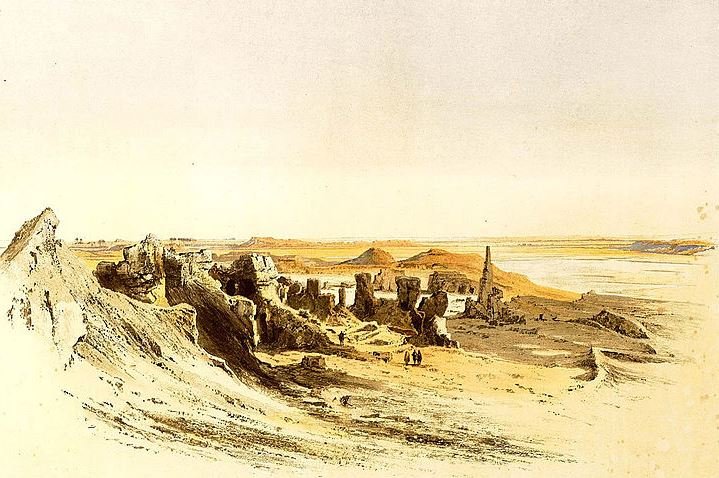
Image: An illustration depicting the ruins of Sais
Modern Cultural Depictions
Sais continues to capture the imagination in contemporary culture. In Hector Berlioz’s oratorio L’enfance du Christ (“The Childhood of Christ”), composed in the 19th century, Sais is portrayed as the setting where Jesus spends his youth until the age of ten after his family flees to escape King Herod’s Massacre of the Innocents. This artistic choice underscores the city’s enduring symbolic resonance and its association with themes of refuge and spiritual significance.
In the realm of modern media, Sais features in the video game Assassin’s Creed Origins, released in 2017. In the game, Sais is depicted under the control of a character known as “The Scarab,” a member of the fictional Order of the Ancients. This portrayal blends historical elements with imaginative storytelling, introducing the ancient city to contemporary audiences and highlighting its historical allure.
Legacy and Enduring Significance
Despite the loss of much of its physical heritage due to natural and human factors, the legacy of Sais endures through historical accounts, literary works, and modern reinterpretations. The city’s role as a religious center dedicated to Neith, its connections with Greek culture, and its place in legends and philosophical dialogues have secured its position in the annals of history.
Sais serves as a testament to the cultural and intellectual exchanges between Egypt and other ancient civilizations. Its medical school highlights the advanced understanding of medicine and the progressive inclusion of women in scholarly pursuits. The city’s depiction in classical literature reflects its influence on Greek thought and the mutual respect between these ancient cultures.
In archaeology, the Neolithic discoveries at Sais contribute valuable insights into the early development of human societies in the Nile Delta. The transition from a fishing camp to an agricultural settlement illustrates the adaptability and innovation of early inhabitants in response to environmental changes.
Conclusion
The history of Sais is a rich tapestry woven from threads of religion, culture, politics, and science. From its Neolithic origins to its prominence in the Late Period of ancient Egypt, Sais played a vital role in the development of Egyptian civilization. Its significance is preserved not only in historical records and archaeological findings but also in the collective memory shaped by literature and art.
While the physical structures of Sais may have largely disappeared, the stories, legends, and scholarly accounts ensure that the city continues to be a subject of fascination and study.
Frequently Asked Questions
When does the Neolithic settlement at Sais date back to, and what discovery supports this?
The Neolithic settlement at Sais dates back to 5000 BC, supported by archaeological discoveries made in 1999 revealing early human activity in the region.
What were the initial activities at Sais during the Early Neolithic period?
Initially, Sais was established as a fishing camp during the Early Neolithic period (Sais I).
How did the settlement at Sais evolve during the Middle to Late Neolithic Period?
It evolved into a settled community of agriculturalists, transitioning from fishing to farming due to climatic changes that made cultivation of the floodplain viable.
What climatic event facilitated the shift from fishing to agriculture at Sais?
The onset of the Middle Holocene Moist phase around 4600 BC led to climatic changes that supported agriculture.
Which Greek historian wrote about Sais, and what did he note about its religious significance?
Herodotus wrote about Sais, noting it as the location of Osiris’s grave and describing nocturnal rituals reenacting his sufferings.
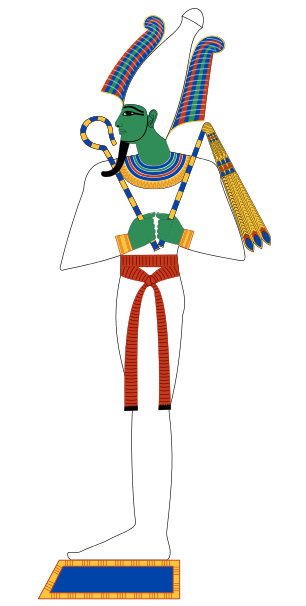
Image: An illustration portraying Osiris.
Who was the patron goddess of Sais, and how did the Greeks associate her with their own deities?
Neith was the patron goddess, associated with warfare and weaving; the Greeks equated her with Athena, suggesting a link between Sais and Athens.
What legend did Diodorus Siculus recount regarding Sais and Athens?
He recounted that Athenians built Sais before a great deluge and that while Greek cities were destroyed, Egyptian cities like Sais survived.

Image: Diodorus Siculus
Why are there few surviving traces of Sais before the Late New Kingdom?
Extensive destruction by the sebakhin, who removed mudbrick deposits for fertilizer, erased much of the city’s early architectural heritage.
What role did Sais play during the Islamic conquest of Egypt?
It was a battleground between the Rashidun Caliphate and the Byzantine Empire and remained a pagarchy and Christian bishopric through the early 700s.
What was notable about the medical school associated with the Temple of Sais?
The medical school included many female students and faculty, especially in gynecology and obstetrics, highlighting women’s roles in medicine.
How is Sais featured in Plato’s dialogues, and why is it significant?
In Timaeus and Critias, Sais is where Solon learns about Atlantis from an Egyptian priest, linking it to the legend of Atlantis and marking it as the birthplace of Pharaoh Amasis II.