Archimedes’ Screw: History and Major Facts
The Archimedes’ screw, attributed to the Greek mathematician Archimedes, is an ancient hydraulic device first described around 234 BC, though used earlier in Egypt. It lifts water by rotating a screw within a pipe and is widely employed in irrigation and modern wastewater treatment. Reversible in function, it can also generate hydroelectric power in low-head sites. These turbines operate effectively across varied flow rates and heads, offering solutions for regions unsuitable for conventional turbines.
Origin Story and Early History
The Archimedes’ screw, a marvel of ancient engineering, traces its roots to Hellenistic Egypt, predating the 3rd century BC. Initially developed as a tool for lifting water, its earliest recorded use involved irrigation systems along the Nile River.
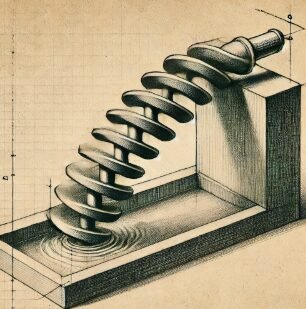
The original design consisted of spiral tubes wound around a cylinder. As the cylinder rotated, water was lifted from the river into irrigation ditches.
Over time, refinements were made, such as incorporating a spiral groove into a solid wooden cylinder, which was then covered with boards or metal to enhance durability and efficiency.
Some historians speculate that the Archimedes’ screw was integral to the irrigation of the Hanging Gardens of Babylon, one of the Seven Wonders of the Ancient World. Assyrian King Sennacherib’s inscriptions from 704–681 BC describe devices resembling bronze water screws, lending credibility to this hypothesis. Greek historian Strabo also noted the use of screws in the gardens, emphasizing their historical importance.
The device was introduced to Greece around 234 BC and is attributed to Archimedes, the renowned Greek mathematician and inventor, during his visit to Egypt. Although Archimedes did not claim to have invented the screw, it became associated with his name due to his detailed descriptions and applications of the device.
Ancient Greeks and Romans employed it for various purposes, including draining water from ships, irrigating fields, and even removing bilge water from large ships like the Syracusia. The Syracusia, designed under Archimedes’ guidance, showcased the versatility of the screw by using it to prevent flooding within the ship.
Mechanics of the Archimedes’ Screw
The Archimedes’ screw remains in use even to this day, often being deployed together with irrigation ditches to irrigate large farms.
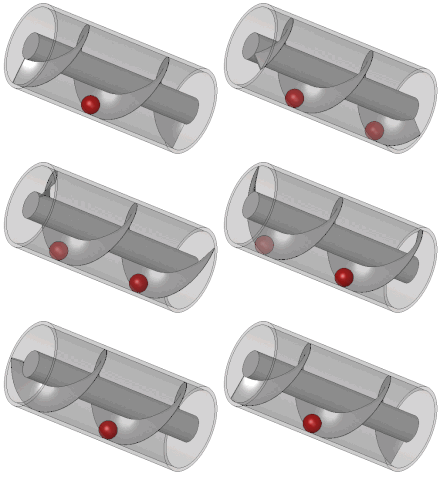
The Archimedes’ screw operates on a simple yet ingenious principle. It consists of a helical screw inside a hollow pipe. The bottom end of the screw is submerged in a water source, and when the screw is rotated, water is captured in the helical sections and pushed upward as the screw turns. This process continues until the water exits at a higher elevation.
One of the key features of the design is its ability to function effectively even if the seal between the screw and the casing is not perfectly watertight. As long as the upward movement of water exceeds any leakage, the device remains efficient. Variants of the design include screws fused with their casings, where both rotate together, and those made of bronze or waterproofed with pitch to prevent leaks.
The screw’s design allows it to adapt to different needs and conditions. For example, its pitch and diameter can be modified to control the volume of water moved with each rotation. Additionally, the device can operate in reverse. When water enters from the top, the screw’s rotation can generate mechanical energy, making it suitable for hydroelectric power generation.
Historical Significance
The Archimedes’ screw represents a significant advancement in ancient hydraulic engineering. Its simplicity, reliability, and efficiency made it indispensable for agricultural and industrial activities in the ancient world. In irrigation, it provided a practical solution for lifting water from rivers or wells to higher ground, enabling the development of more extensive and productive agricultural systems.
Beyond agriculture, the Archimedes’ screw was adapted for a wide range of applications in antiquity. It was used to remove bilge water from ships, ensuring the safety and longevity of vessels. In construction and mining, it served as a means of draining water from flooded sites, enabling work in challenging conditions.
The device’s influence extended beyond its immediate practical uses. Its introduction to Greece and subsequent association with Archimedes highlights the exchange of knowledge and technology between ancient civilizations. It exemplifies how ideas were shared, adapted, and improved upon across cultures, fostering innovation and progress.
Modern Applications and Advancements

Modern Archimedes’ screw
The Archimedes’ screw continues to inspire innovation in modern engineering. One of its most notable adaptations is its use in screw turbines for small hydroelectric power plants. These turbines are particularly effective in low-head sites where traditional turbines struggle to operate efficiently. By reversing the flow of water through the screw, it generates electricity while minimizing environmental impact. The low rotation speed of screw turbines also reduces harm to aquatic life, making them an eco-friendly solution for renewable energy production.
In wastewater treatment plants, Archimedes screws are widely employed to manage varying flow rates and handle solids suspended in water. Their robustness and ability to operate under challenging conditions make them an ideal choice for such applications. Additionally, they are used in fish hatcheries to safely lift and transport fish between locations.
The screw has also found uses in industrial and everyday applications. For instance, it is employed in snow blowers to clear snow, in grain elevators to transport crops, in concrete mixers for construction, and even in chocolate fountains for culinary purposes. Its versatility and reliability ensure its continued relevance across diverse fields.
The device has even contributed to historic preservation efforts. In 2001, an Archimedes screw was instrumental in stabilizing the Leaning Tower of Pisa. By carefully removing groundwater from the subsoil beneath the tower, engineers were able to reduce the tilt and ensure the structure’s stability without causing damage.
Influence on Design and Engineering
The simplicity of the Archimedes’ screw has inspired countless designs and engineering solutions throughout history. Its principle of operation underpins the screw conveyor, a device used to transport granular or powdered materials such as grains, cement, or plastics. Screw conveyors are widely used in industries ranging from agriculture to manufacturing, demonstrating the enduring utility of the original design.
In maritime history, the Archimedes screw laid the foundation for the development of screw propellers. The SS Archimedes, launched in 1839, was the first steamship powered by a screw propeller. This innovation revolutionized maritime propulsion, leading to the design of more efficient and powerful vessels.
Launched in 1839, the SS Archimedes was the first steamship powered by a screw propeller, marking a major advancement in maritime propulsion.
Modern industrial machines, such as injection molding and extrusion equipment, also incorporate Archimedes screws. These devices use screws with varying pitches to compress and melt materials like plastics, enabling the production of a wide range of products. In waste management, large-scale screws are used to compact materials, highlighting their adaptability to contemporary challenges.
Theoretical and Practical Design Considerations
The design of the Archimedes screw involves several critical parameters, including rotation speed, flow rate, and inlet depth. These factors determine the device’s efficiency and capacity for lifting or transporting water or materials. Engineers use analytical equations to optimize these parameters, ensuring that the screw meets specific operational requirements.
For example, the volume of water moved by the screw is influenced by its pitch, diameter, and rotational speed. By adjusting these variables, engineers can design screws for a wide range of applications, from small-scale irrigation systems to large hydroelectric power projects. The adaptability of the Archimedes screw to different scales and conditions underscores its versatility as an engineering solution.
Legacy and Enduring Relevance
The Archimedes’ screw is not merely a relic of ancient engineering; it is a testament to human ingenuity and adaptability. Its continued use and development reflect the timeless principles of simplicity and functionality. From its origins in Hellenistic Egypt to its modern applications in renewable energy, wastewater treatment, and industrial machinery, the screw has evolved to meet the changing needs of society.
The device’s legacy is also symbolic of the interconnectedness of human knowledge. Its journey from ancient Egypt to Greece and its association with Archimedes illustrate how ideas transcend borders and cultures, enriching human understanding and innovation.
Frequently Asked Questions
What is the historical origin of the screw pump?
The screw pump, the earliest positive displacement pump, originated in Hellenistic Egypt before the 3rd century BC, initially featuring spiral tubes around a cylinder to lift water from the Nile for irrigation.
How was the original Egyptian screw designed and refined?
The original design used spiral tubes around a cylinder, while later versions incorporated a spiral groove cut into a solid wooden cylinder, covered with boards or metal for durability.

“Archimedes Thoughtful” by Italian Baroque painter Domenico Fetti (1620)
What role did the Archimedes screw play in ancient Greece?
Introduced to Greece around 234 BC, the Archimedes screw was credited to Archimedes and used for draining ships and irrigating fields. It was powered manually or by treading on the casing.
What improvements were made to the screw pump during the 15th century?
German engineer Konrad Kyeser introduced a crank mechanism, replacing manual labor or treading as the primary means of operation.
How does the Archimedes screw contribute to modern hydropower?
As a reverse turbine, it generates electricity when water enters from the top, rotating the screw to power generators. It is effective in low-head sites and environmentally friendly.
What are some industrial applications of the Archimedes screw?
It is used in snow blowers, grain elevators, concrete mixers, chocolate fountains, and screw conveyors for transporting bulk materials.
How is the Archimedes screw used in wastewater treatment?
Its ability to handle varying flow rates and suspended solids makes it suitable for wastewater treatment plants, ensuring efficient operation.
What unique application of the Archimedes screw was used for the Leaning Tower of Pisa?
It was used in 2001 to stabilize the tower by removing subsoil saturated with groundwater, correcting the lean through the tower’s own weight.
What design parameters determine the performance of the Archimedes screw?
Rotation speed, flow rate, and inlet depth are key parameters, optimized using analytical equations to ensure efficiency in various applications.