Ancient Egyptian God Min
Min was the god of fertility, male potency, and agricultural abundance, associated with reproduction and renewal in both human and natural cycles.
Origins and Cult Centers
Min was known in ancient Egyptian as mnw. He was one of the earliest deities worshipped in Egyptian history, with his cult tracing back to the predynastic period (4th millennium BCE).
His veneration was primarily concentrated in Upper Egypt, specifically in Coptos (modern-day Qift) and Akhmim (Panopolis). These centers played a crucial role in the development of his worship, which involved grand festivals and public processions that celebrated his divine attributes and ensured the continuation of life and fertility.
Min’s worship was not merely localized; it extended to various regions, reflecting his importance in broader Egyptian religious practice.
He was also linked to the eastern desert and the god Horus, who represented kingship and divine rulership.
Did you know…?
- Excavations by English Egyptologist Flinders Petrie uncovered statues of Min that date back to prehistoric times, further supporting his prominence before the unification of Egypt.
- Some scholars believe that references in the Pyramid Texts—such as “he whose arm is raised in the East”—allude to Min, reinforcing his early significance in Egyptian theology.
Role in Egyptian Religion
Min held multiple roles within Egyptian religious thought, primarily as a god of fertility, sexuality, and the regenerative forces of nature.
His association with male potency set him apart as a deity deeply connected to agricultural cycles and human reproduction.
By the Middle Kingdom, Min’s identity merged with that of Horus, forming the deity Min-Horus. Later, during the New Kingdom, he was syncretized with Amun, becoming Min-Amun, a powerful composite deity embodying creative and regenerative forces.

A relief depicting Min-Amun.
Min was a figure in ancient Egyptian religion who embodied fertility, power, and the mysteries of regeneration.
One of the more esoteric aspects of Min’s mythology includes his designation as a kamutef, or “bull of his mother,” a term that describes deities who self-create and father themselves through their mothers. This concept is also seen in Horus-Min, further establishing Min’s role in the divine cycle of rebirth and self-generation.
His importance was highlighted in coronation rites, where pharaohs were expected to symbolically sow seeds, ensuring the fertility of the land and their own divine potency.
Festivals and Worship Practices
Min’s worship was marked by elaborate festivals, the most significant being the Festival of the Departure of Min. This four-day event, recorded on the temple walls of Ramses III at Medinet Habu, celebrated the beginning of the harvest season. The central ritual involved taking Min’s image out of his temple and into the fields, where offerings were presented to ensure an abundant harvest. One of the key activities of this festival was the climbing of a large ceremonial pole, symbolizing virility and the strength of the god.
The prominence of Min’s fertility cult was also reflected in the use of symbolic objects. One of the most notable was the offering of wild prickly lettuce (Lactuca serriola), a plant believed to have aphrodisiac properties. The milky sap produced by the lettuce was likened to semen, reinforcing its association with fertility. Pharaohs continued this tradition by offering the first sprouts of wheat to Min, a practice documented well into the Ptolemaic period.
Min’s festivals, worship practices, and iconic depictions offer a glimpse into a civilization that revered the balance between life, reproduction, and the divine forces that governed them.
For the general populace, Min was a deity of personal devotion, particularly for those seeking blessings in matters of fertility and procreation. Many Egyptians, unable to participate in formal temple rites, paid homage to Min through votive offerings.
Statuettes of ithyphallic figures, ex-voto phalluses, and concubine figurines were placed at household entrances, particularly in workers’ villages like Deir el-Medina. Women hoping to conceive would touch the statues of Min, a practice believed to invoke his divine assistance—a tradition that some argue persists in cultural practices today.
Iconography and Symbolism
Min is easily recognized in Egyptian art due to his distinct and often provocative iconography.
He is depicted as a standing male figure with an erect phallus held in his left hand, emphasizing his role as a fertility god. In his right hand, he holds a flail, a symbol traditionally associated with kingship and authority, reinforcing his role as a protector and life-giver.
Min wears a headdress adorned with two large feathers, a characteristic he shares with the god Amun, with whom he was later merged. Around his forehead, a red ribbon extends downward, which some scholars interpret as a representation of sexual energy. His skin is typically painted black, signifying the fertile soil of the Nile, further linking him to agricultural abundance and renewal.
A notable aspect of Min’s portrayal is his mummiform lower body. Like Osiris and Ptah, Min’s legs are often bound together, a characteristic that may relate to his chthonic connections and the mysteries of rebirth. This aspect of his iconography underscores the dual nature of his power—both life-giving and regenerative in a spiritual sense.

Min’s Associations with Other Deities
Min’s relationships with other deities further highlight his significance within the Egyptian pantheon. He was closely linked to Isis, who was both his mother and consort in certain myths. This dual relationship aligns with the kamutef concept, where the god fathers himself through his mother. Min’s other consorts included Iabet and Repyt, reinforcing his status as a god of fertility and creation.
The Greeks, upon encountering Min’s cult, equated him with Pan, their god of the wild, fertility, and sexuality. This association highlights the enduring themes of virility and untamed masculine energy that defined Min’s identity.
Additionally, Min’s connection to Nubia, as evidenced by trade routes and artistic influences, suggests his cult may have extended beyond Egypt’s borders.
The Controversy of the Ejaculation Ritual
One of the more sensational claims surrounding Min involves the assertion that pharaohs were required to publicly demonstrate their virility during Min’s festivals by engaging in acts of ejaculation. British journalist Jonathan Margolis popularized this idea, suggesting that such rituals were believed to ensure the flooding of the Nile. However, other Egyptologists refute this claim, arguing that no definitive evidence exists to support it. Instead, they propose that this interpretation may stem from misreadings of ancient texts and artistic depictions related to Min’s fertility rites.
Legacy and Cultural Influence
Min’s influence persisted throughout Egyptian history, adapting and evolving as religious beliefs shifted. Even after the decline of pharaonic Egypt, his imagery and attributes continued to appear in Greco-Roman contexts. His association with Pan facilitated his integration into Hellenistic religious thought, where fertility and the generative forces of nature remained central themes.
Archaeological evidence of Min’s worship has continued to surface in modern times, providing further insight into his enduring significance. The symbols associated with Min—such as lettuce, the flail, and ithyphallic statues—reveal a society deeply invested in the cyclical nature of life, fertility, and divine kingship.
Although his worship has long since faded, echoes of Min’s presence can still be found in various cultural traditions. Practices linked to fertility, agricultural blessings, and even certain folk customs bear resemblance to the rites dedicated to him in ancient Egypt.
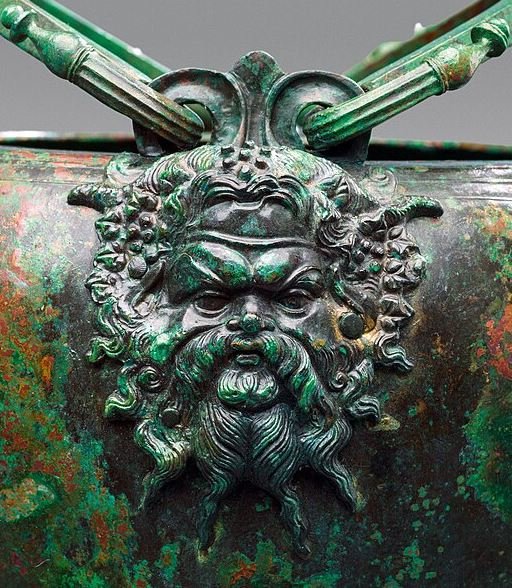
A mask of the god Pan, featured on a bronze stamnoid situla (340–320 BC), from the Vassil Bojkov Collection in Sofia, Bulgaria.
Frequently Asked Questions
Where were Min’s main cult centers?
His primary worship sites were in Upper Egypt, particularly in Coptos (Qift) and Akhmim (Panopolis), where grand festivals were held in his honor.
How was Min depicted in Egyptian art?
He was portrayed as a standing male figure with an erect phallus, a flail in his raised right hand, a headdress with two feathers, and a black complexion symbolizing fertility.
What was the significance of the Festival of the Departure of Min?
It was a four-day festival celebrating the harvest season, where Min’s image was carried to the fields for blessings, and participants engaged in ritualistic games, including climbing a large ceremonial pole.
Why was lettuce associated with Min?
Egyptians believed the milky sap of Lactuca serriola (prickly lettuce) symbolized semen, making it an aphrodisiac and a sacred offering in fertility rites.
How was Min linked to other deities?
Min was syncretized with Horus and Amun, forming Min-Horus and Min-Amun, and was associated with Isis as both her son and consort, reflecting the kamutef (self-creating god) concept.

A sculpture of the god Min-Amun wearing the double plume headdress.
What controversy surrounds Min’s worship?
Some have speculated that pharaohs engaged in public ejaculation rituals to ensure the Nile’s fertility, but Egyptologists largely dismiss this claim as a misinterpretation of fertility rites.
READ MORE: 10 Major Events in Ancient Egyptian History





