Ancient Greek Painter Apelles of Kos
Apelles, a 4th-century BCE Hellenistic Greek painter, remains celebrated as one of antiquity’s most esteemed artists, despite the complete loss of his works. His exceptional reputation is largely based on ancient accounts, which praise his unparalleled skill, innovation, and influence on later art traditions.
Origins and Training
Apelles was of Ionian origin, a region known for its artistic elegance, but he trained under Pamphilus at the Dorian school of Sicyon in southern Greece. This combination of Ionic grace and Dorian rigor is said to have defined his artistic style, blending meticulous technique with aesthetic refinement.
Career and Patronage
Apelles gained fame as the court painter for Philip II of Macedonia and his son Alexander the Great. His painting of Alexander wielding a thunderbolt was particularly renowned, symbolizing the ruler’s divine authority and military power. His role as a court painter allowed him to work on prominent commissions, solidifying his reputation as a master artist.
Notable Works and Themes
While none of Apelles’ paintings survive, ancient texts describe his significant works, including Aphrodite Anadyomene (Aphrodite Rising from the Sea), an allegorical work titled Calumny, and numerous portraits. These works became sources of inspiration for later artists, particularly during the Italian Renaissance, when attempts were made to emulate his style based on descriptions. His simplicity of design, beauty of line, and expressive charm were noted as hallmarks of his artistry.
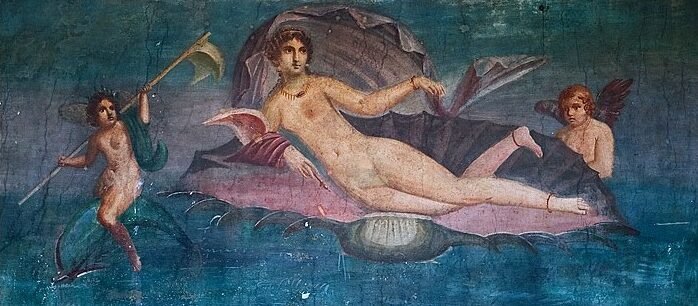
This Pompeii mural is thought to replicate Apelles’ Venus Anadyomene, originally brought to Rome by Augustus.
Techniques and Innovations
Apelles valued the precision of outlines, reputedly practicing them daily. He excelled in creating clear and elegant compositions, avoiding the complexity of elaborate perspectives. He introduced technical innovations, including the use of atramentum, a dark glaze that preserved paintings and softened colors, enhancing their visual harmony.
Legacy
Apelles’ combination of skill, innovation, and aesthetic grace positioned him as a transformative figure in Greek art, influencing artistic traditions long after his time.
Frequently Asked Questions

Apelles was a celebrated 4th-century BCE Greek painter, regarded as one of antiquity’s greatest artists. Image: Alexander the Great and Campaspe in the studio of Apelles, by Italian painter Giovanni Battista Tiepolo.
Where was Apelles born, and where did he study?
He was likely born in Colophon, Ionia, and studied under Ephorus of Ephesus and Pamphilus at Sicyon.
What distinguished Apelles’ artistic style?
Apelles combined Dorian precision with Ionic grace, emphasizing simplicity, beauty of line, and expressive clarity.
Who were Apelles’ prominent patrons?
Apelles served as the court painter for Philip II of Macedonia and his son, Alexander the Great.
What are some of Apelles’ notable works?
His famous works include Alexander Holding a Thunderbolt, Aphrodite Anadyomene, and Calumny of Apelles.
What innovative technique did Apelles introduce?
He used atramentum, a black varnish that preserved his works and softened colors for harmonious effects.
What anecdotes highlight his artistic skill?
Apelles’ precision is exemplified in his line-drawing contest with Protogenes and his portrayal of Campaspe, Alexander’s concubine.
How did Apelles influence later art?
Renaissance artists like Sandro Botticelli and Raphael were inspired by his descriptions and artistic philosophy.
What famous sayings are attributed to Apelles?
“Nulla dies sine linea” (“Not a day without a line”) and “Ne sutor ultra crepidam” (“Let the cobbler stick to his last”).

Apelles’ mastery of grace, innovation, and dedication to craft influenced Greco-Roman and Renaissance art, cementing his status as an icon of artistic excellence. Image: Reconstructed mosaic of the Battle of Issus, inspired by Apelles or Philoxenus, found in Pompeii’s House of the Faun.





