Most Renowned Ancient Greek Painters and their Works
by World History Edu · December 1, 2024
Polygnotus of Thasos (5th Century BC)

Portrait of Polygnotos in the Nationalmuseum Stockholm, Sweden
Polygnotus of Thasos (c. 500–440 BC) was a prominent ancient Greek painter who significantly influenced Classical art. Originating from Thasos in Thrace, he moved to Athens, where he became a citizen and established his artistic reputation. Although none of his paintings have survived, historical records, especially those by Pausanias, highlight his major works and innovations.
Polygnotus is considered one of the earliest great painters of ancient Greece, known for his innovations in fresco and panel painting. He is particularly remembered for his depictions of epic scenes from Greek mythology.
Polygnotus is best known for his large-scale wall paintings, notably the “Iliupersis” (“Sack of Troy”) and the “Nekyia” (“Ulysses Visiting Hades”), displayed in the Cnidian hall at Delphi. These masterpieces featured life-sized, idealized figures arranged dynamically across the composition, departing from the traditional single baseline arrangement. This innovative layout introduced depth and movement, influencing contemporary vase painting techniques.
Unlike earlier styles that relied on rigid forms, Polygnotus introduced depth and emotional resonance into his compositions, paving the way for more realistic and expressive art.
His accomplishments include emphasizing individual character (“ethos”) in his figures, a concept later praised by Aristotle, which portrayed innate dispositions through actions and appearances.
Polygnotus’s style was marked by detailed elements such as delicate headdresses, translucent garments, and expressive facial features.
He employed sharp foreshortening and a limited color palette of black, white, red, and ochre, enhancing the realism and stateliness of his work. Polygnotus’s advancements in composition and character depiction cemented his legacy as a pioneer in classical Greek painting.
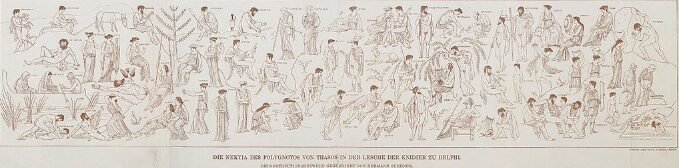
The Nekyia (Underworld Scene), another fresco from the Lesche of the Cnidians, portrays Greek hero Odysseus’s visit to the underworld. Polygnotus masterfully depicted layered figures to create depth and a sense of narrative flow.
Zeuxis of Heraclea (5th–4th Century BC)

Zeuxis revolutionized Greek painting by emphasizing realism and illusion. His meticulous attention to detail and use of shading set a new standard for the depiction of textures and materials. According to ancient accounts, Zeuxis’s works were so lifelike that they could deceive the viewer’s senses.
Notable Works and Achievements:
- The Grapes: A legendary story recounts how birds attempted to eat the grapes in one of his paintings, mistaking them for real fruit.
- Helen of Troy: Commissioned by the citizens of Croton, this portrayal of Helen highlighted Zeuxis’s ability to idealize beauty while maintaining realistic proportions and lifelike details.

Zeuxis’s focus on illusionistic techniques greatly influenced the development of trompe-l’œil art, an approach that would echo through Western painting for centuries. Image: Zeuxis choosing his models (1858) by French fresco painter Victor Mottez
Parrhasius of Ephesus (5th Century BC)
A contemporary and rival of Zeuxis, Parrhasius was celebrated for his mastery of line and his ability to convey character and emotion. Ancient writers often praised his skill in creating optical illusions, and he was considered a leading figure in perfecting contour drawing.
Notable Works and Achievements:
- The Veiled Image: A famous anecdote describes Parrhasius painting a curtain so realistically that Zeuxis himself mistook it for a real drape.
- Portraits of Heroes and Deities: Parrhasius excelled in portraying mythical and historical figures, imbuing them with lifelike individuality and psychological depth.
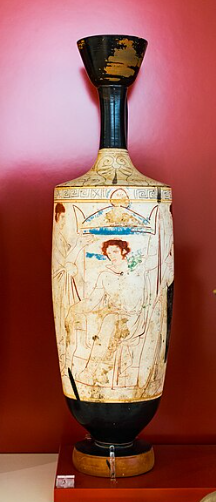
Parrhasius is remembered as a pioneer in psychological portraiture, laying the groundwork for the expressive potential of art. Image: A Group R Lekythos central figure’s slanted head, morose expression, and seated pose reflect Parrhasius’ influence.
Apelles of Kos (4th Century BC)
Apelles, perhaps the most celebrated painter of antiquity, lived during the time of Alexander the Great, for whom he served as the court painter. Apelles was renowned for his unparalleled technique, blending precision with artistic elegance.

Reconstructed mosaic of the Battle of Issus, inspired by Apelles or Philoxenus, found in Pompeii’s House of the Faun.
Notable Works and Achievements:
- Portrait of Alexander the Great with Thunderbolt: This depiction of Alexander highlighted the ruler’s divine attributes, capturing his majesty with fine detail and grace.
- Aphrodite Anadyomene (Aphrodite Rising from the Sea): A work that became iconic in the ancient world, celebrated for its beauty and delicate rendering of the goddess.

Apelles is credited with inventing the technique of shading (sfumato) and the use of varnish to enhance the luminosity of his works. His saying, “Not a day without a line,” underscores his dedication to continuous artistic improvement. Image: Alexander the Great and Campaspe in the studio of Apelles, by Italian painter Giovanni Battista Tiepolo.
Euphronios (Late 6th–Early 5th Century BC)
Euphronios was a master of red-figure vase painting, a technique that revolutionized Greek ceramic art by allowing greater detail and dynamic composition. His works are celebrated for their dramatic poses, intricate anatomical accuracy, and narrative depth.

Louvre G 103: Greek hero and demigod Heracles and Antaios on a chalice krater.
Notable Works and Achievements:
- Sarpedon Krater: This masterpiece, attributed to Euphronios, depicts the death of Sarpedon in vivid detail, with a striking composition that captures the tension and movement of the scene.
- Herakles and Antaios: Another famous vase, showcasing Herakles grappling with the giant Antaios, illustrating Euphronios’s ability to render complex interactions.
Euphronios’s contributions to vase painting marked a turning point in Greek art, emphasizing emotion and dynamism.
The Berlin Painter (Early 5th Century BC)
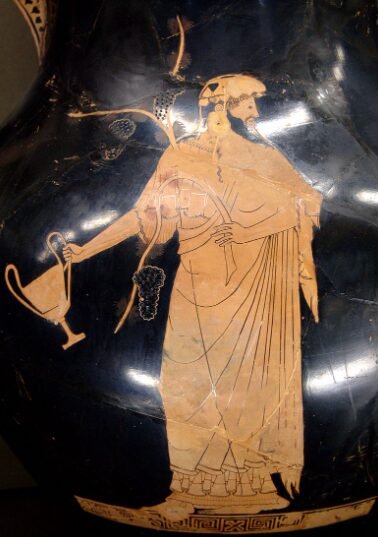
The Berlin Painter is an anonymous artist named after a famous amphora housed in Berlin. Known for his elegant and minimalist style, he focused on isolating figures against black backgrounds, allowing their forms to stand out with clarity. Image: Ancient Greek god Dionysos holding a kantharos (drinking cup). Side A from an Attic red-figure amphora, c. 490–480 BC. Found in Vulci, Italy.
The Berlin Painter, active circa 490–460s BC, was a distinguished Attic Greek vase-painter renowned as one of the earliest and most talented artists of the early 5th century BC.
Although his real name remains unknown, British art historian Sir John Beazley named him after a significant lidded amphora housed in the Antikensammlung Berlin. Over 400 vases and fragments are attributed to him, highlighting his substantial influence in Greek ceramics.
Trained by a member of the Pioneer Group alongside his rival, the Kleophrades Painter, he mastered and advanced the red-figure technique, transitioning from the Late Archaic to the Classic Attic style.
The Berlin Painter specialized in amphorae, particularly Panathenaic and Nolan forms, and his works frequently depicted mythological themes such as Hermes and satyrs, characterized by intricate drapery and expressive figures. He introduced technical innovations like dilute glazes for subtle red tones and developed unique decorative borders with alternating meander boxes and saltire squares.
The Berlin Painter’s refined style influenced a generation of artists, including the renowned Achilles Painter.
Most of his vases were exported to Italy, where they were highly valued as elite grave goods in necropoleis of Magna Graecia and Etruria, notably in Vulci, Nola, and Locri.
Additionally, he mentored numerous younger artists, including the renowned Achilles Painter, ensuring his lasting legacy and significant contribution to the evolution of ancient Greek art.
The Achilles Painter (470–425 BC)
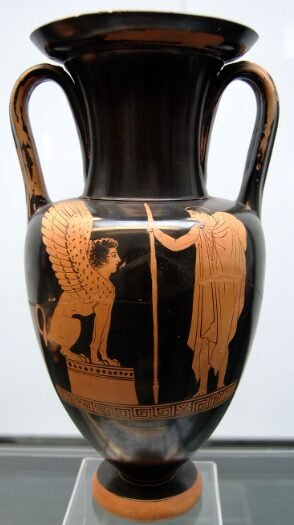
The Achilles Painter’s focus on narrative and emotion made him one of the most influential artists of his time.
A late pupil of the Berlin Painter, the Achilles Painter is best known for his work in red-figure and white-ground vase painting. His compositions are noted for their quiet dignity and emotional subtlety.
Notable Works and Achievements:
- Name Vase (Achilles Amphora): Depicts the Greek hero and demigod Achilles in a reflective pose, emphasizing the warrior’s humanity and inner conflict.
- White-Ground Lekythoi: These funerary vases, featuring delicate linework and somber themes, are considered masterpieces of ancient Greek drawing.
Pausias (4th Century BC)
Pausias was a pioneer in the use of encaustic painting, a technique involving pigments mixed with wax. He excelled in panel painting, particularly in the depiction of floral arrangements and pastoral themes.
Notable Works and Achievements:
- Flower Garland: A famous painting showcasing his ability to render intricate floral designs with realism and vibrancy.
- Portrait of Glycera: This depiction of his lover, holding a garland, highlights his skill in blending personal emotion with artistic refinement.
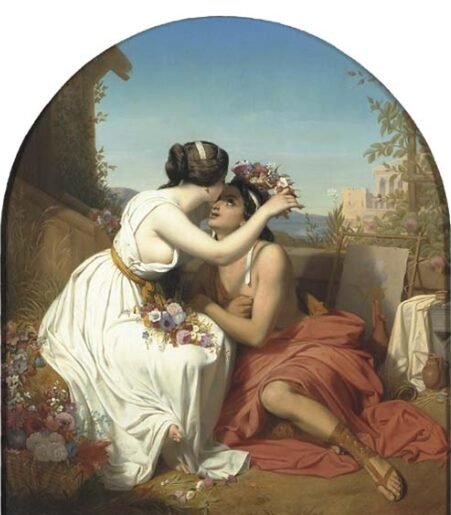
Pausias’s experimentation with encaustic techniques expanded the possibilities of texture and color in Greek painting. Image: Pausias and Glycera by Belgian painter Godfried Guffens





