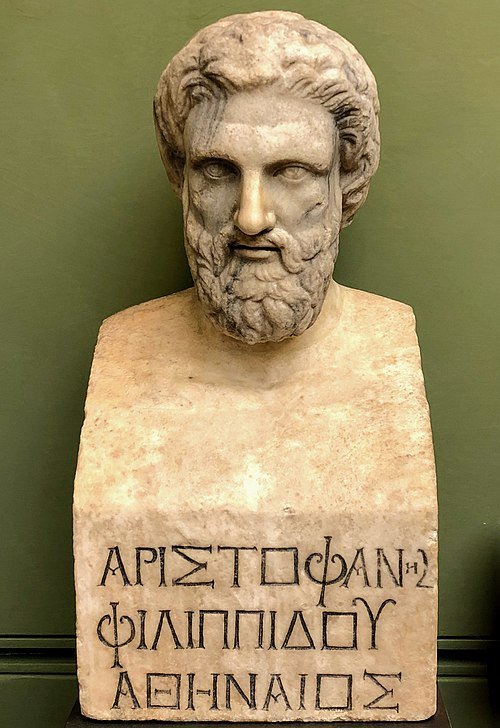
A 1st-century AD bust bearing the inscription “Aristophanes, son of Philippides, the Athenian.”
Let’s take a journey back to 5th century BCE Athens — a city buzzing with politics, drama (literally), and more than a little tension from a seemingly endless war. In the midst of this whirlwind lived Aristophanes, a playwright with a wicked sense of humor, a keen eye for politics, and a knack for making the audience laugh while holding up a mirror to their society. Often dubbed the “Father of Comedy” or the “Prince of Ancient Comedy,” Aristophanes isn’t just a historical figure; he’s a voice that still echoes in theaters, classrooms, and literature today.
Born around 446 BCE in Athens, Aristophanes grew up in the deme of Kydathenaion. His father, Philippus, and mother, Zenodora, belonged to a respectable family, possibly connected to the island of Aegina. But despite his ties to Athens, Aristophanes would go on to criticize the very soil he was raised on — not out of malice, but with the flair of someone who deeply loved his city and wanted it to do better.
READ MORE: 5 Great Accomplishments of Ancient Greece
Crafting Laughter in a City at War
Aristophanes wrote forty plays, though sadly only eleven survive in complete form. What makes his work stand out is its fearless blending of sharp political critique with absurd humor, musical flair, and, yes, a healthy dose of vulgarity. He wrote during what’s known as the era of “Old Comedy,” a style characterized by its open political commentary, slapstick elements, and interactions with the audience — the kind of comedy that didn’t just break the fourth wall, it tap danced on it.
Now, imagine you’re watching a play in Athens. You’re seated at the Theatre of Dionysus with thousands of others, and onstage someone dressed ridiculously as a god is shouting about politics, farting, and singing. That’s Aristophanes for you. And the festivals where his plays were performed — the City Dionysia and the Lenaia — weren’t just entertainment. They were religious, cultural, and political spectacles rolled into one. Winning at these festivals wasn’t just about applause; it was about prestige.
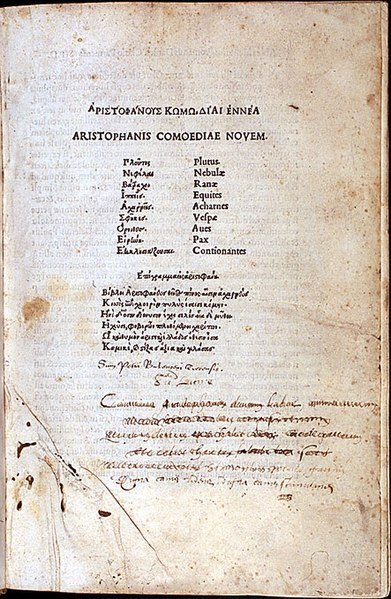
A 1498 edition’s table of contents, featuring all of Aristophanes’ surviving plays, excluding “Thesmophoriazusae” and “Lysistrata”.
Politics, Parody, and Peloponnesian War Punchlines
What really sets Aristophanes apart is his audacity. This guy didn’t hold back. His second play, The Babylonians (now lost), got him in serious trouble with a prominent Athenian politician named Cleon. The play criticized Athens’ imperial policies so sharply that Cleon accused him of slandering the city — possibly even bringing him to court. While we don’t know exactly how the trial played out, Aristophanes certainly didn’t let it go. He spent the next few plays absolutely roasting Cleon, especially in The Knights, where Cleon is portrayed as a blustering, self-serving demagogue.
This fearless mockery wasn’t limited to politicians. Aristophanes went after philosophers too — most notably Socrates in The Clouds. Plato even claimed that this play helped shape public opinion against Socrates, contributing to his execution. But satire was part of the game. It’s worth noting that Socrates and Aristophanes may have actually gotten along — at least well enough to attend the same dinner party, as depicted in Plato’s Symposium.
Who Was Aristophanes, Really?
Oddly enough, most of what we know about Aristophanes comes from the plays themselves. They give us glimpses, little reflections, often through the chorus during sections called the “parabasis,” where the actors would step aside and the chorus would speak directly to the audience — often as the voice of the playwright. But even these moments were more about his artistic choices than his inner life. Did he enjoy poking the bear? Sure. Was he a staunch conservative? Maybe — though that’s up for debate.
Some scholars argue that Aristophanes was just playing to the crowd — or rather, a very specific crowd. You see, these massive theater festivals attracted citizens from all walks of life, but the wealthier class — the same folks who funded the chorus through a sort of civic sponsorship — had a big stake in what got produced. And Aristophanes was acutely aware of this. His satire often defended traditional values, criticized populism, and longed for the good old days — all themes that probably resonated with his financial backers.
From War Hawks to Dung Beetles: The Plots Get Wild
The structure of Aristophanes’ plays followed a pattern, but the content? Anything but predictable. He had a thing for launching his plots from totally absurd premises. A man who negotiates his own private peace with Sparta (The Acharnians)? A trip to the heavens on a giant dung beetle (Peace)? Birds founding a new utopian city in the sky (The Birds)? You get the idea.
Yet, for all their fantasy, these stories always circled back to real concerns: war, corruption, justice, civic duty. Aristophanes wasn’t just mocking society — he was proposing imaginative alternatives to it, no matter how outlandish.
The Language: A Jester’s Toolbox
If Aristophanes were alive today, he’d probably be a stand-up comedian, a poet, and a rapper all in one. His mastery of the Attic dialect — the elite Athenian version of Greek — made his writing a linguistic playground. He created outrageous compound words, twisted syntax for comic effect, and embedded clever puns everywhere. A line might end with a punch word, build to a ridiculous climax, or double back on itself in a way that kept the audience in hysterics.
His work used a mix of poetic meters — from the conversational iambic trimeter to the bouncy anapestic rhythms. The chorus would break into song, characters would argue in exaggerated verse, and clever turns of phrase would keep the tone light even when the subject matter was weighty.
The Big Picture Behind the Punchlines
Aristophanes’ use of humor wasn’t just for laughs — it was a weapon. He lashed out at war profiteers, mocked the fickleness of the democratic assembly, and highlighted the contradictions in Athens’ imperial policies. And yet, for all this, he never seemed to suffer real political consequences. Even Cleon, his main punching bag, continued to climb the political ladder until his death. Aristophanes was somehow both feared and untouchable — the court jester whose barbs cut deep but were tolerated, even respected.
He lived through the Peloponnesian War, the rise and fall of Athenian democracy, and the shift from Athens as a political power to a center of learning. His last surviving play, Wealth (Plutus), shows signs of this transformation. It lacks the raucous energy of Old Comedy and leans more toward the sentimental and character-driven style that would define New Comedy — the same style later mastered by Menander.
The Family Business
Aristophanes didn’t just fade into obscurity after his death around 386 BCE. His legacy lived on through his sons, particularly Araros, who also became a comic poet and likely helped produce some of his father’s later plays. Another son, Philippus, continued the tradition, possibly directing comedies by other playwrights. Even Aristophanes’ grandsons kept the theatrical flame alive, hinting at a family dynasty in comic drama.
More Than a Playwright: Aristophanes in Plato’s Symposium
Want to see a softer, more human side of Aristophanes? Look no further than Plato’s Symposium. In this famous dialogue, Aristophanes is one of the guests at a philosophical drinking party. He gives a quirky, heartfelt speech about love, suggesting that humans were once spherical beings split in half, doomed to search for their other half — a notion that’s somehow both touching and ridiculous, which is peak Aristophanes.
Although we can’t know how accurately Plato portrayed him, this version of Aristophanes feels warm, witty, and deeply self-aware — someone who understood the power and limits of comedy.
The Legacy: From Scrolls to Stage Lights
So how did Aristophanes’ plays survive when so many others from the same era didn’t? The answer lies in their linguistic and literary brilliance. Scholars and students throughout the centuries recognized the value of his Greek — both as a tool for learning and a model of style. His plays were copied, studied, and eventually translated into Latin and modern languages, ensuring their survival.
During the Renaissance, writers like Racine and Goethe drew on Aristophanes for inspiration. In the 20th century, modern directors like Karolos Koun used his work to challenge political norms. Even Soviet cultural leaders saw Aristophanes as a voice for the people. He’s been interpreted as both a radical and a conservative, depending on the era and reader. That’s part of his magic — he speaks across generations without being pinned down.
Aristophanes in Music, Comics, and Beyond
You’ll find echoes of Aristophanes far beyond the stage. French composer Jean-Philippe Rameau took cues from The Frogs for his opera Platée. British composer Ralph Vaughan Williams created an orchestral suite inspired by The Wasps. In modern Greece, Aristophanes’ plays have been adapted into comic books, complete with bold artwork and slapstick humor. BBC radio brought him to life in shows like Acropolis Now, portraying him as a cheeky celebrity playwright. He’s inspired everything from philosophical dialogues to pig-themed political satire.
A Quick Peek at the Greatest Hits
Of the eleven plays that survive in full, some stand out more than others:
-
The Acharnians: A daring call for peace in the midst of war.
-
The Knights: A brutal takedown of Cleon’s populist politics.
-
The Clouds: A comedic indictment of philosophical abstraction (hello, Socrates).
-
The Wasps: A satire on Athens’ obsession with litigation.
-
Peace: A literal journey to bring peace back to earth.
-
The Birds: A fantasy about founding a city in the sky — no gods allowed.
-
Lysistrata: Women withhold sex to end the war — a feminist classic.
-
The Frogs: Dionysus judges dead poets in the underworld — literary nerd heaven.
-
Ecclesiazusae: A proto-communist experiment gone hilariously wrong.
-
Wealth: A more sentimental comedy about the god of money.
Why Aristophanes Still Matters
Aristophanes wasn’t just funny — he was a social critic, a poet, and a philosopher in disguise. His work challenges us to think about war, justice, democracy, and power, all while keeping us laughing. His plays offer rare insights into ancient Athenian life — how people spoke, what they feared, what they found funny, and how they coped with uncertainty.
For all the weird plots, bawdy jokes, and oversized phalluses, Aristophanes gives us something deeper: a portrait of humanity with all its flaws, absurdities, and hope. He reminds us that laughter is a form of resistance — and sometimes the truest form of truth-telling.
Frequently Asked Questions about Aristophanes
What role did Aristophanes play in ancient Greek drama?
Aristophanes was a leading playwright of Old Comedy in classical Athens, known for his satirical and fantastical plays that critiqued politics, society, and cultural trends.
How many of his plays survive today?
Out of the forty plays Aristophanes wrote, eleven survive in complete form, making them the most important examples of Old Comedy.
What were his plays mainly about?
His plays often addressed real-life events and figures, like the Peloponnesian War, Socrates, Euripides, and the populist politician Cleon, blending absurdity with sharp political satire.
Where were Aristophanes’ plays performed?
They were performed at major Athenian festivals such as the City Dionysia and the Lenaia, where comic playwrights competed for prestigious prizes.
Why was Aristophanes considered controversial?
He openly mocked powerful figures and Athenian policies, which led to public backlash—most notably from Cleon, who may have taken legal action against him.
Did Aristophanes direct his own plays?
Yes, later in his career, he often directed his own productions, a role that included training the chorus and shaping the play’s message and staging.
What is the significance of the “parabasis” in his plays?
The parabasis was a moment when the chorus spoke directly to the audience, often expressing the playwright’s views and offering biographical insights.
How did Aristophanes influence the evolution of comedy?
He helped shape Old Comedy and, in his later works, transitioned toward the more character-driven style of New Comedy, influencing future generations of playwrights.
Was Aristophanes politically active?
Despite his politically charged plays, there’s little evidence he was directly involved in politics, though he may have served on Athens’ Council of Five Hundred.
How did Plato portray Aristophanes?
In The Symposium, Plato presents him as witty, gentle, and self-deprecating, suggesting mutual respect despite Aristophanes’ earlier mockery of Socrates.
What was distinctive about Aristophanes’ use of language?
He was a master of the Attic dialect, creating compound words, puns, and poetic rhythms that mixed high literary skill with street-level humor.
Aristophanes’ works provide rare insights into classical Athenian life, and his fearless satire, imaginative plots, and linguistic creativity continue to influence literature, theater, and political commentary.





