Antiochus IV Epiphanes
Antiochus IV Epiphanes (c. 215 BC–164 BC) ruled the Seleucid Empire from around 175 BC to 164 BC. His reign was marked by significant events, including his attempted conquest of Egypt, persecution of Jews in Judea, and the subsequent Maccabean Revolt. While remembered for his eccentricities and often ruthless policies, Antiochus’ controversial actions shaped the history of the Seleucid Empire and its neighbors. This article explores his rise to power, governance, conflicts, and legacy.

Bust of Antiochus IV Epiphanes
Rise to Power
Born around 215 BC, Antiochus IV was the son of Antiochus III the Great, one of the most influential Seleucid rulers. Initially named Mithridates, his name changed upon ascending the throne or after the death of his elder brother. Following the Treaty of Apamea (188 BC), Antiochus became a hostage in Rome, a practice designed to secure peace after his father’s defeat.
Antiochus IV’s eccentric behavior, controversial policies, and harsh treatment of the Jewish population sparked the Maccabean Revolt, weakening his rule and destabilizing the Seleucid Empire.
When his older brother, Seleucus IV Philopator, succeeded their father in 187 BC, Antiochus was exchanged for Seleucus’ son, Demetrius I. After Seleucus’ assassination in 175 BC by Heliodorus, Antiochus traveled from Athens to Syria, ousting Heliodorus with support from Eumenes II of Pergamum. He declared himself co-regent with Seleucus’ infant son but likely orchestrated the child’s death, solidifying his rule.
Ruling Style
Antiochus IV cultivated an image of generosity and splendor. He distributed money to the public, funded grand projects like the Temple of Zeus in Athens, and hosted lavish banquets. His military parades and public appearances earned him admiration from some but criticism from others, who nicknamed him Epimanes (“The Mad”) due to his unpredictable behavior.
Unlike his predecessors, Antiochus IV adopted divine epithets such as Theos Epiphanes (“God Manifest”) and Nikephoros (“Bringer of Victory”). These titles, possibly inspired by eastern Hellenistic rulers, emphasized his divinity and authority.
Despite Antiochus IV’s ambitions, internal dissent and external threats weakened the Seleucid dynasty, contributing to its eventual decline.
Sixth Syrian War
Antiochus IV’s military campaigns were pivotal in his reign. In 170 BC, he confronted Ptolemaic Egypt, exploiting internal divisions. After defeating Egyptian forces, he captured Pelusium and advanced into Egypt, securing most of the kingdom. However, he allowed Ptolemy VI Philometor to rule as a puppet king, avoiding direct Roman intervention.
The Ptolemaic siblings eventually reconciled and co-ruled Egypt, prompting Antiochus to launch a second invasion in 168 BC. His campaign was halted at the “Day of Eleusis” when Roman envoy Gaius Popillius Laenas demanded his immediate withdrawal. Antiochus acquiesced, possibly avoiding a costly siege of Alexandria.

Relations with Rome
Antiochus maintained cautious diplomacy with Rome, paying indemnities from the Treaty of Apamea. His adherence to Roman demands at Eleusis underscored his pragmatic approach, despite the humiliation portrayed in ancient accounts.
Persecution of Jews and the Maccabean Revolt
Antiochus’ rule in Judea marked a departure from traditional Seleucid tolerance. A dispute over the High Priesthood in Jerusalem, involving Jason and Menelaus, escalated tensions. When a rumor of Antiochus’ death spread in 168 BC, Jason attempted to retake power, inciting a violent backlash. Antiochus, enraged, attacked Jerusalem, restored Menelaus, and massacred thousands.
Subsequent decrees outlawed Jewish religious practices, converted the Temple into a shrine to Zeus, and mandated Hellenistic rites. These policies alienated traditionalist Jews and fueled the Maccabean Revolt.
Led by the Hasmonean family, the revolt gained momentum despite initial Seleucid victories. Antiochus established a military garrison in Jerusalem but underestimated the resolve of the rebels. His policies, viewed as oppressive, became a rallying point for Jewish resistance and left a lasting legacy in Jewish tradition, commemorated in Hanukkah.
Eastern Campaigns and Final Years
While dealing with the Maccabean Revolt, Antiochus faced a growing threat from Parthia. King Mithridates I seized key eastern territories, disrupting trade routes and weakening the empire’s cohesion.
In 164 BC, Antiochus campaigned in Persia, reportedly looting temples. According to various accounts, he died in Isfahan under mysterious circumstances. Jewish sources attributed his death to divine punishment for desecrating the Jerusalem Temple. Greek and Roman sources depict his demise as a combination of hubris and misfortune.
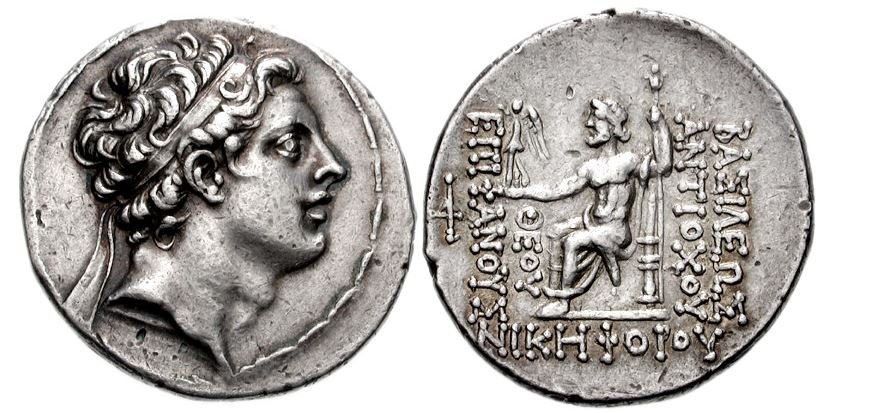
Silver coin of Antiochus IV Epiphanes.
Legacy
Antiochus IV is vilified in Jewish texts, including the Books of the Maccabees and the “Scroll of Antiochus.” He is remembered as a symbol of persecution and tyranny. Rabbinical sources refer to him as harasha (“the wicked”), emphasizing his role in the events leading to Hanukkah.
Ancient historians like Polybius and Diodorus portrayed Antiochus negatively, highlighting his eccentricities and failures. However, modern scholars argue for a more nuanced view. Antiochus demonstrated political acumen and maintained stability in parts of his empire. His interventions in Judea may reflect an attempt to enforce central authority rather than sheer hostility.

Frequently Asked Questions

An illustration by French artist Noël Hallé, depicting Antiochus falling from a horse.
Why was Antiochus IV’s accession to the throne controversial?
Antiochus IV seized the throne after his brother Seleucus IV’s death, bypassing the rightful heir, Demetrius I, who was a hostage in Rome. This usurpation set a precedent for future instability in the Seleucid dynasty.
What was the “Day of Eleusis,” and why was it significant?
The “Day of Eleusis” refers to a standoff where a Roman envoy, Gaius Popillius Laenas, forced Antiochus to withdraw from Egypt under threat of war. This incident is often seen as a humiliation for Antiochus and a marker of Rome’s growing dominance in the region.
How did Antiochus IV’s policies impact the Jewish population?
Antiochus IV imposed Hellenistic practices on the Jewish population, outlawed traditional Jewish rites, and desecrated the Temple in Jerusalem. These actions provoked the Maccabean Revolt, which became a turning point in Jewish history.
What role did Antiochus IV’s personality play in his reign?
Antiochus IV was known for his eccentric and unpredictable behavior, earning him the nickname “Epimanes” (“The Mad”). While his generosity and public engagement endeared him to some, his erratic policies and despotic actions alienated others.
How did Antiochus IV’s reign influence later perceptions of him?
Jewish traditions, particularly those associated with Hanukkah, depict Antiochus IV as a persecutor and villain. Historians have debated his legacy, with some arguing he was a capable ruler tarnished by political bias in ancient sources.
What led to Antiochus IV’s downfall?
Antiochus faced simultaneous challenges: the Maccabean Revolt in Judea and an eastern campaign against the Parthians. His failure to fully suppress the Jewish rebellion and his untimely death in 164 BC during his eastern campaign marked the decline of Seleucid power.
How did Antiochus IV’s reign affect the Seleucid Empire’s stability?
Antiochus IV’s actions, including his controversial rise to power and divisive policies, exacerbated internal divisions and set the stage for succession disputes and external threats, accelerating the empire’s decline.





