Ares Borghese: History and Major Facts about the Roman Marble Statue
The Ares Borghese is a remarkable Roman marble statue from the imperial era, dating back to the 1st or 2nd century AD. Standing at an imposing height of 2.11 meters (6 feet 11 inches), this statue has long been a subject of scholarly interest and debate.
Traditionally identified as representing Ares, the Greek god of war, the statue’s true identity remains uncertain. This ambiguity, coupled with its artistic qualities and historical journey, makes the Ares Borghese a fascinating study in the interplay between Greek originals and Roman reinterpretations.
In the article below, World History delves into the history, artistic influences, identification controversies, symbolic meanings, and cultural significance of the Ares Borghese statue.
Description of the Statue
The Ares Borghese is a marble sculpture that exemplifies the grandeur and craftsmanship of Roman imperial art. Although it is referred to as Ares, this identification is not universally accepted among scholars. The statue portrays a youthful, beardless warrior, embodying the martial attributes associated with Ares.
The statue’s posture and musculature suggest a figure ready for battle, emphasizing strength and aggression. However, certain features, such as an anklet on the left leg, introduce elements that complicate its identification with Ares.
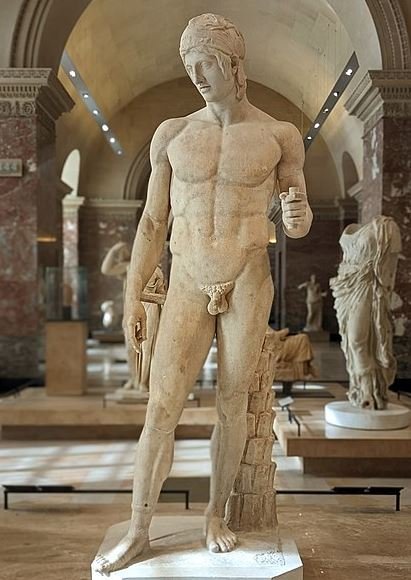
Image: The Ares Borghese as situated in the Louvre Museum in France.
Historical Context
The Ares Borghese originates from the Roman imperial period, a time when Rome was at the height of its power and influence. The imperial era saw the flourishing of art and culture, with Roman artists often drawing inspiration from Greek models. This period was marked by a fascination with classical Greek art, which Romans sought to emulate and adapt to their own aesthetic and cultural contexts. The Ares Borghese fits within this tradition, potentially preserving stylistic elements of earlier Greek originals that have since been lost.
Artistic Influences and Origins
The representation of Ares in ancient Greek art, especially in sculpture, was exceptionally rare. Unlike gods such as Zeus or Athena, Ares was not commonly depicted in monumental art, making the Ares Borghese a unique artifact. Some scholars have speculated that the statue might be derived from a work by Alcamenes, a renowned Athenian sculptor of the 5th century BC.
According to the ancient traveler Pausanias, Alcamenes created a statue of Ares that was displayed in the Athenian Agora. However, this connection is problematic for several reasons:
- Chronological Discrepancies: The temple of Ares mentioned by Pausanias was relocated from Acharnes to the Agora during the reign of the Roman Emperor Augustus. This move occurred centuries after Alcamenes’ time, making it unlikely that the Ares Borghese is a direct copy of his work.
- Stylistic Differences: Known replicas of Alcamenes’ Ares depict the god wearing a breastplate, a feature absent in the Ares Borghese. This discrepancy suggests that the Roman statue may not be a faithful copy of Alcamenes’ original but rather a reinterpretation or adaptation in the Neo-Attic style, which sought to revive classical Greek aesthetics with Roman influences.
The Ares Borghese exhibits a Neo-Attic or classicizing style, blending Greek classical elements with Roman artistic sensibilities.
Given these factors, it is more plausible that the Ares Borghese represents a Roman creation inspired by earlier Greek models rather than a direct replica of Alcamenes’ work. The Neo-Attic style was characterized by a blend of classical Greek elements with contemporary Roman tastes, resulting in sculptures that honored Greek traditions while serving Roman cultural and political purposes.
Roman Use and Symbolism
In Roman art, the Ares Borghese type became a popular motif, often paired with statues of the Venus de Milo type. This combination symbolized the harmonious union between military strength (Ares/Mars) and peace or love (Venus). Such representations were especially common in imperial portraiture, emphasizing the dual ideals of war and concord that were integral to the Roman state. The pairing of Ares and Venus underscored the Roman values of strength tempered by beauty and affection, reflecting the empire’s complex societal dynamics.
The Ares Borghese was part of the prestigious Borghese collection, renowned for its extensive array of classical sculptures. In 1807, Napoleon Bonaparte acquired the statue from the Borghese collection, further cementing its historical and cultural significance. This acquisition not only highlighted the statue’s artistic value but also its role in the broader narrative of art collection and cultural heritage during the Napoleonic era.

Image: Jacques-Louis David’s 1812 painting “The Emperor Napoleon in His Study at the Tuileries”.
Identification Controversy
Despite its traditional identification as Ares, the statue’s true identity remains a subject of scholarly debate. A prominent feature contributing to this uncertainty is the anklet on the statue’s left leg. Various interpretations of this feature have led to multiple hypotheses regarding the statue’s true subject:
Some scholars suggest that the anklet could be a decorative element, such as a bronze greave (a piece of armor for the leg) or the top of a boot. This interpretation does not necessarily clarify the statue’s identification with Ares but rather highlights the stylistic embellishments typical of Roman sculptures.
Some scholars propose the Ares Borghese statue could represent Theseus or Achilles, based on the anklet and other stylistic elements.
Classicists like Johann Joachim Winckelmann and Friedrich Wilhelm von Bissing Furtwängler have proposed that the anklet represents part of a chain. This could allude to myths involving Ares’ imprisonment in Sparta or the myth of Ares and Aphrodite being bound together by Hephaestus after their affair was discovered. These interpretations emphasize the narrative aspects of Ares’ mythology but do not conclusively identify the statue as Ares.
Other scholars argue that the statue could represent heroes such as Theseus or Achilles. For instance, the anklet might highlight Achilles’ legendary vulnerable heel, aligning the statue with his mythological narrative. This alternative identification underscores the complexity of attributing specific deities or heroes to ancient statues based solely on stylistic features.
The presence of the anklet introduces ambiguity, as it is not a definitive attribute exclusively associated with Ares. This uncertainty necessitates a broader examination of the statue’s stylistic elements, historical context, and comparative analysis with other known works to achieve a more accurate identification.
Artistic Style and Roman Reinterpretation
The Ares Borghese is believed to embody the Neo-Attic or classicizing style prevalent in Roman art. This style sought to revive and reinterpret classical Greek artistic traditions, infusing them with Roman aesthetic preferences and cultural values. Key characteristics of the Neo-Attic style include:
- Elegance and Grace: Roman adaptations emphasized fluid lines and graceful proportions, aligning with contemporary tastes for refined and harmonious forms.
- Symmetry and Balance: The statues often exhibited balanced compositions, reflecting the Roman appreciation for order and symmetry.
- Blend of Mythological Elements: Roman sculptures frequently merged attributes from different mythological figures, creating composite images that served specific symbolic or political purposes.
In the case of the Ares Borghese, the statue likely combines Greek martial iconography with Roman interpretative elements, resulting in a piece that honors Greek origins while serving Roman cultural narratives. This synthesis is evident in the statue’s muscular physique and warrior attributes, which align with traditional representations of Ares, yet the overall aesthetic and craftsmanship bear the hallmarks of Roman artistic innovation.
Symbolism and Cultural Significance
The Ares Borghese, through its artistic and symbolic elements, encapsulates key aspects of Roman ideology and societal values. The pairing with Venus de Milo-type statues symbolized the ideal balance between martial prowess and peaceful beauty, reflecting the Roman emphasis on duality and complementarity within the empire. This symbolism reinforced the notion of a united and harmonious state, where strength and love coexisted to maintain stability and prosperity.
Moreover, the statue’s integration into imperial portraiture served political purposes. By associating the emperor with divine figures like Ares and Venus, the Romans projected an image of divinely sanctioned authority and benevolent leadership. This divine association legitimized the emperor’s rule and underscored the emperor’s role as a protector and benefactor of the state.
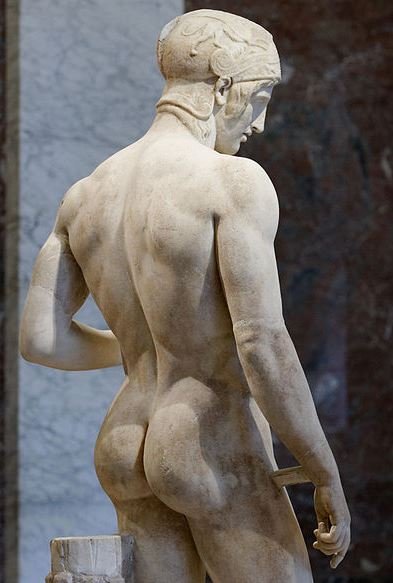
Image: Rear view of the statue.
Legacy and Cultural Impact
The Ares Borghese has left a lasting legacy in the study of ancient art and mythology. Its historical journey—from the Borghese collection to Napoleon’s acquisition—reflects the broader narrative of art collection and cultural appropriation during the Roman Empire and the subsequent European art movements. The statue’s blend of Greek and Roman elements makes it a valuable resource for understanding the transmission and transformation of artistic styles across cultures and eras.
In contemporary culture, the Ares Borghese continues to inspire and captivate audiences. Its appearance in modern media, such as the anime Sekko Boys, attests to its enduring aesthetic appeal and symbolic resonance. The statue’s portrayal as a youthful, beardless warrior aligns with modern interpretations of classical heroes, bridging the gap between ancient mythology and contemporary artistic expression.
Preservation and Current Location
The original Ares Borghese is housed in the Museum of the Villa, where it is preserved alongside other classical artifacts. This location ensures that the statue remains accessible to scholars and the public, allowing ongoing study and appreciation of its artistic and historical significance. The preservation efforts underscore the importance of maintaining cultural heritage and facilitating the continued exploration of ancient art’s influence on modern society.
Conclusion
The Ares Borghese stands as a testament to the intricate interplay between Greek origins and Roman reinterpretations in ancient art. Its traditional identification as Ares, though debated, highlights the complexities of attributing ancient statues to specific deities or figures based solely on stylistic features. The statue’s Neo-Attic style, combined with its symbolic pairing with Venus de Milo-type figures, underscores the Roman penchant for blending artistic traditions to convey cultural and political ideals.
Despite the uncertainties surrounding its exact identity, the Ares Borghese remains a significant artifact in the study of ancient mythology and art. Its journey from a possible Greek original to a prized Roman masterpiece reflects the broader themes of cultural exchange and artistic evolution that defined the ancient Mediterranean world. As a piece that bridges the gap between mythological narrative and artistic expression, the Ares Borghese continues to inspire and inform our understanding of classical heritage and its enduring legacy in contemporary culture.
Through its depiction of Ares—or a figure resembling him—the statue encapsulates the dichotomy between brute strength and strategic wisdom, a recurring theme in both mythology and human history. Whether viewed as the embodiment of war’s chaotic nature or as a symbolic representation of martial virtues, the Ares Borghese offers a rich and multifaceted perspective on the ancient world’s artistic and cultural dynamics.
Conclusion
The Ares Borghese is more than just a marble statue; it is a symbol of the intricate blend of Greek and Roman artistic traditions, the complexities of mythological representations, and the enduring legacy of classical art. Its traditional identification as Ares, while debated, opens avenues for exploring the nuanced relationships between deities, the stylistic innovations of Roman sculptors, and the cultural dialogues between Greece and Rome. The statue’s journey from a possible Greek original to a prized Roman masterpiece, and its eventual acquisition by Napoleon, underscores its historical significance and artistic excellence.
Frequently Asked Questions
How tall is the Ares Borghese statue?
The statue is 2.11 meters (6 feet 11 inches) high.
What is the origin of the Ares Borghese statue?
The statue is thought to preserve stylistic elements of a lost 5th-century BC bronze original, though its connection to earlier Greek art is uncertain.
Why is the identification of the statue as Ares debated?
The identification is debated due to features like the anklet on the left leg, which has been interpreted in multiple ways, and the lack of direct evidence linking it to earlier representations of Ares.
Who is Alcamenes, and how is he related to the Ares Borghese statue?
Alcamenes was an Athenian sculptor who, according to Pausanias, created a statue of Ares displayed in the Athenian Agora. However, the Ares Borghese is unlikely to be a direct copy of his work due to stylistic and historical discrepancies.
What stylistic discrepancies exist between the Ares Borghese and Alcamenes’ works?
Known replicas of Alcamenes’ Ares portray the god wearing a breastplate, while the Ares Borghese does not, suggesting it may be a Roman reinterpretation in a Neo-Attic style.
What role did the Ares Borghese type play in Roman art?
The Ares Borghese type became a popular motif in Roman art, often paired with Venus de Milo-type statues to symbolize the union of military strength (Ares/Mars) and peace or love (Venus).
What historical significance does the statue hold in terms of its collection?
The Ares Borghese was part of the Borghese collection and was later purchased by Napoleon in 1807, adding to its prominence.
What are some interpretations of the anklet feature on the statue?
Interpretations include it being a decorative element like a bronze greave or part of a chain referencing myths of Ares’ imprisonment or his entrapment with Aphrodite by Hephaestus. Others suggest it links the statue to Theseus or Achilles.
Why do some scholars think the anklet identifies Achilles?
The anklet could highlight Achilles’ vulnerable heel, aligning with his mythology.
How does the statue reflect the blending of Greek and Roman artistic traditions?
The Ares Borghese combines Greek classical elements with Roman reinterpretations, illustrating a Neo-Attic style popular in Roman imperial art.
What does the pairing of Ares Borghese and Venus de Milo-type statues symbolize?
This pairing symbolizes the union of war and peace, emphasizing ideals of military strength and concord in Roman imperial portraiture.
How is the Ares Borghese represented in modern popular culture?
The statue appears as a bust in the anime Sekko Boys, showcasing its enduring cultural resonance.
FACT CHECK: At World History Edu, we strive for utmost accuracy and objectivity. But if you come across something that doesn’t look right, don’t hesitate to leave a comment below.





