Ptolemy XII Auletes
Ptolemy XII Neos Dionysus, commonly known by his epithet Auletes (“the Flautist”), was a pivotal ruler of the Ptolemaic Kingdom of Egypt. His reign, spanning from 80 to 58 BC and then again from 55 BC until his death in 51 BC, was characterized by political intrigue, familial conflicts, strategic alliances, and a delicate balancing act with the rising power of Rome. Ptolemy XII’s ability to navigate these complexities not only preserved his dynasty but also set the stage for the eventual prominence of his daughter, Cleopatra VII.
In the article below, World History Edu delves into the life, reign, and accomplishments of Ptolemy XII, highlighting his lineage, ascent to power, interactions with Rome, and efforts to maintain his dynasty amidst internal and external pressures.

Ptolemy XII Neos Dionysus, also known as Auletes (“the Flautist”), ruled Ptolemaic Egypt from 80–58 BC and 55–51 BC. Image: Relief of Ptolemy XII from the double temple at Kom Ombo, Aswan Governorate, Upper Egypt
Early Life and Lineage
Ptolemy XII was born around 117 BC, the eldest son of Ptolemy IX, a member of the illustrious Ptolemaic dynasty established by Ptolemy I Soter, a Macedonian Greek general and companion of Alexander the Great. The identity of Ptolemy XII’s mother remains a subject of scholarly debate.
Ptolemy IX was married twice—first to his sister Cleopatra IV from approximately 119 BC until their forced divorce in 115 BC, and then to another sister, Cleopatra Selene, from 115 BC until he abandoned her during his flight from Alexandria in 107 BC.
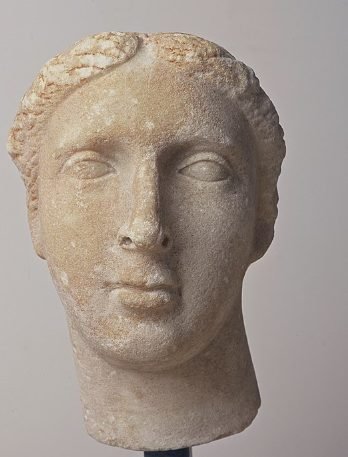
Believed to be an illegitimate son of Ptolemy IX, Ptolemy XII married Cleopatra V, fathering Cleopatra VII and others. Image: A 1st century BC sculpture of Cleopatra V Tryphaena (VI) from Lower Egypt, Musée Saint-Raymond.
Despite these legitimate marriages, ancient sources such as Cicero referred to Ptolemy XII as an illegitimate son. Pompeius Trogus labeled him a “nothos” (bastard), and Pausanias noted that Ptolemy IX had no legitimate sons. This has led scholars to propose that Ptolemy XII’s mother might have been a concubine, likely an Alexandrian Greek or an unknown woman from the Egyptian elite.
However, some historians argue that Ptolemy XII was indeed the son of Cleopatra IV but was considered illegitimate because she never served as co-regent. This perspective suggests that his illegitimacy was more about political status than maternal lineage.
Ptolemy XII likely had a brother, known as Ptolemy of Cyprus, born around a year after him. By 116 BC, Ptolemy IX returned to Alexandria to assume the throne upon his father’s death, becoming the junior co-regent alongside his grandmother Cleopatra II and his mother, Cleopatra III. This period marked the beginning of Ptolemy XII’s introduction into public life and the political sphere.
Rise to Power and Early Challenges
In 115 BC, under the influence of his mother Cleopatra III, Ptolemy IX was compelled to divorce Cleopatra IV, who subsequently fled into exile. Cleopatra IV married the Seleucid king Antiochus IX but was murdered by his half-brother Antiochus VIII in 112 BC. Ptolemy IX then remarried Cleopatra Selene, with whom he had a daughter, Berenice III.
By 109 BC, Ptolemy IX began introducing Ptolemy XII into public life, appointing him as the Priest of Alexander and Ptolemaic kings, and establishing a festival in his honor in Cyrene. However, tensions between Ptolemy IX and Cleopatra III escalated, leading to Ptolemy IX’s exile to Cyprus in 107 BC, where he was replaced by his younger brother, Ptolemy X. During this tumultuous period, Ptolemy XII and his brother were captured by Mithridates VI of Pontus around 88 BC and held as hostages until 80 BC.
Upon Ptolemy IX’s death in December 81 BC, his half-sister Berenice III ascended to the throne. However, her reign was short-lived as she was murdered by her husband, Ptolemy XI, who was then killed by an Alexandrian mob. This chaos created a power vacuum that paved the way for Ptolemy XII to be recalled from Pontus and proclaimed pharaoh in April 80 BC. Simultaneously, his brother, also named Ptolemy, was installed as king of Cyprus.

Ptolemy XII before Hathor and Philae, at the Hathor Temple, Dendera
Marriage and Dynastic Strategies
Shortly after his accession, Ptolemy XII married Cleopatra V, a relative likely to be his sister or cousin. This marriage was a strategic move aimed at consolidating his claim to the throne and strengthening dynastic ties.
Ptolemy XII and Cleopatra V had at least one child together, Berenice IV, who would later become his rival. Cleopatra V was also probably the mother of Cleopatra VII, who would become one of the most renowned figures in ancient history. The youngest three of Ptolemy XII’s children—Arsinoe IV, Ptolemy XIII, and Ptolemy XIV—were born to an unknown mother, adding another layer of complexity to his familial dynamics.
Ptolemy XII’s uncle, Ptolemy X, had previously left Egypt to Rome in the absence of heirs, threatening the possibility of Roman annexation. To counter this looming threat, Ptolemy XII established an alliance with Rome, a crucial move to secure his dynasty’s survival. This strategic alliance with Rome was instrumental in preserving his rule and maintaining Egypt’s autonomy amidst the growing influence of the Roman Republic.
In 76 BC, Cleopatra V ceased to be mentioned as co-regent, likely due to a divorce. Ptolemy XII adopted the epithet Neos Dionysos (“New Dionysus”) after this break, which may have symbolized his shift away from Cleopatra V and his efforts to solidify his own authority. This change in title reflected his attempt to present himself as a rejuvenated ruler, aligning his image with the god Dionysus, associated with rebirth and renewal.
Relations with Rome and Economic Policies
During Ptolemy XII’s reign, the Ptolemaic Kingdom increasingly faced the influence and pressure of Rome. Following the will of Ptolemy X, which stipulated that Egypt should be left to Rome if there were no surviving heirs, Ptolemy XII pursued a pro-Roman policy to avert annexation.
Rome’s interest in Egypt was further evidenced in 65 BC when Marcus Licinius Crassus proposed annexing Egypt. This proposal was opposed by Quintus Lutatius Catulus and Cicero, highlighting the contentious nature of Rome’s intentions towards Egypt.
To secure Rome’s favor and support, Ptolemy XII engaged in substantial bribery, raising taxes, and taking loans from Roman bankers like Gaius Rabirius Postumus. This financial dependence on Rome increased Rome’s leverage over Egypt, making Ptolemy XII more susceptible to Roman influence.
Ptolemy XII Neos Dionysus’s reign was a period of significant political maneuvering and strategic alliances aimed at preserving the Ptolemaic dynasty’s hold on Egypt amidst growing Roman power.
In 60 BC, Ptolemy XII traveled to Rome and negotiated with the First Triumvirate—Pompey, Crassus, and Julius Caesar—paying them six thousand talents to form a formal alliance. This negotiation culminated in Rome recognizing him as king and adding him to the list of friends and allies of the Roman people (amici et socii populi Romani) in 59 BC. This formal alliance was a significant achievement, as it not only secured his position but also ensured Rome’s backing in maintaining his reign.
Deposition and Restoration
Despite his efforts to secure his reign through diplomacy and financial manipulation, Ptolemy XII faced significant internal opposition. In 58 BC, Rome annexed Cyprus, leading to the suicide of his brother, Ptolemy of Cyprus. This event, combined with growing public discontent due to heavy taxation and the increasing influence of Roman creditors, led the Egyptian populace to depose Ptolemy XII. Forced to flee to Rome, he left his eldest daughter, Berenice IV, to take the throne.
However, Berenice IV’s rule was short-lived. With Roman funding and military assistance, Ptolemy XII returned to Egypt in 55 BC, leading a military intervention orchestrated by the Roman general Aulus Gabinius.
Upon his restoration, Ptolemy XII executed Berenice IV to eliminate opposition and solidify his authority. He maintained his rule with the assistance of approximately two thousand Roman soldiers and mercenaries, known as the Gabiniani. This arrangement cemented Rome’s influence over Egypt, as Ptolemy XII relied heavily on Roman support to retain power.
Final Years and Succession
In his later years, Ptolemy XII grappled with mounting debts and continued dependence on Rome. The economic strain led to increased public discontent, exemplified by a farmers’ strike in Herakleopolis around 61/60 BC. To mitigate this, Ptolemy XII attempted to shift the blame for taxation from himself to his Roman creditor, Gaius Rabirius Postumus, whom he appointed as the minister of finance.
However, Rabirius’s exploitation of Egypt’s resources further alienated the populace, forcing Ptolemy to imprison and eventually allow Rabirius to escape to Rome, where Rabirius faced legal challenges but was likely acquitted with the help of Cicero.
By 55 BC, Ptolemy XII had secured his position through military intervention by Gabinius, who marched to Alexandria, defeated the Egyptian frontier forces, and attacked the palace, leading to Ptolemy’s reinstatement. He executed Berenice IV to eliminate opposition and solidified his authority by naming his daughter Cleopatra VII as his co-regent in 52 BC.
Ptolemy XII died in 51 BC, leaving Cleopatra VII and her brother Ptolemy XIII as joint rulers. His will, backed by Roman support, ensured that Cleopatra VII, who would later become one of the most famous rulers in history, would continue his legacy.
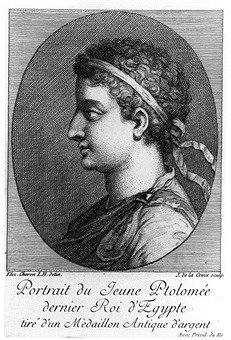
Ptolemy XIII Theos Philopator. Image: A 1736 engraving by French painter Élisabeth Sophie Chéron, inspired by a medallion dating back to the 1st century BC.
Character and Legacy
Ptolemy XII is often portrayed as a weak and self-indulgent ruler, indulging in luxurious living and being perceived as a lover of music and the flute—a trait mocked by contemporaries like Strabo, who gave him the nickname “Auletes” (“the Flautist”).
However, his reign was also marked by significant political maneuvers aimed at preserving his dynasty’s hold on Egypt through strategic alliances and appeasement of Rome.
Mary Siani-Davies highlights that Ptolemy XII’s principal aim was to secure the Egyptian throne for his heirs, even at the cost of substantial economic and political concessions. His reliance on Roman support and financial manipulations exemplified the challenges faced by smaller Hellenistic kingdoms in maintaining independence amidst the rise of Rome as a dominant imperial power.
Impact on the Ptolemaic Dynasty and Egypt
Ptolemy XII’s reign set the stage for the eventual rise of Cleopatra VII, his daughter, who would become one of the most renowned figures in ancient history.
By ensuring Cleopatra VII’s co-regency, Ptolemy XII aimed to secure a smooth transition and maintain dynastic continuity.
However, his heavy reliance on Rome also made Egypt increasingly susceptible to Roman influence and eventual annexation, which would occur shortly after his death.
His economic policies, characterized by heavy taxation and debt, weakened Egypt’s internal stability and increased public unrest. This economic strain, combined with his perceived incompetence and indulgence, eroded the populace’s support, making his successors vulnerable to both internal revolts and external pressures.
The Gabiniani, Roman mercenaries stationed in Egypt, further entrenched Roman influence and contributed to the destabilization of the Ptolemaic rule.
Accomplishments of Ptolemy XII
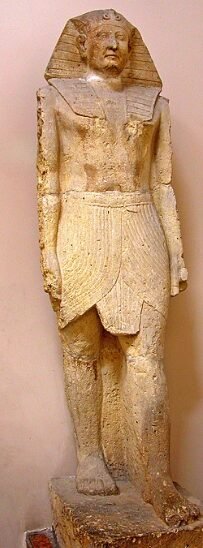
Egyptian-style statue of Ptolemy XII found at the Temple of the Crocodile in Fayoum, Egypt
Despite the negative portrayals, Ptolemy XII achieved several notable accomplishments during his reign:
His alliance with Rome was a masterstroke in ensuring his dynasty’s survival. By securing Roman recognition and support, he maintained his rule and protected Egypt from immediate annexation.
Ptolemy XII adeptly navigated the complex political landscape of his time, balancing internal family conflicts with external threats. His ability to restore his reign after deposition demonstrated significant political resilience.
Ptolemy XII engaged in religious activities to legitimize his rule. For instance, he appointed his son, Pasherienptah III, as the High Priest of Ptah in Memphis, reinforcing the close relationship between the Ptolemaic kings and the Egyptian priesthood. This religious patronage helped solidify his authority and maintain support among the Egyptian elite.
To manage his debts and fund his policies, Ptolemy XII implemented economic measures such as debasing the coinage. While this had negative consequences, it was a necessary step to sustain his alliance with Rome and maintain his reign.
Although not extensively documented, Ptolemy XII likely continued the Ptolemaic tradition of patronizing public works and building projects, which would have contributed to Egypt’s infrastructure and economic stability.
Challenges and Criticisms

To prevent Roman annexation, Ptolemy XII allied with Rome. After being deposed and fleeing to Rome, he regained power with Roman support, eliminated rivals, and appointed Cleopatra VII as co-regent before his death in 51 BC. Image: Ptolemy XII shown on the Temple of Edfu, with him smitting his enemies.
Ptolemy XII faced numerous challenges and criticisms during his reign:
His reliance on Roman loans and heavy taxation led to economic strain and public discontent. The debasement of coinage and exploitation of resources by Roman creditors further exacerbated economic instability.
Ptolemy XII’s heavy dependence on Roman support compromised Egypt’s autonomy. The presence of Roman soldiers and mercenaries in Egypt undermined the authority of the Ptolemaic rulers and made Egypt susceptible to Roman intervention.
The internal conflicts within the Ptolemaic family, including the rivalry between his daughters Berenice IV and Cleopatra VII, as well as the disputes involving his brothers, created political instability and weakened his rule.
The economic policies and perceived incompetence of Ptolemy XII led to widespread public discontent, culminating in revolts and the eventual deposition of the king. The farmers’ strike in Herakleopolis and the rebellion led by Berenice IV are testament to the growing dissatisfaction among the populace.
Historical sources often depict Ptolemy XII as a weak and indulgent ruler, which tarnished his reputation and diminished his standing among both contemporaries and later historians.
Conclusion
Ptolemy XII Neos Dionysus’s reign was a period of significant political maneuvering and strategic alliances aimed at preserving the Ptolemaic dynasty’s hold on Egypt amidst the growing power of Rome. His ability to secure Roman recognition and support was instrumental in maintaining his rule, even though it came at the cost of economic exploitation and increased Roman influence over Egypt.
While often portrayed negatively in historical sources as a weak and self-indulgent ruler, Ptolemy XII’s efforts to navigate the complex political landscape of his time were crucial in ensuring the survival of his dynasty.
His reign set the stage for the rise of Cleopatra VII, who would become one of the most iconic figures in ancient history. Cleopatra VII’s ascent to power was facilitated by the foundations laid by Ptolemy XII, including the establishment of strong dynastic ties and the manipulation of Roman alliances.
However, Ptolemy XII’s heavy reliance on Rome also made Egypt increasingly vulnerable to Roman domination, ultimately leading to the kingdom’s annexation shortly after his death.
Frequently Asked Questions

Bust of Ptolemy XII housed at the Department of Greek, Etruscan and Roman Antiquities at the Louvre
Who was Ptolemy XII Neos Dionysus’s father?
Ptolemy XII Neos Dionysus was the oldest son of Ptolemy IX, a member of the Ptolemaic dynasty founded by Ptolemy I, a Macedonian Greek general and companion of Alexander the Great.
What uncertainty exists regarding Ptolemy XII’s mother?
The identity of Ptolemy XII’s mother is uncertain. Although Ptolemy IX was married twice—to his sister Cleopatra IV and then Cleopatra Selene—ancient sources like Cicero referred to Ptolemy XII as an illegitimate son, suggesting his mother might have been a concubine or an unknown woman from the Egyptian elite.
Who were Ptolemy IX’s wives, and what happened to them?
Ptolemy IX was married first to his sister Cleopatra IV from around 119 BC until their forced divorce in 115 BC. Afterward, he married another sister, Cleopatra Selene, from 115 BC until he abandoned her during his flight from Alexandria in 107 BC. Cleopatra IV later married the Seleucid king Antiochus IX but was murdered by his half-brother Antiochus VIII in 112 BC.
Why do some ancient sources consider Ptolemy XII illegitimate?
Ancient sources such as Cicero referred to Ptolemy XII as an illegitimate son. Pompeius Trogus labeled him a “nothos” (bastard), and Pausanias stated that Ptolemy IX had no legitimate sons, leading to the belief that Ptolemy XII’s mother was not a legitimate wife but possibly a concubine.
Some scholars argue that Ptolemy XII was indeed the son of Cleopatra IV but was considered illegitimate because she never served as co-regent. This perspective is supported by historian Adrian Goldsworthy, suggesting that his illegitimacy was more about political status than maternal lineage.
How did Ptolemy XII rise to power amid familial conflicts?
Ptolemy XII rose to power during a period of political turmoil. After the death of his father Ptolemy IX in December 81 BC, his half-sister Berenice III ascended to the throne but was soon murdered by her husband Ptolemy XI, who was then killed by an Alexandrian mob. This chaos allowed Ptolemy XII to be recalled from Pontus and proclaimed pharaoh in April 80 BC, while his brother was installed as king of Cyprus.
Who did Ptolemy XII marry, and who were his children?
Shortly after his accession, Ptolemy XII married Cleopatra V, likely his sister or cousin. They had at least one child together, Berenice IV, and Cleopatra V was probably also the mother of Cleopatra VII. The youngest three of Ptolemy XII’s children—Arsinoe IV, Ptolemy XIII, and Ptolemy XIV—were born to an unknown mother.
What strategy did Ptolemy XII employ to prevent Roman annexation of Egypt?
To prevent Roman annexation, Ptolemy XII established a strategic alliance with Rome. He engaged in substantial bribery, raised taxes, and took loans from Roman bankers like Gaius Rabirius Postumus. In 60 BC, he traveled to Rome and negotiated with the First Triumvirate—Pompey, Crassus, and Julius Caesar—paying them six thousand talents to form a formal alliance, ensuring Rome recognized him as king and listed him as a friend and ally of the Roman people.
Major Things Named After Roman General and Dictator Julius Caesar
How did Ptolemy XII interact with Rome to secure his reign?
Ptolemy XII actively sought Roman support to secure his reign. He bribed Roman politicians, raised taxes, and took loans to gain favor. In 60 BC, he negotiated with the First Triumvirate, paying a significant sum to gain formal recognition and alliance with Rome. This alliance included financial support and military assistance, which were crucial in maintaining his hold on the Egyptian throne.
What led to Ptolemy XII’s deposition in 58 BC?
In 58 BC, Rome annexed Cyprus, leading to the suicide of Ptolemy XII’s brother, Ptolemy of Cyprus. This event, combined with growing public discontent due to heavy taxation and Roman influence, led the Egyptian populace to depose Ptolemy XII, forcing him to flee to Rome. His eldest daughter, Berenice IV, took the throne but was later overthrown and executed when Ptolemy XII returned with Roman military support.
How was Ptolemy XII restored to power after his deposition?
Ptolemy XII was restored to power in 55 BC with the military assistance of Aulus Gabinius, a Roman general. Gabinius marched to Alexandria, defeated the Egyptian frontier forces, and attacked the palace, leading to the surrender of palace guards without significant fighting. Upon his return, Ptolemy XII executed his rival, Berenice IV, and maintained his rule with the help of approximately two thousand Roman soldiers and mercenaries known as the Gabiniani.

Despite his personal flaws and the economic hardships his policies inflicted on Egypt, Ptolemy XII’s actions were instrumental in maintaining his lineage’s rule, paving the way for Cleopatra VII’s eventual prominence. Image: Ptolemy XII before Isis and Osiris, at the Hathor Temple, Dendera
How did Ptolemy XII manage his debts and relationship with Roman creditors?
Ptolemy XII initially raised taxes and took loans from Roman bankers like Gaius Rabirius Postumus to secure Roman support. As debts mounted, he shifted the blame for taxation to his Roman creditors by appointing Rabirius as the minister of finance. However, Rabirius exploited Egypt’s resources excessively, leading to public unrest. Ptolemy imprisoned Rabirius to protect his life but eventually allowed him to escape to Rome, where Rabirius faced legal challenges but was likely acquitted with the help of Cicero.
What is Ptolemy XII’s legacy and how is he characterized by historical sources?
Ptolemy XII is often portrayed as a weak and self-indulgent ruler, indulging in luxurious living and being perceived as a lover of music and the flute—a trait mocked by contemporaries like Strabo, who gave him the nickname “Auletes” (“the Flautist”).
Despite his personal flaws, his reign was marked by significant political maneuvers to preserve his dynasty through strategic alliances with Rome. Some scholars note that his primary aim was to secure the Egyptian throne for his heirs, even at the cost of substantial economic and political concessions.

The Berlin Cleopatra is a Roman sculpture of Cleopatra VII, daughter of Ptolemy XII, wearing a royal diadem, mid-1st century BC (around the time of her visits to Rome in 46–44 BC).





