Artaxerxes III
Artaxerxes III, born Ochus, was one of the most notable kings of the Achaemenid Empire, reigning from 359/58 to 338 BC. As a ruler, he is remembered for consolidating his power through a series of ruthless actions, two ambitious campaigns against Egypt, and efforts to suppress uprisings across his vast empire. His reign marked the final phase of Persian dominance before the rise of Alexander the Great.
Etymology
The name Artaxerxes is derived from the Old Persian Artaxšaçā, meaning “whose reign is through truth.” It was transliterated into various languages, including Greek, Elamite, and Akkadian. Ochus, his personal name, was also known in Babylonian texts.

A rock relief depicting Artaxerxes III at Persepolis.
READ MORE: Rulers of the Achaemenid Empire: From Cyrus the Great to Artaxerxes V
Background and Rise to Power
Artaxerxes III was the son of Artaxerxes II and Queen Stateira. He had two elder full-brothers, Darius and Ariaspes, and numerous illegitimate siblings. Initially, Darius was the crown prince, but a failed coup against their father led to his execution. Subsequently, Ariaspes became heir, but Ochus manipulated events to cause his brother’s suicide. After the murder of another contender, Arsames, Ochus ascended to the throne following the death of Artaxerxes II.
Initial Reforms and Suppression of Satraps
Upon becoming king, Artaxerxes III sought to centralize power by demanding the disbanding of mercenary armies controlled by satraps in western Anatolia. This move curbed the semi-autonomous rule of satraps, ensuring their loyalty. However, it provoked revolts, notably the rebellion of Artabazus II of Hellespontine Phrygia, which persisted until Artabazus fled to Macedonia.
First Campaign Against Egypt
In 351 BC, Artaxerxes III launched an invasion of Egypt, seeking to reclaim it after decades of independence. However, the campaign ended in a crushing defeat at the hands of Nectanebo II, supported by Greek mercenaries. This failure emboldened revolts in Cyprus, Phoenicia, and Anatolia.
Phoenician and Cyprian Revolts
Following the Egyptian debacle, major rebellions broke out in Cyprus and Phoenicia. Artaxerxes entrusted the suppression of Cyprus to Idrieus of Caria and Greek commanders, who successfully subdued the island. Meanwhile, Sidon, the heart of the Phoenician revolt, proved a tougher challenge. The city’s king, Tennes, initially resisted Persian forces with Greek mercenaries but later betrayed Sidon to Artaxerxes.
Siege and Destruction of Sidon
Artaxerxes personally led a massive force to Phoenicia, including a contingent of Greek allies. Sidon surrendered after Tennes handed over 100 of its leading citizens, who were executed. Artaxerxes allowed the city to be burned, resulting in the deaths of 40,000 inhabitants. This brutal suppression was a turning point in reasserting Persian dominance.
Conquest of Egypt
In 343 BC, Artaxerxes embarked on a meticulously planned second invasion of Egypt. Leading a vast army, bolstered by Greek mercenaries, he achieved decisive victories over Nectanebo II. The capture of key cities, including Pelusium and Bubastis, led to Egypt’s reconquest. Artaxerxes implemented harsh policies, looting temples and imposing heavy taxes to ensure Egypt’s subjugation.
Later Reign
After consolidating Egypt, Artaxerxes focused on internal stability. He quelled remaining uprisings and strengthened Persian control over coastal Asia Minor. Key generals, such as Mentor of Rhodes and the eunuch Bagoas, played vital roles in maintaining order and suppressing rebellious satraps.
Conflict with Philip II of Macedon
The growing power of Philip II of Macedon became a concern for Artaxerxes. While the Achaemenid king supported Greek states like Perinthus in resisting Macedonian aggression, these efforts were insufficient to stem Philip’s rise. By the end of Artaxerxes’ reign, Macedonia had emerged as a formidable adversary.
Cultural and Architectural Contributions
Artaxerxes III initiated a renewed building program at Persepolis, commissioning a new palace, the Hall of Thirty-Two Columns, and his tomb. The Unfinished Gate offers insights into Persian construction techniques. In Babylon, he expanded the palace of Nebuchadnezzar II, underscoring his interest in monumental architecture.
Death and Legacy
In 338 BC, Artaxerxes III was poisoned by his chiliarch Bagoas, who sought to manipulate succession. Most of the king’s sons were also murdered, leaving Arses (Artaxerxes IV) as his successor. Artaxerxes’ death weakened the empire, paving the way for Alexander the Great‘s conquest.
Questions and Answers
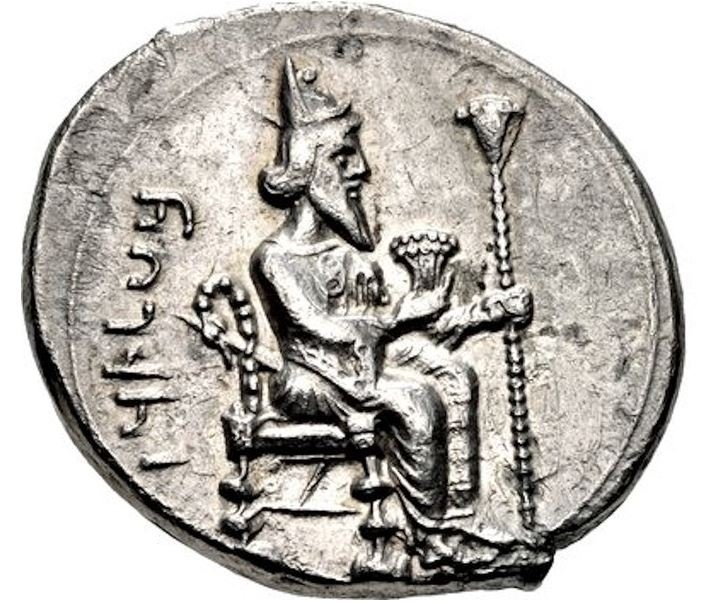
A silver coin depicting Artaxerxes III as Pharaoh of Egypt
How did Artaxerxes III secure his throne?
He eliminated his rivals by executing royal family members, including brothers, to consolidate power after his father’s death.
What were Artaxerxes III’s military achievements?
He launched two campaigns against Egypt, with the second successfully defeating Pharaoh Nectanebo II, bringing Egypt back under Persian control after six decades.
What challenges did Artaxerxes III face during his reign?
His reign was marked by revolts in Phoenicia, Cyprus, and Anatolia, as well as resistance from Greek city-states influenced by Philip II of Macedon.
What role did Artaxerxes III play in architectural development?
He initiated construction projects at Persepolis, including a new palace and the Unfinished Gate, and expanded Nebuchadnezzar II’s palace in Babylon.
What was Artaxerxes III’s religious policy?
He adhered to Zoroastrianism, promoting Ahura Mazda and Mithra, but controversially erected statues of Anahita, blending religious influences.
How did Artaxerxes III die?
He was poisoned in 338 BC by his court eunuch Bagoas, who later installed Artaxerxes’ son, Arses, as king.





