Battle of Issus
The Battle of Issus, fought on November 5, 333 BC, was a pivotal confrontation during Alexander the Great‘s campaign against the Achaemenid Empire. Taking place in southern Anatolia near the Pinarus River, it marked the first encounter between Alexander and Darius III. This engagement demonstrated the tactical brilliance of Alexander, leading to a decisive victory for the Macedonian forces and altering the course of ancient history.

A depiction of the The Battle of Issus by Flemish artist Jan Brueghel the Elder.
Strategic Context
Before Issus, Alexander had secured a significant victory at the Battle of the Granicus in 334 BC, defeating Persian satraps and opening the path into Asia Minor. Darius III, recognizing the threat posed by Alexander, assumed direct control of his army and began preparations to counter the advancing Hellenic League. By cutting off Alexander’s supply lines through a surprise maneuver, Darius aimed to leverage his numerical superiority and weaken the Macedonian forces.

Geography and Battlefield
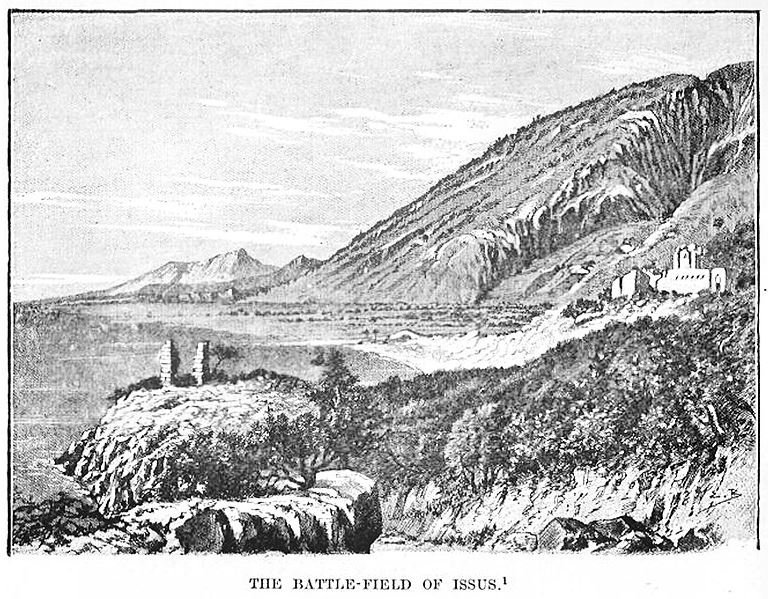
The battle unfolded near the modern-day city of Iskenderun in Turkey, south of the ancient city of Issus. The battlefield was a narrow coastal plain flanked by mountains and the Gulf of Issus. This geography limited the advantage Darius’s massive army could gain from its size. The precise location of the Pinarus River, where the battle occurred, remains debated among historians, with some identifying it as the Payas River based on ancient accounts and geographical studies.
Prelude to the Battle
Alexander, having occupied Asia Minor, sought to secure coastal cities to neutralize the Persian fleet. While stationed in Tarsus, he learned of Darius’s movements to gather a substantial army in Babylon. Darius aimed to reach the Gulf of Issus to strengthen his position and support his naval forces in the Mediterranean.
As Alexander advanced through the Pass of Jonah, Darius outmaneuvered him, capturing Issus and severing the Macedonian supply lines. This forced Alexander to reverse his march northward, setting the stage for a confrontation near the Pinarus River.
Persian Forces versus the Macedonian Forces
Estimates of Darius’s army size vary widely. Ancient sources like Arrian cite numbers as high as 600,000, though modern historians argue for a more conservative figure of 100,000 troops. This force included 11,000 cavalry, 10,000 elite Immortals, and 10,000 Greek mercenaries.
Alexander’s army was considerably smaller, comprising approximately 40,000 soldiers. This included 24,000 heavy infantry, 13,000 light infantry, and 5,850 cavalry. Despite being outnumbered, the Macedonians were highly disciplined and well-trained, with Alexander’s innovative tactics often giving them a decisive edge.
Battle Dispositions
Darius arranged his forces with heavy cavalry on the coastal flank, supported by Greek mercenaries in the center. Persian infantry extended along the riverbank, with units positioned in the foothills to threaten Alexander’s flank. Darius himself commanded from the center, surrounded by his elite guard.
Alexander positioned his phalanx in the center, flanked by the Companion cavalry on the right and Thessalian cavalry on the left, under Parmenion’s command. His strategy focused on exploiting the weaknesses in Darius’s extended formation.
The Battle
The engagement began with the Persian cavalry launching an assault on Alexander’s left flank, pressing the Thessalian forces. In the center, the Macedonian phalanx faced fierce resistance as it crossed the river and advanced uphill against the Persian infantry and Greek mercenaries. The intense fighting resulted in significant Macedonian casualties, particularly among officers.
On the right, Alexander personally led the Companion cavalry and hypaspists in a decisive charge against the Persian left flank. This maneuver created a gap in Darius’s lines, allowing Alexander to exploit the breach and target the Persian king directly. Confronted by the imminent threat, Darius fled the battlefield, leaving his army in disarray.
Alexander then redirected his forces to assist the struggling Macedonian center and left flank. The Greek mercenaries, witnessing their king’s retreat, began to withdraw. The Persian army quickly collapsed into a chaotic retreat, with Macedonian forces pursuing and inflicting heavy losses.
Aftermath and Consequences of the Battle of Issus
The Battle of Issus solidified Alexander’s reputation as a brilliant tactician and dealt a severe blow to the Achaemenid Empire. It marked the first defeat of a Persian king in battle with his army present. The aftermath of the battle had far-reaching consequences:
Darius’s mother, wife (Stateira I), and daughters (Stateira II and Drypetis) were captured by Alexander. They were treated with dignity, a gesture that enhanced Alexander’s image as a magnanimous ruler.
Alexander’s victory at Issus paved the way for subsequent triumphs, including the decisive Battle of Gaugamela, which ultimately led to the fall of the Achaemenid Empire.
The victory allowed Alexander to secure his hold over the eastern Mediterranean and continue his advance into the heart of the Persian Empire.
The defeat undermined the authority of Darius III and weakened Persian resistance to Alexander’s campaigns.
Surviving Greek mercenaries from the Persian army later joined the Spartan king Agis III in his rebellion against Macedonian rule, though this was ultimately suppressed.

Darius III
Depictions in Art and Literature
The dramatic events of the Battle of Issus have inspired numerous artistic and historical works. Among the most notable depictions are:
- Albrecht Altdorfer’s “The Battle of Alexander at Issus” (1529): A Renaissance masterpiece portraying the battle with symbolic grandeur.
- Jan Brueghel the Elder’s Painting (c. 1599-1600): Another vivid representation of the historic encounter, emphasizing its epic scale.

Rulers of the Achaemenid Empire: From Cyrus the Great to Artaxerxes V
Frequently Asked Questions about the Battle of Issus in 333 BC
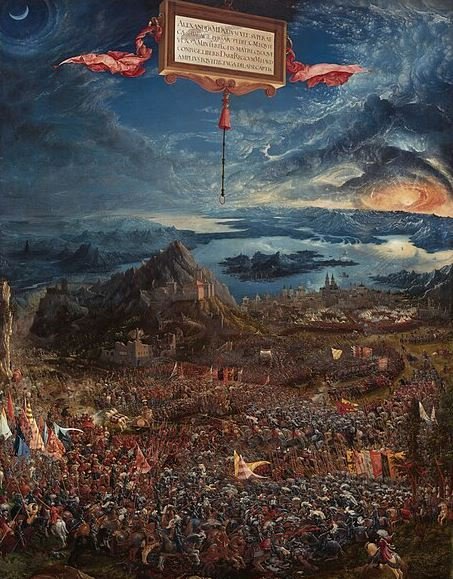
“The Battle of Alexander at Issus” by Altdorfer
Why was the battle significant?
It marked the first direct encounter between Alexander and Darius, showcasing Alexander’s military genius and signaling the decline of Persian power.
What led to the battle?
After defeating Persian satraps at Granicus in 334 BC, Alexander advanced into Asia. Darius amassed a large army and attempted to outmaneuver Alexander by cutting off his supply lines, forcing Alexander to countermarch.
Where did the battle occur?
Near the Pinarus River, close to present-day Iskenderun, in a narrow coastal plain that limited Darius’s numerical advantage.
What were the sizes of the armies?
Persian forces were estimated between 25,000 and 100,000, with modern estimates favoring the lower end. Alexander’s army numbered around 40,000, including 24,000 infantry and 5,850 cavalry.

The Alexander Mosaic, depicting the Battle of Issus, discovered in the House of the Faun in Pompeii.
How did the battle unfold?
Darius positioned his forces across the Pinarus River, with heavy cavalry on the coast and infantry along the line. Alexander led a direct assault on the Persian center, targeting Darius. After Darius fled, Persian forces collapsed, leading to a rout.
What were the key tactics used by Alexander?
Alexander exploited the narrow terrain, used coordinated cavalry and infantry assaults, and focused on breaking the Persian center where Darius was stationed.
What was the aftermath of the battle?
Alexander captured Darius’s family, including his wife, daughters, and mother, treating them with respect. The victory solidified Macedonian dominance and set the stage for Alexander’s continued conquests in the Persian Empire.
Why did Alexander the Great’s successors fight over his body?