Origins of Attic Greek
Attic Greek originates from the region of Attica in ancient Greece, encompassing the city of Athens and surrounding territories. As a dialect of Ancient Greek, it belongs to the Eastern Greek group, which evolved alongside Western Greek.
The Mycenaean Greeks, who used the Linear B script between the 16th and 11th centuries BC, represent the earliest attestation of the Greek language.
Linear B texts provide insight into the early divergence of Eastern and Western Greek, with Mycenaean Greek serving as a precursor to Attic. These linguistic developments established the foundation for Attic Greek’s evolution into a distinct dialect.
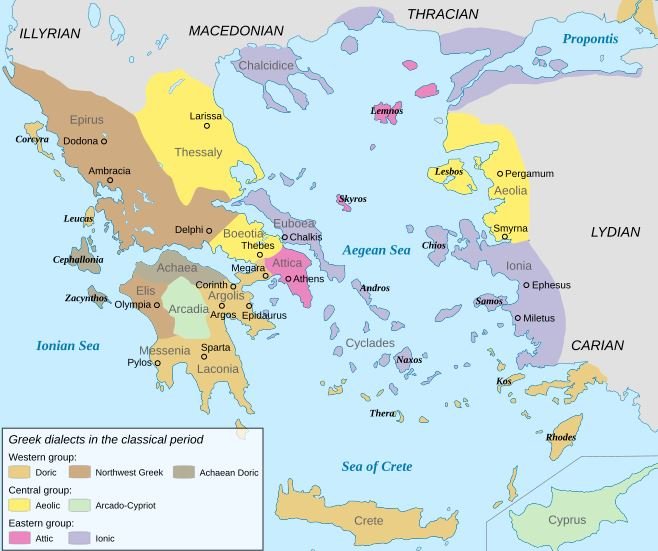
Image: A map showing Greek dialects during the Classical era.
Early Development and Classification
Attic Greek is classified within the Ionic group of Ancient Greek dialects due to its close relationship with Ionic Greek. This connection is evident in shared phonological and morphological features, though Attic developed unique characteristics over time.
Unlike its sister dialects Aeolic and Doric, Attic Greek gained prominence as the language of Athens, a city that would become a major cultural and intellectual hub during the classical period. By the 6th century BC, Attic Greek had begun to solidify its role as a key medium for artistic, philosophical, and political expression.
Historical Context and Growth
The rise of Athens as a political and cultural power during the 5th century BC played a pivotal role in the expansion of Attic Greek. Following the reforms of Solon and the establishment of democracy, Athens became a center of innovation and influence across the Mediterranean. The Persian Wars and subsequent leadership in the Delian League further elevated Athens’ stature, spreading its language and culture. Attic Greek flourished during this classical period, becoming the primary dialect of literature, philosophy, and rhetoric.
The influence of Attic Greek extended far beyond Athens. Its use in administration, trade, and diplomacy made it a lingua franca within the Greek world. Other regions adopted it for practical and cultural reasons, and its prestige encouraged widespread study and emulation of Athenian texts.

Literary Contributions
Attic Greek’s literary achievements remain a cornerstone of its historical significance. The 5th century BC saw the emergence of monumental works by dramatists such as Aeschylus, Sophocles, and Euripides. Their plays, written in Old Attic, set the standard for Greek tragedy and comedy, blending poetic expression with complex themes.
Historians like Thucydides and Xenophon chronicled the political and military history of their time in clear, precise Attic prose, which became models of historical writing. The orators, including Demosthenes and Lysias, developed the art of rhetoric, crafting speeches that influenced political and legal discourse. Philosophers such as Plato and Aristotle used Attic Greek to articulate their groundbreaking ideas, solidifying its role as the dialect of intellectual inquiry.
READ MORE: Most Famous Ancient Greek Philosophers and their Works
Transition to New Attic and Hellenistic Koine
By the late 4th century BC, the conquest of Alexander the Great marked the beginning of the Hellenistic era, during which Greek culture and language spread across a vast territory. Attic Greek evolved into a more simplified form, New Attic, under the influence of other dialects and non-Greek speakers. This adaptation facilitated communication across the Hellenistic world.
The transition from Attic to Hellenistic Koine Greek was pivotal in shaping the linguistic landscape of the Eastern Mediterranean. Koine retained many features of Attic while incorporating elements from other dialects, making it more accessible to diverse populations. This development ensured the continued relevance of Attic Greek, as it provided the linguistic foundation for the Hellenistic and early Christian worlds.
The Attic Alphabet and Orthography
The writing system of Attic Greek underwent significant changes over time. Initially, it employed a local variant of the Greek alphabet, which featured differences in letter shapes and usage compared to other regions. By the late 5th century BC, Athens adopted the Ionic alphabet, a standardized system that became the classical Greek orthography.
Attic is classified as part of or closely related to the Ionic branch, reflecting its influence on Greek language development and its enduring legacy in classical literature and education.
The reform of 403 BC, following the fall of the Thirty Tyrants, formalized the use of the Ionic alphabet in public documents. This shift reflected broader cultural and political changes, aligning Athenian practices with those of the wider Greek world. The adoption of the Ionic alphabet ensured the consistency and longevity of Attic texts, which were transmitted to future generations in this new orthographic system.
Phonological Features
Attic Greek exhibits distinctive phonological characteristics that set it apart from other Ancient Greek dialects. One notable feature is the evolution of Proto-Greek long ā into ē in most contexts, except when preceded by certain consonants such as r, i, and e, where ā remained. This change gave Attic its unique vowel system, distinguishing it from Doric and Aeolic Greek.
Another phonological hallmark is the palatalization of certain consonant clusters, which resulted in the replacement of Ionic -σσ with Attic -ττ, as seen in words like γλῶττα (tongue) instead of γλῶσσα. Attic also underwent compensatory lengthening, where the loss of certain consonants, such as /s/, led to the lengthening of adjacent vowels.
The pronunciation of upsilon (/u/) as /y/ (similar to the French “u” or German “ü”) is another defining feature of Attic Greek. These phonological developments contributed to the distinct rhythm and sound of Attic, making it recognizable among the Greek dialects.
Morphological and Grammatical Distinctions
Attic Greek’s morphology and grammar demonstrate both shared features with other Ancient Greek dialects and unique innovations. One significant grammatical feature is its retention of the dual number, used for referring to two entities. Although this feature disappeared by the end of the 5th century BC, its presence highlights the archaic elements preserved in Attic.
Declension patterns in Attic Greek also reveal distinctive traits. For example, it replaced the Ionic suffix -ter with -tes in nouns, as seen in δικαστής (judge). Adjectives and nouns frequently used the -eios ending, in contrast to the Ionic -ēios, reflecting nuanced differences in morphological structures.
The syntax of Attic Greek adhered to general Ancient Greek norms but displayed preferences for specific constructions. These grammatical peculiarities contributed to its precision and clarity, characteristics that made it the dialect of choice for philosophical and rhetorical works.
Cultural and Intellectual Influence
Attic Greek played a central role in shaping the cultural and intellectual identity of the ancient world. As the language of Athens, it became synonymous with artistic and philosophical excellence. The works of Athenian playwrights, historians, and philosophers set benchmarks for literature, drama, and thought, influencing subsequent generations of writers and thinkers.
During the Hellenistic period, Attic Greek’s prestige ensured its continued study and emulation. The Atticist movement of the Roman era sought to preserve the purity of Attic Greek, promoting it as the standard for literary composition. This reverence for Attic Greek extended into the Byzantine and Renaissance periods, where it remained a cornerstone of classical education.
Legacy and Modern Relevance
The legacy of Attic Greek endures in its contributions to the development of the Greek language and its impact on Western intellectual traditions. As the basis of Hellenistic Koine, it influenced early Christian texts, including the New Testament. Its literary and philosophical works continue to be studied for their historical, cultural, and linguistic significance.
Modern students of Ancient Greek often begin with Attic Greek due to its role as the standard dialect in classical literature. Its clarity, precision, and rich literary corpus make it an essential subject in the study of the ancient world.
Attic Greek remains a testament to the linguistic and cultural achievements of ancient Athens, preserving the legacy of a civilization that shaped the course of history.
READ MORE: The Origins of Language