Battle of Chickamauga in 1863
The Battle of Chickamauga, fought from September 18–20, 1863, was one of the most significant engagements of the American Civil War. It marked the end of the Union’s Chickamauga Campaign and was the first major battle fought in Georgia. It was also the second-deadliest battle of the war, following Gettysburg. The battle was fought between the Union Army of the Cumberland, commanded by Major General William Rosecrans, and the Confederate Army of Tennessee, led by General Braxton Bragg. The battle resulted in a Confederate victory, driving the Union army back to Chattanooga, where it was later besieged.

A map showing key activities during the battle.
Background and Strategic Importance
Before the battle, Rosecrans had achieved significant success in the Tullahoma Campaign, forcing Bragg to abandon Middle Tennessee and retreat to Chattanooga. President Abraham Lincoln and General Henry Halleck pressured Rosecrans to maintain momentum and capture Chattanooga, a vital rail hub and industrial center. Seizing Chattanooga would have allowed the Union to launch further offensives into Georgia and the Deep South.
Meanwhile, Bragg’s army had been reinforced with troops from Mississippi and Virginia, including soldiers from General James Longstreet’s Corps, detached from Robert E. Lee’s Army of Northern Virginia. With these reinforcements, Bragg planned to counterattack and recapture Chattanooga, hoping to shift the momentum in the Western Theater.
The Confederate victory allowed Gen. Braxton Bragg’s forces to besiege the city, setting the stage for Union counteroffensives later that year.
Initial Movements: Setting the Stage
The battle took place near Chickamauga Creek, a name that has been loosely translated as “River of Death” in some accounts. In early September 1863, Rosecrans maneuvered his forces southward, forcing Bragg to abandon Chattanooga. Assuming that Bragg was retreating further south, Rosecrans pursued the Confederates aggressively.
Bragg, however, was not in full retreat. He concentrated his forces in northern Georgia and prepared a counteroffensive. On September 18, as Confederate troops attempted to cross Chickamauga Creek, they clashed with Union cavalry and mounted infantry armed with Spencer repeating rifles. Skirmishes occurred at Alexander’s Bridge and Reed’s Bridge, signaling the beginning of the battle.
The Battle Begins: September 19, 1863
On the morning of September 19, full-scale fighting erupted. Bragg’s forces launched a series of attacks on the Union left flank, but despite heavy assaults, they were unable to break the Union defensive line. Rosecrans, realizing the threat, rushed reinforcements to the area, leading to a day of intense, confused combat in the dense Chickamauga woods.
The terrain played a crucial role. The dense forests made coordination difficult for both armies, leading to a chaotic battlefield where units became disorganized and often fought in isolated engagements. The thick undergrowth and limited visibility prevented generals from having a clear overview of the battle.
Both armies suffered heavy casualties as attacks and counterattacks continued throughout the day. However, the Union forces managed to hold their ground. The Confederate right flank, under General Leonidas Polk, failed to execute an effective assault, giving Rosecrans a chance to maintain a defensive position.
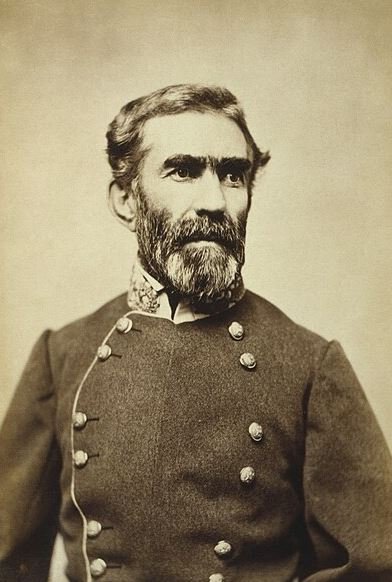
Portrait of Braxton Bragg.
The Critical Mistake: September 20, 1863
On the morning of September 20, Bragg renewed his assault, this time with better coordination. He ordered his right wing, commanded by D.H. Hill and Leonidas Polk, to launch a massive attack on the Union left. However, due to miscommunication, the attack was delayed.
Meanwhile, Rosecrans received faulty intelligence that there was a gap in his defensive line. In response, he ordered Brigadier General Thomas J. Wood to move his division to close the supposed gap. This maneuver inadvertently created an actual gap in the Union line—right in front of an advancing Confederate assault column led by General James Longstreet.
Longstreet’s men poured through the opening, shattering the Union right flank. Rosecrans and several of his top officers were caught in the chaos and forced to retreat to Chattanooga, abandoning the battlefield. Approximately one-third of the Union army was routed.
Despite being routed, Union forces under Maj. Gen. George H. Thomas (“The Rock of Chickamauga”) held firm long enough to organize a retreat to Chattanooga.
The Stand at Horseshoe Ridge
Despite the disaster on the right flank, Major General George H. Thomas quickly reorganized the remaining Union troops and formed a strong defensive position on Horseshoe Ridge, also known as Snodgrass Hill. Thomas’s forces withstood repeated Confederate assaults, holding their ground until nightfall. His ability to maintain this defensive stand prevented the total destruction of the Union army and allowed thousands of Union soldiers to retreat in an orderly fashion.
Because of his leadership during the battle, Thomas earned the nickname “The Rock of Chickamauga.” His stand was one of the most remarkable defensive actions of the war.
What were the sociocultural effects of the American Civil War?
Aftermath and Consequences
As night fell, Union forces withdrew to Chattanooga, leaving the field in Confederate hands. Bragg had achieved a tactical victory, but his army was too exhausted to pursue the retreating Union forces immediately. Instead, the Confederates occupied the surrounding heights and began a siege of Chattanooga.
The Battle of Chickamauga had severe consequences for both sides:
- Union Army: Suffered 16,170 casualties (1,657 killed, 9,756 wounded, and 4,757 missing or captured). It was one of the worst defeats suffered by the Union in the Western Theater.
- Confederate Army: Suffered 18,454 casualties (2,312 killed, 14,674 wounded, and 1,468 missing or captured). Though victorious, Bragg’s army was significantly weakened and unable to capitalize on its success.
Strategic Impact
While Bragg won the battle, his inability to destroy the Union army or immediately recapture Chattanooga was a major missed opportunity. His decision to besiege the city rather than pursue an immediate attack allowed the Union Army to regroup.
In October 1863, Union reinforcements under General Ulysses S. Grant arrived. By November, Grant launched the Chattanooga Campaign, which resulted in a decisive Union victory at Missionary Ridge and Lookout Mountain, forcing Bragg to retreat into Georgia.
Leadership and Command Issues
The battle exposed serious command issues in both armies:
- Union leadership: Rosecrans was relieved of command after the battle and replaced by Thomas. His misjudgment in repositioning his troops led directly to the collapse of the Union right flank.
- Confederate leadership: Bragg’s leadership was heavily criticized by his subordinates, leading to internal conflict. Several Confederate generals, including Leonidas Polk and D.H. Hill, lost confidence in Bragg’s abilities.
Legacy and Battlefield Preservation
The Chickamauga battlefield is now preserved as part of the Chickamauga and Chattanooga National Military Park, one of the first national military parks established in the United States. The battle remains one of the most studied engagements of the Civil War due to its high casualties and its impact on subsequent military campaigns.
The battle is also referenced in literature, with Ambrose Bierce’s short story “Chickamauga” offering a haunting fictional account of the battle’s brutality.
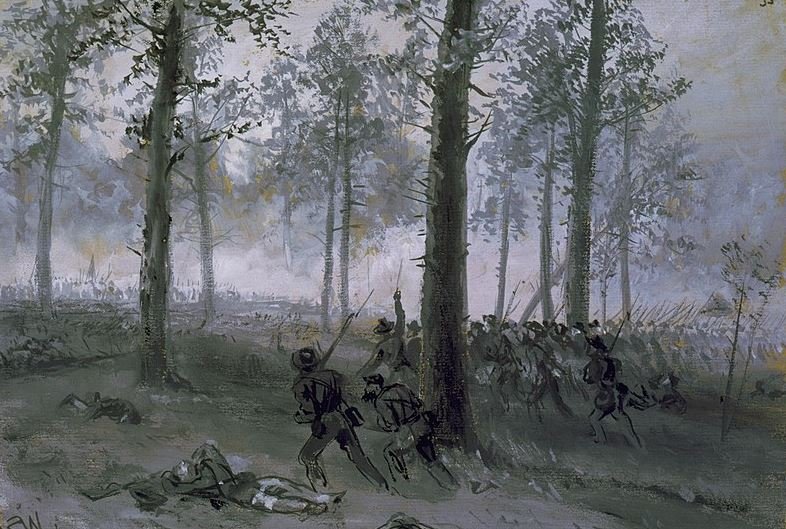
A depiction of Confederate troops at Chickamauga. Artwork by American artist Alfred R. Waud.
Conclusion
The Battle of Chickamauga was a pivotal moment in the Western Theater of the Civil War. Though it was a Confederate victory, Bragg failed to achieve his strategic objectives. The battle set the stage for the Chattanooga Campaign, which ultimately led to a major Union triumph.
The battle’s lessons in leadership, strategy, and the impact of miscommunication remain important in military history.
Frequently Asked Questions
What was the significance of the Battle of Chickamauga?
The Battle of Chickamauga was the most significant Union defeat in the Western Theater and the second-bloodiest battle of the Civil War. It marked the end of the Union’s Chickamauga Campaign and led to the Confederate siege of Chattanooga.
Who were the key commanders in the battle?
The Union Army of the Cumberland was led by Major General William Rosecrans, while the Confederate Army of Tennessee was commanded by General Braxton Bragg. Other key figures included General George H. Thomas for the Union and General James Longstreet for the Confederates.
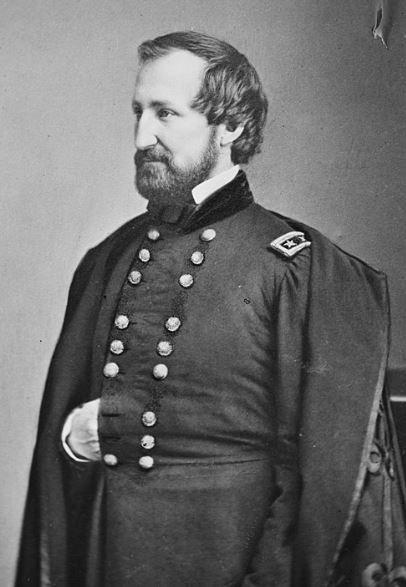
Portrait of William Rosecrans.
What was the main cause of the Union defeat?
The Union defeat was largely due to a miscommunication when Rosecrans mistakenly believed there was a gap in his lines and ordered a realignment, unintentionally creating an actual gap. Confederate forces under Longstreet exploited this, routing one-third of the Union army.
What was the role of General George H. Thomas?
General Thomas played a crucial role in holding the Union line at Horseshoe Ridge, earning him the nickname “The Rock of Chickamauga.” His defensive stand prevented the complete destruction of the Union army.
How did the terrain affect the battle?
The dense forests of Chickamauga made visibility and coordination difficult for both sides. Units often became disorganized, leading to chaotic engagements where commanders struggled to control their forces.
Despite being routed, Union forces under Maj. Gen. George H. Thomas (“The Rock of Chickamauga”) held firm long enough to organize a retreat to Chattanooga.
What were the battle’s casualty numbers?
The Union suffered approximately 16,170 casualties, while the Confederates lost around 18,454 soldiers. These high losses made Chickamauga one of the deadliest battles of the war.
What happened after the battle?
After their victory, Confederate forces besieged the Union army in Chattanooga. However, Union reinforcements under General Ulysses S. Grant arrived in November, lifting the siege and driving the Confederates out.
How is the battlefield preserved today?
The Chickamauga battlefield is part of the Chickamauga and Chattanooga National Military Park, one of the first military parks in the U.S., preserving key sites of the battle for historical study and public visitation.





