Coba: Ancient Maya city on the Yucatán Peninsula
Coba, or Cobá in Spanish, is an ancient Mayan city located on the Yucatán Peninsula in Quintana Roo, Mexico. Renowned as the center of the largest network of stone causeways in the Maya world, Coba is also home to numerous stelae engraved with inscriptions documenting significant events from the Late Classic Period (AD 600–900). Modern Coba, a small village adjacent to the ruins, has a population of a couple of thousand.
Geography and Accessibility
Situated about 48 km northwest of Tulum, the Coba archaeological site lies amid lush jungle and is surrounded by two lagoons, Lake Coba and Lake Macanxoc. The site is accessible via a two-kilometer road branching from the Tulum–Nuevo Xcán highway.
Architectural Highlights
Coba’s hallmark is its sacbeob, raised stone pathways connecting the main site to surrounding areas. The longest, stretching over 100 kilometers, links Coba to the site of Yaxuná. These roads are constructed with a stone base and a smooth plaster finish, showcasing the advanced engineering skills of the Maya.
Visitors entering the central tourist area, called the Coba Group, will find it at coordinates North 19° 29.6’ and West 87° 43.7’.
The Nohoch Mul group features temple pyramids, with Ixmoja, standing 42 meters tall, being the most prominent. It is among the tallest pyramids on the Yucatán Peninsula, second only to Calakmul.

Coba Archeological Area.
Historical Overview
Archaeological evidence suggests that Coba was first inhabited between 50 BC and 100 AD. The earliest structures were wooden, with platforms for agricultural and social activities. By 100 AD, Coba grew rapidly, becoming a political and economic powerhouse.
Coba’s influence peaked during the Classic Period, dominating vast swaths of northern Quintana Roo and eastern Yucatán. Its strategic location ensured control over key agricultural areas, trading routes, and water resources. Alliances and marriages with other powerful Maya city-states like Tikal and Calakmul reinforced its dominance.
From 900 AD, the rise of rival city-states like Chichén Itzá led to Coba’s decline. Although its political clout waned, it retained religious and symbolic importance, with new structures built in the Eastern Coastal style until the Spanish conquest around 1550.
Collapse of the Maya Civilization in the Terminal Classic Period
Did you know…?
Coba experiences a tropical savanna climate, with alternating wet and dry seasons. Rainfall is heaviest from September to November, while February and March are relatively dry. Average temperatures range from 27°C to 32°C, providing a warm, humid environment conducive to its lush surroundings.
Archaeological Significance
Coba’s stelae provide invaluable insights into Maya history, culture, and governance. Many stelae depict powerful female rulers, reflecting the prominence of women in Coba’s political and ceremonial life.
Evidence of Teotihuacan architectural features suggests interaction between Coba and central Mexican cultures during the early Classic period.
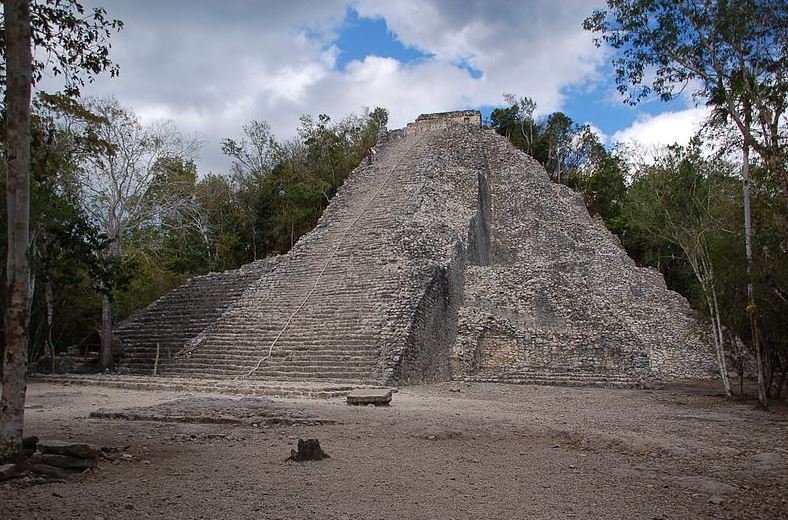
Nohoch Mul Pyramid in Cobá.
Exploration History
Coba was first mentioned in 1842 by John Lloyd Stephens. However, its inaccessibility delayed exploration until the late 19th and early 20th centuries. Notable explorers like Teoberto Maler and Thomas Gann documented the ruins, leading to broader archaeological interest.
In the 1970s, modern roads and tourist facilities were developed, spurring further archaeological efforts. Structures such as the Iglesia and Nohoch Mul Pyramid were excavated and restored, revealing the city’s grandeur.
Cultural and Economic Importance
Coba’s economy thrived on agriculture and trade. Key exports included maize, cacao, jade, and textiles, with trade facilitated by ports like Xel-Há and an extensive sacbe network.
Coba is now a major tourist destination, attracting visitors to its pyramids, stelae, and scenic lagoons. The site hundreds of thousands of visitors annually.
Key Attractions
The Nohoch Mul Pyramid offers panoramic views of the surrounding jungle. While climbing was allowed previously, it has been restricted since 2020 for preservation.
Macanxoc Group features altars and eight stelae, highlighting its spiritual significance.
Near the site entrance, the Coba group includes the Iglesia Pyramid and a ball court, integral to Mayan rituals and social activities.
Frequently Asked Questions
Why is Cobá significant in Maya history?
Cobá was a major Maya city during the Classic Period (AD 600–900), known for its extensive network of stone causeways (sacbeob), large pyramids, and hieroglyphic inscriptions that document ceremonial and political events.
What is Nohoch Mul, and why is it important?
Nohoch Mul is a pyramid in Cobá, standing 42 meters tall, making it one of the tallest structures on the Yucatán Peninsula. It offers insights into Maya architectural achievements and was a central ceremonial site.
How did Cobá interact with other Maya cities?
Cobá maintained trade and political alliances with cities like Tikal and Calakmul, controlling key routes and resources. Its power began to decline after conflicts with Chichén Itzá around AD 900.
What role did women play in Cobá?
Stelae in Cobá reveal that women held significant leadership roles, with evidence of female rulers (Ajaw) documented between AD 500–780.





