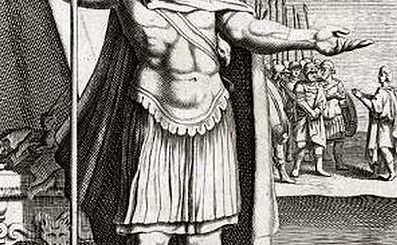
Deification of Alexander the Great
Alexander the Great (356–323 BCE) stands as one of history’s most extraordinary figures. His unparalleled military achievements, vast conquests, and profound influence on cultures have made him a subject of fascination for centuries. What elevates Alexander’s persona further is the perception and portrayal of him as a god during and after his lifetime. This phenomenon was not a mere coincidence but a confluence of political ambition, cultural traditions, and the religious environment of the ancient world.

A 3rd-century BC statue of Alexander the Great, displayed at the Istanbul Archaeological Museum.
Divine Ancestry
Alexander’s divine associations began with his lineage. He claimed descent from both Zeus and Heracles.
Alexander’s mother, Olympias, was a member of the Molossian royal house, claiming descent from the hero Heracles. Heracles was a demigod, the son of Zeus, which gave Alexander a mythical connection to the king of the gods.
Macedonian tradition celebrated a mythological link to Zeus. Alexander’s father, King Philip II, also asserted this connection, reinforcing Alexander’s divine heritage.
Olympias and the Divine Birth Myth
Olympias played a critical role in cultivating Alexander’s divine identity. According to legend, she dreamt that her womb was struck by lightning or visited by a serpent, both symbols of Zeus. This dream was interpreted to mean that Alexander was sired by Zeus himself. Such myths were common in antiquity, often used to elevate rulers beyond mortal status.
Proclamation of Divinity in Egypt
In 332 BCE, Alexander visited the Oracle of Amun at the Siwa Oasis in Egypt, an event pivotal to his divine status. The oracle supposedly addressed him as the “son of Zeus-Amun,” affirming his divinity. The god Amun was equated with Zeus in the syncretic traditions of the Hellenistic world. This declaration:
- Solidified his divine legitimacy in Egypt.
- Enhanced his political standing among his subjects, particularly in the Persian Empire, where rulers were often regarded as semi-divine.
Alexander’s Self-Representation as a God
Throughout his campaigns, Alexander adopted imagery and practices that underscored his divinity:
- Coinage: Alexander’s portraits often depicted him with the ram’s horns of Amun, a clear reference to his divine paternity.
- Art and Sculpture: Statues portrayed Alexander in heroic, semi-divine forms, sometimes likened to Apollo or Zeus.
- Proskynesis: Alexander adopted the Persian custom of proskynesis (ritual bowing), a practice controversial among his Macedonian companions. While it alienated some followers, it further ingrained his godlike image in the eyes of eastern subjects.

Silver tetradrachm of Alexander.
Alexander and the Idea of Apotheosis
In ancient Greece, the concept of apotheosis (the elevation of a mortal to divine status) was not new. Heroes like Heracles and Achilles were worshipped as gods after their deaths. Alexander consciously aligned himself with these figures, aspiring to a similar divine reverence.
For example, he modeled himself on Achilles, whom he admired deeply, even visiting the hero’s tomb at Troy.
Also, his adoption of Persian and Egyptian royal traditions further emphasized his role as a divinely chosen ruler.
Alexander as a God in Hellenistic and Eastern Cultures
Alexander’s deification was not confined to Greek traditions. His conquests spanned diverse cultures, each interpreting his divinity through their own lenses:
- In Egypt: Pharaohs were traditionally viewed as gods incarnate. Alexander’s role as Pharaoh naturally elevated him to divine status in Egyptian eyes.
- In Persia: The Achaemenid tradition regarded kings as having divine favor or semi-divine status. By integrating Persian customs, Alexander became a “King of Kings” with divine attributes.
- In India: Indian accounts and legends often depict Alexander as a godlike figure. Some identified him with local deities or heroes due to his extraordinary abilities and charisma.
Hellenistic Kingdoms: What were they and what were some of their notable achievements?
The Cult of Alexander
The worship of Alexander as a god began during his lifetime and intensified after his death.
Temples dedicated to Alexander were established in several cities. After his death, his successors promoted his cult to legitimize their own rule.
Alexander the Great’s divinity legitimized his rule over diverse populations.
Also, the Diadochi (Alexander’s successors) often styled themselves as divine figures, drawing inspiration from Alexander’s example.
Criticism and Resistance to Deification
While many embraced Alexander’s divinity, not everyone accepted it.
Among his Macedonian troops and generals, the notion of Alexander as a god was met with skepticism and resistance. They were accustomed to viewing kings as mortal leaders, not gods.
Philosophers like Callisthenes, Alexander’s court historian, reportedly opposed the idea of proskynesis, arguing against the blurring of mortal and divine distinctions.
Posthumous Deification
After Alexander’s untimely death in 323 BCE, his divine image was solidified.
The Ptolemies, who ruled Egypt after Alexander, promoted his worship. The city of Alexandria, founded by Alexander, became a center of his cult.
By integrating elements of Greek, Persian, and Egyptian traditions, Alexander’s godlike image bridged cultural divides.
The Romans admired Alexander, and leaders like Augustus and Julius Caesar drew parallels between themselves and Alexander, emphasizing their own divine claims.

A floor mosaic in Otranto Cathedral depicts Alexander the Great being carried aloft by griffins.
Alexander as a God in Later Traditions
The image of Alexander as a god persisted beyond antiquity, evolving in different cultural contexts.
In the Islamic world, Alexander appears as “Dhul-Qarnayn” (The Two-Horned One) in the Quran, blending historical and mythical elements.
Alexander’s image as a divinely inspired conqueror influenced Renaissance thinkers, artists, and rulers.

Questions and Answers
What was Alexander the Great’s connection to the concept of divine rulership?
Alexander the Great embraced the idea of divine rulership more fully than most, seeing himself not only as a ruler with divine favor but as a god. His belief in his divine origins fueled his conquests and left a lasting cultural legacy.
What role did Olympias play in shaping Alexander’s belief in his divine ancestry?
Olympias, Alexander’s mother, traced her lineage to Achilles and reinforced myths of Alexander’s divine parentage. She claimed Zeus was his true father, recounting a story of being struck by a bolt of lightning, symbolizing Zeus, on the night of his conception.

Olympias
What omens and events surrounded Alexander’s birth?
Alexander’s birth was marked by legends, including the burning of the Temple of Artemis at Ephesus, seen as an omen of his greatness. His father, Philip, received news of Alexander’s birth alongside military and Olympic victories, enhancing the significance of the event.
How did Alexander’s religious beliefs influence his rule and conquests?
Alexander considered himself deeply religious, viewing Zeus as the father of all humanity. He respected the cultures and religions of conquered peoples, made sacrifices to their gods, and believed in the divine mission of his conquests, drawing inspiration from Homeric heroes like Achilles and Heracles.
How did the Oracle of Zeus-Ammon at Siwa impact Alexander’s self-perception?
During his visit to the Oracle of Zeus-Ammon, the priest addressed Alexander as “son of Zeus,” confirming his belief in his divine origins. This validation reinforced his self-image as a god and influenced his adoption of symbols of divinity, such as the ram’s horns of Zeus-Ammon.
What were Alexander’s key military achievements, and how did he inspire his troops?
Alexander never lost a battle, achieving significant victories at Granicus, Issus, and Gaugamela. He inspired his troops by leading from the front, sharing their hardships, and promising glory and riches, earning their unwavering loyalty.
How did Alexander’s adoption of Persian customs create controversy?
Alexander’s adoption of Persian customs, such as wearing a diadem and requiring proskynesis, alienated some Macedonian followers who viewed him as mortal. These practices highlighted cultural tensions within his empire.
What criticisms have been leveled against Alexander?
Critics view Alexander as a ruthless conqueror responsible for countless deaths and question his relentless campaigns. His men grew weary, and rumors of mutiny emerged as his conquests continued.

Did Alexander truly believe he was a god?
While historians debate whether Alexander truly believed he was a god, his actions suggest he embraced the idea. His deification by Egyptians, Persians, and others reinforced his divine image and cemented his place as a figure of mythic proportions.